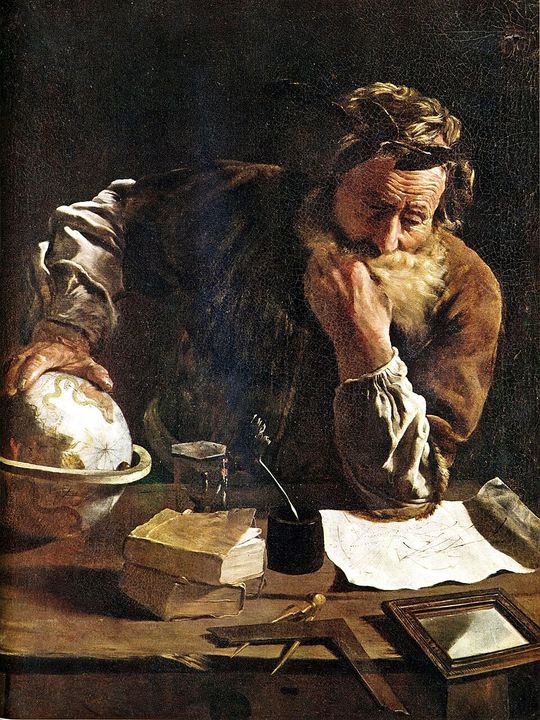
Archimedes of Syracuse (c. 287–212 BCE) was the greatest mathematician and mechanician of antiquity. In The Sand-Reckoner he names his father, Phidias, as an astronomer; Diodorus reports that he studied in Alexandria, and his letters address mathematicians there, including Conon of Samos, Dositheus and Eratosthenes. His surviving works include On the Sphere and Cylinder, Measurement of a Circle, Quadrature of the Parabola, On Conoids and Spheroids, On Spirals, On the Equilibrium of Planes, On Floating Bodies and The Sand-Reckoner. Ancient writers credit him with machines for the defence of Syracuse against the Romans during the Second Punic War. He was killed when the city fell to Marcellus in 212 BCE; Plutarch tells several versions of his death, and Cicero later found his tomb, marked with a sphere inscribed in a cylinder.
The Method, known in Greek as the Ephodos and translated in the library text as Geometrical Solutions Derived from Mechanics, is a letter from Archimedes of Syracuse to Eratosthenes, the head of the Library at Alexandria. In it Archimedes does something almost unique in ancient mathematics: he explains how he found his results before he proved them.