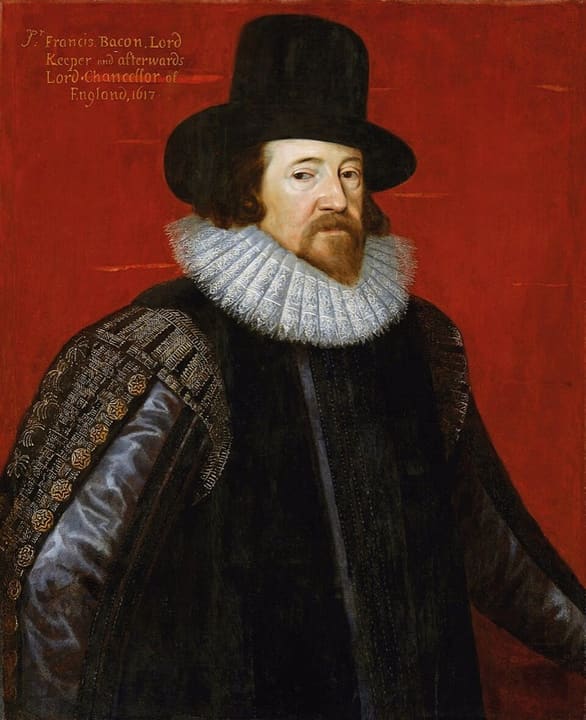
Francis Bacon (1561–1626), son of Elizabeth I's Lord Keeper, trained as a lawyer and rose under James I to Attorney General and Lord Chancellor, becoming Baron Verulam and Viscount St Albans. In 1621 he was impeached for accepting gifts from litigants, fined and briefly imprisoned. In retirement he wrote natural history and revised his Essays. John Aubrey reported that he died of a chill caught while stuffing a chicken with snow to test refrigeration.
Bacon's Essays, or Counsels, Civil and Moral, grew over almost thirty years from a slim volume of ten pieces in 1597 to fifty-eight in the final edition of 1625, the text used here. Bacon borrowed the name essay from Montaigne, but where Montaigne explored himself at leisure, Bacon compressed observation into dense, balanced sentences meant for men of business and government.
The Novum Organum ('new instrument') is the second and only substantially completed part of Bacon's projected Instauratio Magna, a six-part plan to rebuild human knowledge from its foundations. Its title throws down a challenge to the Organon, the collection of Aristotle's logical works that had governed university teaching for centuries.