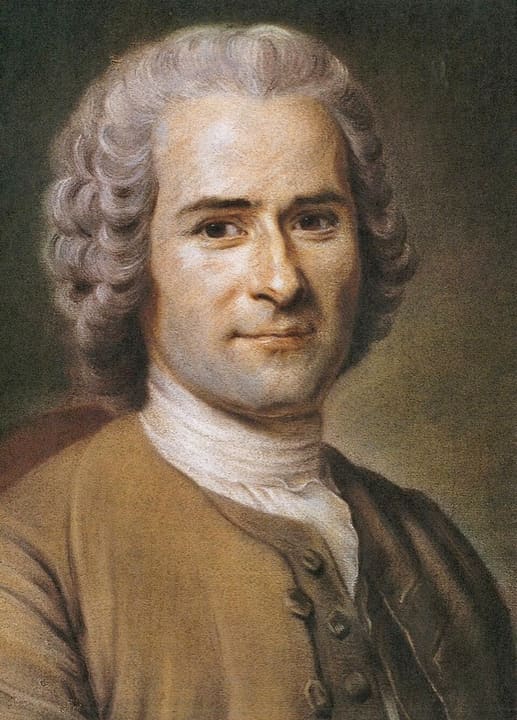
Jean-Jacques Rousseau (1712–1778) was born in Geneva, the son of a watchmaker, and left the city at sixteen. After years as a wanderer, tutor, music copyist and composer in Savoy and Paris, he won fame with his Discourse on the Sciences and Arts (1750). His later works include Julie, or the New Heloise (1761), The Social Contract and Emile (both 1762), and the posthumous Confessions. Condemned in Paris and Geneva for Emile's religious views, he spent his last years moving between refuges and died at Ermenonville in 1778.
“It is therefore certain that pity is a natural sentiment, which, by moderating in every individual the activity of self-love, contributes to the mutual preservation of the whole species.”
“The first man, who, after enclosing a piece of ground, took it into his head to say, "This is mine," and found people simple enough to believe him, was the true founder of civil society.”
“whoever refuses to obey the general will shall be compelled to do so by the whole body. This means nothing less than that he will be forced to be free”
The Discourse on the Origin and Foundations of Inequality among Men is Jean-Jacques Rousseau's answer to a prize question set by the Academy of Dijon in 1753: what is the origin of inequality among men, and is it authorized by natural law? Rousseau's essay did not win the prize, but it was printed at Amsterdam by Marc-Michel Rey in 1755 with a dedication to the Republic of Geneva, a preface and extensive notes.
Of the Social Contract, or Principles of Political Right is a compact treatise in four books, the only finished part of a larger work on political institutions that Rousseau abandoned. It opens with its most famous sentence, that man is born free and everywhere in chains, and with a promise not to explain how this happened but to say what could make it legitimate.
Rousseau's Confessions is the founding text of modern autobiography. It promises to show 'a man in all the integrity of nature', the author himself, concealing nothing.