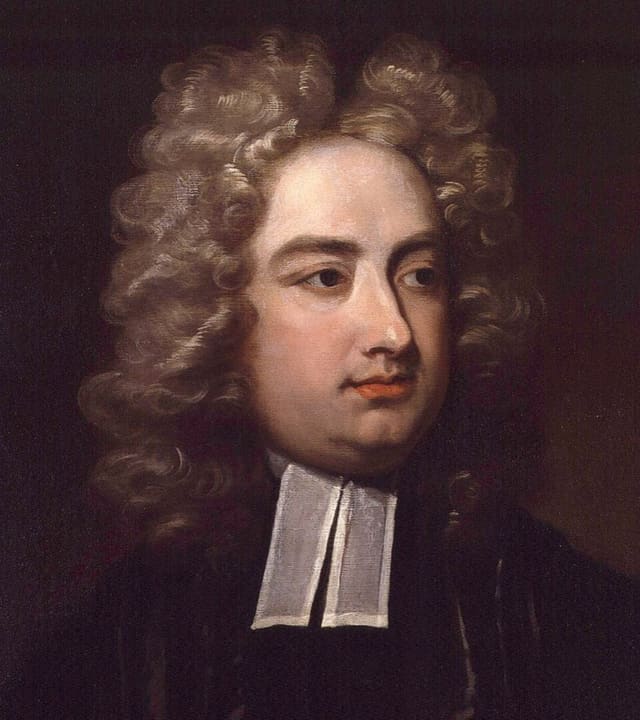
Jonathan Swift (1667–1745) was an Anglo-Irish satirist, poet and clergyman, Dean of St Patrick's Cathedral in Dublin from 1713. Allied with the Tory ministry under Queen Anne and a member of the Scriblerus Club with Pope, Gay and Arbuthnot, he later became a champion of Irish causes in The Drapier's Letters and A Modest Proposal (1729). In his last years he suffered from Ménière's-like vertigo and cognitive decline, and he left money to found St Patrick's Hospital for the mentally ill in Dublin.
“whoever could make two ears of corn, or two blades of grass, to grow upon a spot of ground where only one grew before, would deserve better of mankind, and do more essential service to his country, than the whole race of politicians put together”
“He had been eight years upon a project for extracting sunbeams out of cucumbers, which were to be put in phials hermetically sealed, and let out to warm the air in raw inclement summers”
Travels into Several Remote Nations of the World, by Lemuel Gulliver, presents itself as the sober memoir of a ship's surgeon. In Part I, shipwrecked, Gulliver wakes on the shore of Lilliput tied down by people six inches tall.
A Modest Proposal is Swift's savage 1729 pamphlet on Irish poverty under British rule, written in the voice of a projector who treats hunger, tenancy, children, and mothers as items in a national account. The speaker begins with beggars and starving children in Dublin streets, then adopts the language of calculation: numbers of infants, costs of nursing, market value, culinary uses, and benefits to landlords.