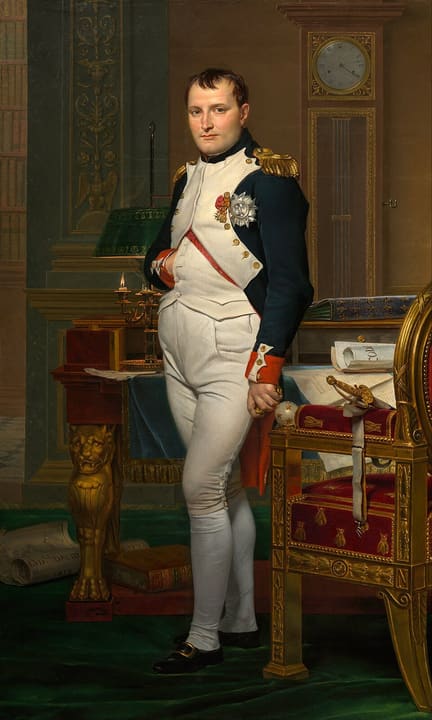
Napoleone Buonaparte (1769–1821) was born in Ajaccio a year after Genoa ceded Corsica to France, trained at the military schools of Brienne and Paris, and rose through the Revolution as an artillery officer. After the Italian campaign of 1796–1797 and the expedition to Egypt, he seized power in the coup of Brumaire (1799), crowned himself emperor in 1804, and dominated Europe until defeats in Russia (1812), Germany (1813) and at Waterloo (1815). He died in British custody on St Helena on 5 May 1821.
Napoleon dictated or wrote tens of thousands of letters, often several dozen a day, to generals, ministers, prefects, bishops, kings, his family and the women he loved. Napoleon III's government published a thirty-two-volume Correspondance de Napoléon Ier between 1858 and 1870, pruning letters that embarrassed the dynasty; the Fondation Napoléon's complete edition, begun in 2004, runs to more than forty thousand items.
Napoleon's Maxims of War is not a book Napoleon wrote but a compilation made by a French officer, General Burnod, who in 1827 published Maximes de guerre de Napoléon, drawn from the emperor's memoirs dictated on St Helena and other sources. The British officer George Charles D'Aguilar translated it into English in 1831, adding explanatory notes with examples from the campaigns of Gustavus Adolphus, Turenne, Montecuccoli, Frederick the Great and Napoleon himself.