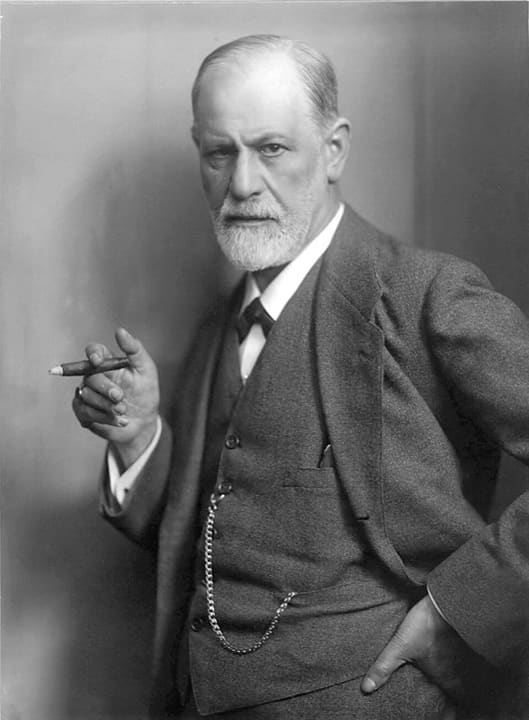
Sigmund Freud (1856–1939) was a Viennese neurologist who trained in neuroanatomy under Ernst Brücke, studied hysteria with Jean-Martin Charcot in Paris in 1885–86, and co-wrote Studies on Hysteria (1895) with Josef Breuer. Through clinical work and a self-analysis begun after his father's death in 1896, he developed psychoanalysis, a theory of unconscious mental life and a method of treatment by free association. His later works include Three Essays on the Theory of Sexuality, Beyond the Pleasure Principle and Civilization and Its Discontents. He fled the Nazi annexation of Austria in 1938 and died in London.
Die Traumdeutung appeared in November 1899 with the date 1900 on its title page, and Freud regarded it as his most important book. Its central claim is that dreams are meaningful psychic acts that can be interpreted, and that every dream, properly analysed, proves to be the fulfilment of a wish.
Freud's late essay, in German Das Unbehagen in der Kultur ('the uneasiness in culture'), asks why civilized people, who have built so much for their own protection, are so often unhappy. It is written in eight short chapters in a conversational, self-questioning style.