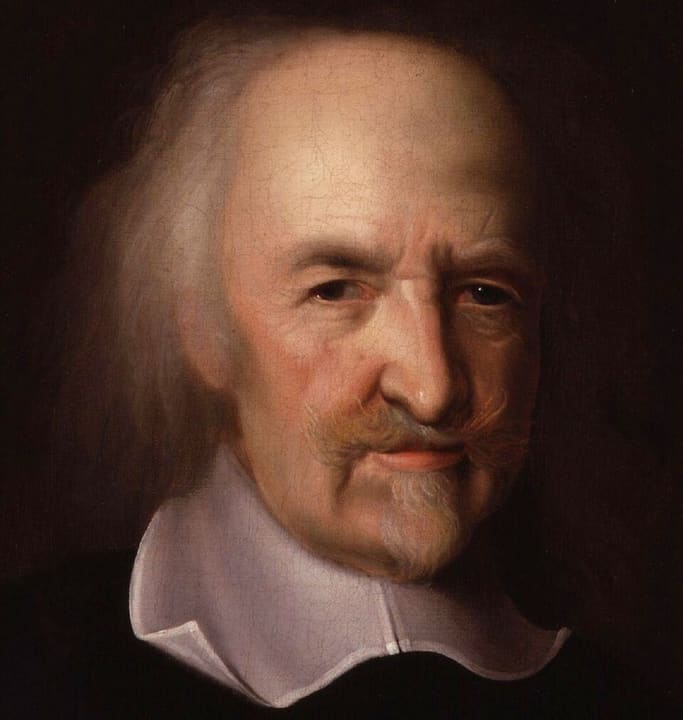
Thomas Hobbes (1588–1679) was born at Westport, Malmesbury, reportedly prematurely when his mother heard of the approaching Spanish Armada, which he later said made him and fear twins. He spent most of his life as tutor and secretary to the Cavendish earls of Devonshire, met Galileo, debated Descartes, and translated Thucydides (1629). Fearing arrest for royalist views, he fled to Paris in 1640, where he tutored the future Charles II in mathematics and wrote Leviathan. He returned to England in 1651 and wrote into his nineties.
“So that in the first place, I put for a generall inclination of all mankind, a perpetuall and restlesse desire of Power after power, that ceaseth onely in Death”
1651 · Renaissance Early Modern · Political Theory
Leviathan, or the Matter, Forme and Power of a Common-Wealth Ecclesiasticall and Civil was published in London in 1651, two years after the execution of Charles I, and its famous frontispiece shows a giant crowned sovereign whose body is made of hundreds of tiny subjects, holding a sword and a bishop's crozier above a peaceful town. The Introduction states the governing analogy: as art can make automata with springs for hearts and strings for nerves, so human art creates the commonwealth, an artificial man whose soul is sovereignty.