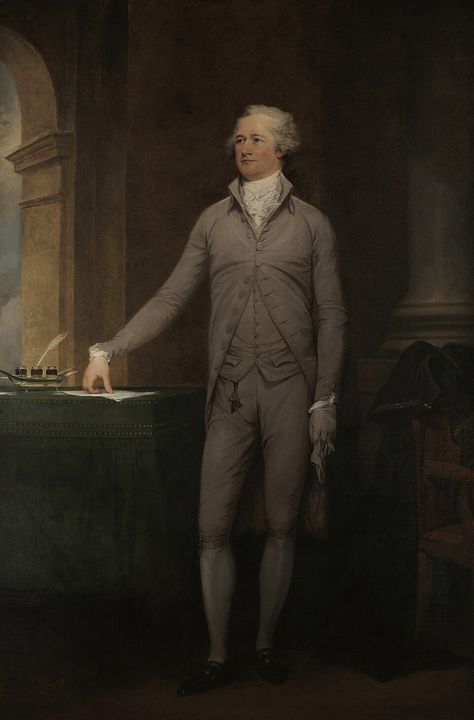
Alexander Hamilton (1755 or 1757-1804) was born on Nevis in the British West Indies, worked as a merchant's clerk on St. Croix, and came to New York in the early 1770s to study at King's College. He served as George Washington's aide-de-camp during the Revolutionary War and led an assault on a British redoubt at Yorktown in 1781. He represented New York at the Annapolis Convention and the Philadelphia Convention, and wrote most of The Federalist with James Madison and John Jay. As the first Secretary of the Treasury (1789-1795) he designed the federal government's financial system. He died on 12 July 1804, the day after he was mortally wounded in a duel with Vice President Aaron Burr.
“the creation of debt should always be accompanied with the means of extinguishment. This he regards as the true secret for rendering public credit immortal.”
“every power vested in a government is in its nature sovereign, and includes, by force of the term, a right to employ all the means requisite and fairly applicable to the attainment of the ends of such power, and which are not precluded by restrictions and exceptions specified in the Constitution, or not immoral, or not contrary to the essential ends of political society.”
This anthology gathers three state papers that Alexander Hamilton wrote during his first two years as Secretary of the Treasury. On 21 September 1789 the House of Representatives asked him for a plan to support the public credit.