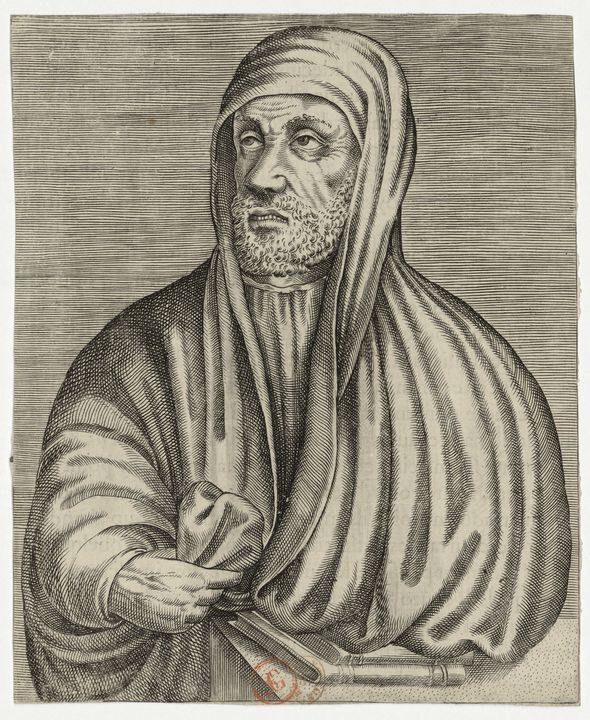
Avicenna as imagined in a later engraving. Source · CC0
About Ibn Sina (Avicenna)
Abu Ali al-Husayn ibn Abd Allah ibn Sina (980-1037), known in Latin as Avicenna, was born at Afshana near Bukhara in the Samanid realm of Central Asia. By his own account he mastered logic, medicine and metaphysics as a youth, and his cure of the Samanid ruler gave him access to the royal library. He spent his adult life serving princes in Khwarazm, Rayy, Hamadan and Isfahan as physician and sometimes vizier, and died at Hamadan. Besides the Canon he wrote the philosophical encyclopedia al-Shifa (The Healing) and many shorter works.
Frequently Cited
“Therefore in safeguarding the emotions the health of the mind and body are at the same time maintained.”
The Canon of Medicine (al-Qanun fi al-Tibb) is Ibn Sina's encyclopedia of medicine in five books, and Book I, the subject of this record, sets out the general principles on which the rest depends. It opens with a definition: medicine is the science of the states of the human body in health and when not in health, and of how health is lost and restored, with a theoretical part that gives knowledge and a practical part that guides the physician's judgment.