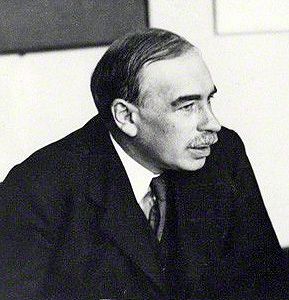
John Maynard Keynes (1883-1946) was an English economist, a fellow of King's College, Cambridge, and an adviser to the British Treasury in both world wars. He resigned from the British delegation at the Paris Peace Conference and wrote The Economic Consequences of the Peace (1919). His Treatise on Money (1930) was followed by The General Theory (1936). Created Baron Keynes in 1942, he led the British delegation at the Bretton Woods conference in 1944 and died in 1946.
Frequently Cited
“Practical men, who believe themselves to be quite exempt from any intellectual influences, are usually the slaves of some defunct economist.”
The General Theory of Employment, Interest and Money, published by Macmillan in London in February 1936, is John Maynard Keynes's attempt to explain why an economy can remain for long periods with many people out of work. Written during the Great Depression, it argues that the classical economics Keynes had been taught describes only a special case, one of full employment, and that a more general theory is needed for the world as it is.