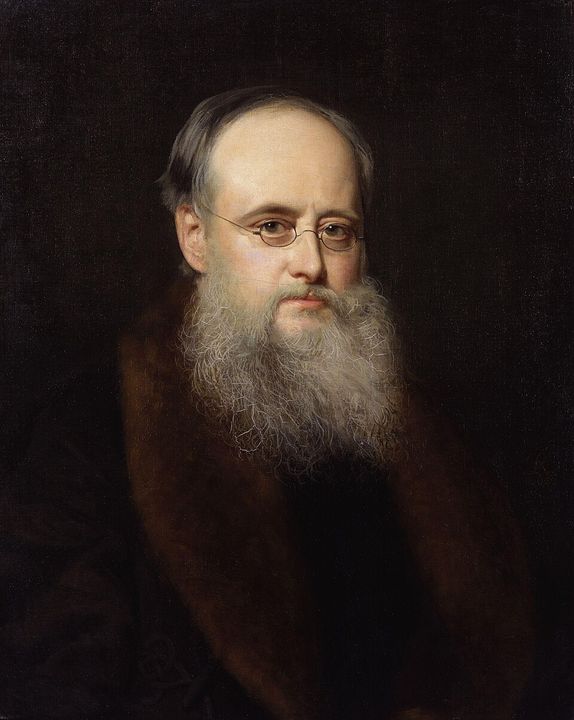
William Wilkie Collins (1824-1889) was born in London, the son of the landscape painter William Collins, and was named after his godfather, the painter David Wilkie. He worked for a tea merchant, studied law at Lincoln's Inn and was called to the bar in 1851, though he never practised. A close friend and collaborator of Charles Dickens, he wrote for Dickens's magazines Household Words and All the Year Round, and the two travelled and acted together in amateur theatricals. The Woman in White (1860) and The Moonstone (1868) made him one of the most popular novelists of the age; he also wrote No Name (1862), Armadale (1866) and many plays and stories. He suffered for years from painful rheumatic gout, for which he took laudanum.
“There, in the middle of the broad bright high-road—there, as if it had that moment sprung out of the earth or dropped from the heaven—stood the figure of a solitary Woman, dressed from head to foot in white garments, her face bent in grave inquiry on mine, her hand pointing to the dark cloud over London, as I faced her.”
The Woman in White, First Epoch, The Story Begun by Walter Hartright, IV
“The fool’s crime is the crime that is found out, and the wise man’s crime is the crime that is NOT found out.”
The Woman in White, Second Epoch, The Story Continued by Marian Halcombe, III
Walter Hartright, a young London drawing-master, is engaged through his Italian friend Professor Pesca to teach watercolour at Limmeridge House in Cumberland. Walking home across Hampstead Heath late on the night before he leaves, he is touched on the shoulder by a woman dressed entirely in white who asks the way to London and speaks fondly of Limmeridge; soon after, two men in a chaise ask a policeman whether he has seen a woman escaped from an asylum.
The Moonstone, subtitled A Romance, tells the story of a great yellow diamond taken from India and the year of suspicion that follows its disappearance from an English country house. A Prologue, drawn from a family paper, describes the storming of Seringapatam in 1799, when the officer John Herncastle seizes the jewel from Tipu Sultan's treasury, killing its guardians; one dying Indian warns that the Moonstone will have its vengeance.