Work record
Dred Scott v. Sandford
1857 · 19th Century · Court Decision · English
Abstract
Question Presented. May a man descended from Africans brought to America in bondage be a citizen entitled to sue in a federal court, and did Congress have authority to forbid slaveholding in the Louisiana Purchase north of the 1820 line?
Arguments. Sanford's counsel maintained that the founders formed a political community that did not include persons of that descent, and that federal territory is held for all states alike, so settlers cannot lose property by entering it. Scott's lawyers replied that free Black men held state citizenship and voted when the Union was formed, and that Congress had governed territories and barred slavery in them since the Northwest Ordinance.
Holding. Seven justices concurred in the judgment against Scott, with McLean and Curtis dissenting. Taney's majority ruling denied national citizenship to the class described in the plea, confined the Article IV power to lands owned in 1787, declared the 36°30′ restriction beyond congressional authority, and left Scott's status to Missouri law, directing dismissal for want of jurisdiction.
Significance. Rather than quieting the territorial controversy, the ruling sharpened it, becoming a chief subject of Lincoln's 1858 campaign. Abolition by constitutional amendment followed in 1865, and in 1868 the nation adopted the rule that birth or naturalization on American soil confers citizenship, displacing Taney's conclusion.
Key figures
- Dred Scott: Freedom claimant whose suit lasted eleven years
- John F. A. Sanford: New York claimant named as defendant
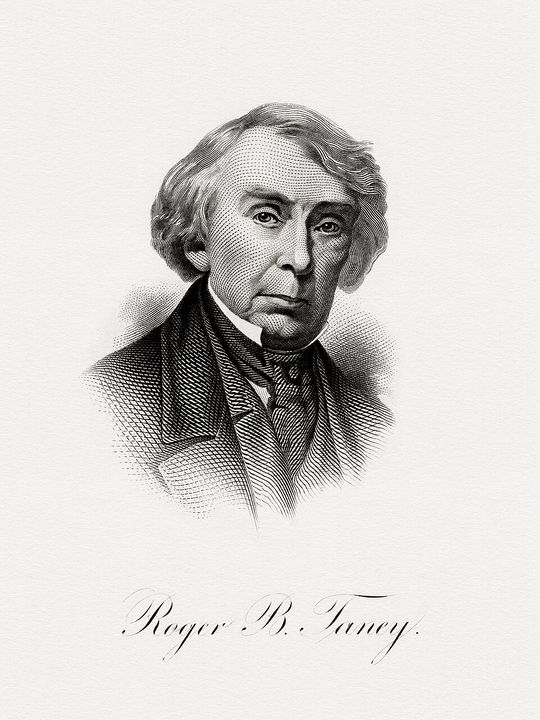
- Roger B. Taney: Chief Justice delivering the majority ruling
- Benjamin R. Curtis: Massachusetts justice who wrote the fuller dissent
- John McLean: Ohio justice who also dissented

Summary
Dred Scott was held as a slave by Dr. John Emerson, an army surgeon who took him in the 1830s to the free state of Illinois and then to Fort Snelling, in a part of the Wisconsin Territory where the Missouri Compromise of 1820 forbade slavery. There Scott married Harriet Robinson, and the family later returned to Missouri. After Emerson's death, the Scotts sued for freedom in a St. Louis court in 1846, arguing that residence on free soil had made them free. A jury agreed in 1850, but the Missouri Supreme Court reversed in 1852. Scott then sued John F. A. Sanford of New York, who claimed him through Emerson's estate (the report spells the name Sandford), in federal court, which hears suits between citizens of different states. Sanford answered with a plea that Scott could not be a citizen of Missouri because he was of African descent and his ancestors had been brought to America as slaves. Two questions reached the Supreme Court: whether a person so described could be a citizen with the right to sue in federal court, and whether Congress could prohibit slavery in a federal territory, so that residence there made Scott free. On 6 March 1857 the Court ruled against Scott, 7–2. Chief Justice Taney held that people of African descent whose ancestors were imported as slaves, whether free or enslaved, were not part of the people who made the Constitution and were not citizens of the United States. He drew this from founding-era laws and opinion, which in his reading treated them as a separate and subordinate class, from the Declaration of Independence as its authors understood it, and from the Constitution's slave-trade and fugitive-slave clauses. A state might grant its own citizenship, but could not make anyone a citizen of the United States. Taney then held that the territory clause of Article IV applied only to lands held in 1787, that Congress's power over later territories was bounded by the Fifth Amendment's protection of property, and that the Missouri Compromise prohibition was therefore void. Scott's status after returning to Missouri was governed by Missouri law. Justices McLean and Curtis dissented. Justice Curtis answered that free men of African descent were citizens of at least five states when the Constitution was ratified and voted on its adoption, and that anyone born a citizen of a state is a citizen of the United States. The library text contains Taney's opinion and an excerpt of Curtis's dissent that covers citizenship and breaks off before his discussion of the territories; the other opinions and footnotes are omitted. The decision became a central issue in the 1858 Illinois Senate race and the 1860 election. Scott and his family were freed by private manumission in May 1857. The Thirteenth Amendment (1865) abolished slavery, and the Fourteenth (1868) declared all persons born or naturalized in the United States and subject to its jurisdiction citizens of the nation and of their state, superseding the decision's citizenship holding.
Virtues in this work
- Fortitude: Dred and Harriet Scott pressed their claims for eleven years through state trial and appeal and a second suit in the federal courts.
- Justice: Curtis gathered the laws of five states and the 1778 record of the Confederation Congress to argue that free men of African descent already held citizenship at the founding.
- Prudence: Justice Nelson would have decided the case on Missouri law alone, leaving the citizenship and territorial questions undecided.
Plot or Argument
- The plea in abatement is before the Court
Taney first holds that Sanford's plea denying Scott's citizenship is properly part of the record, so the Court must decide whether the Circuit Court had jurisdiction even though Sanford later prevailed on the merits.
- Who are the people of the United States?
Taney distinguishes state citizenship from national citizenship and holds that only Congress, through naturalization, can add to the body of national citizens. The question becomes whether descendants of imported slaves were among the people who formed the Constitution.
- The evidence of history
Surveying English and American laws of the eighteenth century, state statutes on marriage and militia service, the Declaration of Independence, and the Constitution's provisions on the slave trade and fugitives, Taney concludes that the founders regarded people of African descent as outside the political community, and that the Court must apply the Constitution as understood when it was adopted.
- The territories and the Missouri Compromise
The power to make needful rules for the territory of the United States, Taney holds, referred to lands then held. Congress's authority over later acquisitions is limited by the Constitution, including the Fifth Amendment's protection of property, so a law forbidding slaveholding north of 36 degrees 30 minutes is void and residence at Fort Snelling did not free Scott.
- Illinois and the return to Missouri
Following Strader v. Graham, Taney holds that Scott's status on returning to Missouri depended on Missouri law as declared by its own supreme court. The judgment is reversed and the case remanded with directions to dismiss for want of jurisdiction.
- Curtis's dissent on citizenship
Curtis argues that the record of the founding era shows free men of African descent were citizens of New Hampshire, Massachusetts, New York, New Jersey and North Carolina, and voted in some of them. He notes that Congress rejected a 1778 motion to insert the word white in the Articles of Confederation, finds nothing in the Constitution depriving such citizens of their status, and holds that birth as a citizen of a state makes one a citizen of the United States. The excerpt ends as he sets out the possible sources of birthright citizenship.
Characters
- Dred Scott, plaintiff in error
Man held in slavery who sued for his freedom and his family's for eleven years in state and federal courts.
- Harriet Robinson Scott, wife and co-litigant in the state suits
Married Dred Scott at Fort Snelling and pursued her own freedom suit in Missouri.
- John F. A. Sanford, defendant in error
New York businessman and brother of Irene Emerson, who claimed the Scotts; the report spells his name Sandford.
- Roger B. Taney, Chief Justice; author of the opinion of the Court
Marylander who had led the Court since 1836.
- Benjamin R. Curtis, dissenting justice
Massachusetts lawyer who wrote the longer of the two dissents and resigned from the Court later in 1857.
- John McLean, dissenting justice
Ohioan who also dissented, arguing that Congress could prohibit slavery in the territories.
Lessons
Original understanding as a method
Taney insisted that the Constitution must be read as its framers understood it, and he built his citizenship holding on a survey of founding-era laws and opinion. Curtis used the same method and reached the opposite answer by pointing to states where free men of African descent voted. The case shows that a shared method does not settle disputed history.
- What kinds of evidence does Taney rely on to show how the founders understood citizenship?
- What evidence does Curtis offer in reply, and why does he emphasize voting?
- When two judges read the same historical record differently, how should a reader decide between them?
Two kinds of citizenship
The opinion separates citizenship of a state from citizenship of the United States, and holds that a state cannot make anyone a national citizen. Curtis rejects the separation for those born citizens of a state. The Fourteenth Amendment later defined national citizenship by birth or naturalization and made state citizenship follow from residence.
- Why does it matter for jurisdiction whether Scott was a citizen of Missouri?
- How does the first sentence of the Fourteenth Amendment answer the question Taney posed?
Can a court settle a national dispute?
President Buchanan and others hoped the Court would end the controversy over slavery in the territories. The decision instead became a central issue in the debates of 1858 and the election of 1860, illustrating the limits of judicial authority over questions that divide a whole people.
- Why might political leaders have wanted the Court rather than Congress to decide the territorial question?
- How did Lincoln and Douglas each respond to the decision in their 1858 debates?
- What are the risks when a court decides more questions than a case requires?
Persistence in the courts
Dred and Harriet Scott pursued their claims from 1846 to 1857 through trial, appeal, a new federal suit and two arguments in Washington. Their case is a reminder that great constitutional decisions begin with particular families and long, costly litigation.
- Why did Scott begin a new suit in federal court after losing in the Missouri Supreme Court?
- How were the Scotts finally freed, and when?
Context
By the 1850s the question whether slavery could spread into the western territories dominated national politics. The Missouri Compromise had drawn a line at 36 degrees 30 minutes in 1820, the Compromise of 1850 adopted popular sovereignty for new territories, and the Kansas-Nebraska Act of 1854 repealed the Missouri line and led to fighting in Kansas and the founding of the Republican Party.
Composition
The federal suit was filed in 1853 or 1854 in the Circuit Court at St. Louis, where Judge Robert W. Wells ruled that Scott could sue but the jury found for Sanford. The Supreme Court heard argument in February 1856, ordered reargument for December 1856, and announced its decision on 6 March 1857, two days after James Buchanan's inauguration. Each of the nine justices wrote; Justice Nelson's opinion, resting only on Missouri law, had at first been prepared as the opinion of the Court. The library text, from Wikisource, prints Taney's opinion and part of Curtis's dissent.
Reception
Southern Democrats welcomed the ruling as confirming slaveholders' rights in the territories; Republicans rejected its territorial holding, and Lincoln in 1858 argued that it pointed toward the spread of slavery. Douglas defended the decision while maintaining that territories could still discourage slavery through local legislation. Congress prohibited slavery in the territories in 1862, the Thirteenth Amendment abolished it in 1865, and the Fourteenth Amendment's Citizenship Clause in 1868 established birthright citizenship in national law.
Comparisons
- lincoln-douglas-debates
The 1858 Illinois Senate debates turned repeatedly on the decision, with Douglas defending it and Lincoln challenging its territorial holding.
- house-divided-speech
Lincoln's June 1858 speech presents the decision as one piece of a larger design concerning the spread of slavery.
- the-founding-documents
Both opinions argue over the meaning of the Declaration's 'all men are created equal,' the Preamble's 'We the People' and the territory clause of Article IV.
- compromise-of-1850-speeches
The Senate speeches of 1850 debated the same question of congressional power over slavery in the territories that the Court tried to settle seven years later.
- united-states-v-wong-kim-ark
In 1898 the Court applied the Fourteenth Amendment's Citizenship Clause, which superseded Dred Scott, to a man born in San Francisco to Chinese parents.
- slaughter-house-cases
The first major reading of the Fourteenth Amendment describes the Citizenship Clause as overturning the Dred Scott decision on national citizenship.
Quotes
Frequently cited
“The question is simply this: Can a negro, whose ancestors were imported into this country, and sold as slaves, become a member of the political community formed and brought into existence by the Constitution of the United States, and as such become entitled to all the rights, and privileges, and immunities, guarantied by that instrument to the citizen?”
Frequently cited
“We think they are not, and that they are not included, and were not intended to be included, under the word 'citizens' in the Constitution, and can therefore claim none of the rights and privileges which that instrument provides for and secures to citizens of the United States.”
Frequently cited
“And my opinion is, that, under the Constitution of the United States, every free person born on the soil of a State, who is a citizen of that State by force of its Constitution or laws, is also a citizen of the United States.”
“And an act of Congress which deprives a citizen of the United States of his liberty or property, merely because he came himself or brought his property into a particular Territory of the United States, and who had committed no offence against the laws, could hardly be dignified with the name of due process of law.”
“Upon these considerations, it is the opinion of the court that the act of Congress which prohibited a citizen from holding and owning property of this kind in the territory of the United States north of the line therein mentioned, is not warranted by the Constitution, and is therefore void; and that neither Dred Scott himself, nor any of his family, were made free by being carried into this territory; even if they had been carried there by the owner, with the intention of becoming a permanent resident.”
“These colored persons were not only included in the body of 'the people of the United States,' by whom the Constitution was ordained and established, but in at least five of the States they had the power to act, and doubtless did act, by their suffrages, upon the question of its adoption.”
For Students
A reading companion for classical Christian high school students. See the student guide.
Reading Guide
Watch for
- How Taney frames the citizenship question and why he begins with the plea in abatement.
- The distinction Taney draws between citizenship of a state and citizenship of the United States.
- The kinds of eighteenth-century evidence Taney offers about the founders' understanding.
- Taney's reading of the territory clause and his use of the Fifth Amendment.
- Curtis's evidence from the five states and from the 1778 vote on the Articles of Confederation.
Key terms and names
- Plea in abatement
- A defendant's answer that does not deny the claim but objects that the court cannot hear it, here because Scott was said not to be a citizen.
- Diversity jurisdiction
- The power of federal courts to hear suits between citizens of different states.
- Missouri Compromise
- The 1820 act admitting Missouri and forbidding slavery in the Louisiana Purchase lands north of 36 degrees 30 minutes outside Missouri.
- Territory clause
- Article IV, Section 3, giving Congress power to make all needful rules and regulations respecting the territory of the United States.
- Manumission
- The legal act by which an owner frees a person held in slavery.
- Citizenship Clause
- The first sentence of the Fourteenth Amendment (1868), making all persons born or naturalized in the United States and subject to its jurisdiction citizens.
Seminar Questions
- Comprehension Where did John Emerson take Dred Scott, and why did Scott argue those journeys made him free?
- Comprehension What two main questions did Taney answer, and how did he answer each?
- Interpretation Why does Taney think the meaning of the Constitution cannot change with later public opinion, and how does that principle shape his holding?
- Interpretation How does Curtis use the same appeal to the founding era to reach the opposite conclusion?
- Interpretation Once the Court decided it had no jurisdiction, was it proper for it to go on to decide the territorial question?
- Big Question What makes a person a member of a political community, and who has the authority to decide?
Faith Connections
- Acts 17:26 (Scripture)
Paul's statement that God made of one blood all nations of men was frequently cited in the nineteenth-century debates over slavery and the unity of mankind.
- Genesis 1:27 (Scripture)
The creation of man in the image of God underlies the Christian teaching on human dignity that readers bring to the case's question of who belongs to the people.
- Frederick Douglass, speech on the Dred Scott decision (May 1857) (Great Conversation)
Douglass answered the decision weeks after it was announced, arguing from the Constitution's text that it contained no warrant for the Court's reasoning.
Logic and Rhetoric
Central argument: Because the Constitution must be read as its framers understood it, and because the laws and opinion of the founding era placed descendants of imported slaves outside the political community, such persons are not citizens of the United States and cannot sue in federal court; and because Congress's power over later territories is limited by the Fifth Amendment, it could not forbid slaveholding there.
Rhetorical device: framing the question. Taney opens with 'The question is simply this' (quote 0), defining the issue in terms that already point toward his historical answer.
Debate: Resolved: that free persons of African descent born in a state that recognized them as citizens were citizens of the United States under the original Constitution.
Memory Work
And my opinion is, that, under the Constitution of the United States, every free person born on the soil of a State, who is a citizen of that State by force of its Constitution or laws, is also a citizen of the United States.
The question is simply this: Can a negro, whose ancestors were imported into this country, and sold as slaves, become a member of the political community formed and brought into existence by the Constitution of the United States, and as such become entitled to all the rights, and privileges, and immunities, guarantied by that instrument to the citizen?
Writing Prompts
Essay: Lay out Taney's reasoning on citizenship and Curtis's reply step by step, and explain which use of founding-era evidence is more careful and complete.
Comparison with The Lincoln-Douglas Debates: Compare how Lincoln and Douglas each responded to the Dred Scott decision in 1858, and explain what each believed the decision meant for the territories.
Medical Lens
John Emerson's work as an army surgeon explains the moves between military posts that gave rise to the suit, but neither opinion in the library text discusses medicine.
Creative Prompts
- Classroom
Hold a moot court limited to the jurisdictional question: one team argues Sanford's plea from Taney's sources, the other Scott's side from Curtis's evidence of voting in five states, and the bench must decide whether the Circuit Court could hear the case.
- Essay
Write a brief explaining how Section 1 of the Fourteenth Amendment answers each part of Taney's citizenship holding, phrase by phrase.
- Dialogue
Write a conversation in May 1857 between two St. Louis lawyers, one of whom has just helped arrange the Scotts' manumission, about what the decision did and did not settle.
- Classroom
Prepare a timeline from the Missouri Compromise (1820) to the Fourteenth Amendment (1868), marking each step of the Scotts' litigation alongside the national events it touched.
Further Reading
- The Dred Scott Case: Its Significance in American Law and Politics, Don E. Fehrenbacher
Pulitzer Prize-winning study of the litigation, the opinions and their political setting.
- Dred Scott and the Politics of Slavery, Earl M. Maltz
Concise account, in the Landmark Law Cases series, of the litigation and the justices' deliberations.
- The Dred Scott Decision: Law or Politics?, Stanley I. Kutler (editor)
Collection of documents and historians' essays presenting differing interpretations of the decision.
Verification notes
All six quotations were found by Grep as exact strings in content/texts/dred-scott-v-sandford.txt. Quotations reproduce the period language of the opinions exactly. The seven-to-two vote, the 6 March 1857 date, the Scotts' manumission in May 1857 and the amendments' dates are standard facts. Web searches were unavailable while this record was written, so the filing year of the federal suit (given as 1853 or 1854), Nelson's opinion having first been prepared for the Court, and the furtherReading titles other than Fehrenbacher should be confirmed.
- Confirm whether the federal suit was filed in late 1853 or 1854.
- Confirm that Justice Nelson's opinion was first prepared as the opinion of the Court before the majority broadened its scope.
- Confirm the bibliographic details of the Maltz and Kutler titles.