Work record
McCulloch v. Maryland
1819 · 19th Century · Court Decision · English
Abstract
Question Presented. Two linked issues came before the justices. Could the federal legislature create a corporation, a power nowhere listed among its grants? And if it could, might a state levy a duty on the corporation's local office?
Arguments. Maryland's advocates portrayed the Union as an agreement among sovereign states whose delegated authority must be read narrowly; on their view only indispensable measures qualified, and taxation remained a retained state power checked solely by explicit bans. The bank's lawyers traced national authority to the people, cited decades of reliance on a national bank for public finance, and warned that state levies could cripple federal instruments.
Holding. By a 7-0 vote, the charter was upheld and the Maryland duty struck down. Congress may select any fitting means plainly adapted to a permitted end, and a state may not burden the operations of a lawful national agency, though it may tax real estate and shares in common with other property.
Significance. Marshall's expansive reading of congressional means remains foundational. The decision provoked anonymous press debates in Virginia, was reaffirmed against Ohio in 1824, and preceded Jackson's 1832 veto, after which the institution lost its national charter in 1836.
Text. The stored version reproduces Marshall's reasons in full together with the formal judgment reversing the Maryland Court of Appeals, while omitting the speeches of the six advocates.
Key figures
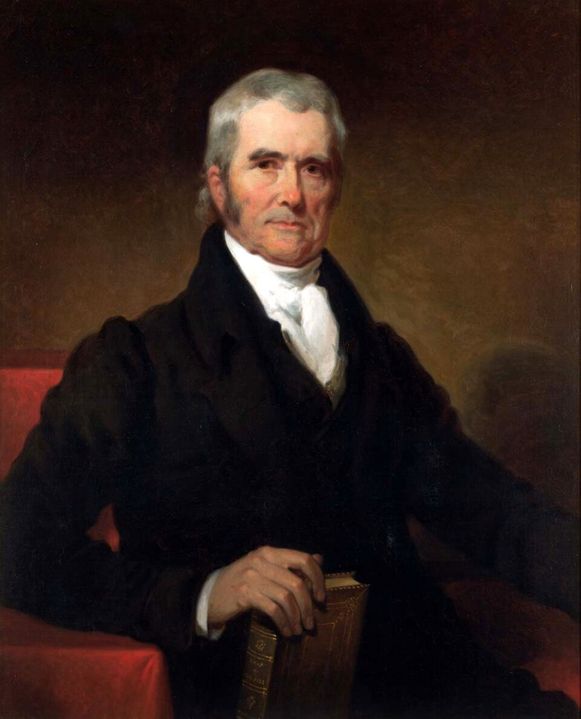
- John Marshall: Chief Justice speaking for all seven members of the bench
- James W. McCulloch: Baltimore cashier who issued unstamped banknotes
- Luther Martin: Veteran Maryland advocate defending the state levy
- Daniel Webster: Lead counsel for the national institution

Summary
Congress chartered the Second Bank of the United States in 1816, five years after the charter of the first national bank, created in 1791 on Alexander Hamilton's plan, had lapsed. The new bank opened a branch in Baltimore. In February 1818 the Maryland legislature imposed a tax on any bank operating in the state without a state charter, payable either as a stamp duty on each note issued or as an annual fee of $15,000. James W. McCulloch, cashier of the Baltimore branch, issued notes without the stamps. Maryland sued him in the Baltimore County Court and won, the Maryland Court of Appeals affirmed, and McCulloch brought the case to the Supreme Court. The argument lasted nine days. Luther Martin, Joseph Hopkinson and Walter Jones spoke for Maryland. They held that the Constitution was a compact of sovereign states, that the powers it delegated must be read strictly, that the word necessary in the Necessary and Proper Clause meant indispensable, and that a bank was a convenience Congress could do without. They also stressed that the power to tax was retained by the states and limited only by express prohibitions such as the ban on duties on imports. Daniel Webster, Attorney General William Wirt and William Pinkney answered for the bank: the national government derived from the people, Congress had long used the bank to collect revenue and pay its debts, necessary meant useful or conducive, and a state tax on a federal instrument could cripple it. On 6 March 1819 the Court ruled for McCulloch, 7-0, in an opinion by Chief Justice Marshall. He addressed two questions. First, Congress may incorporate a bank. The Constitution emanates from the people, not the state governments, and the national government, though one of enumerated powers, is supreme within its sphere. Because a constitution can mark only great outlines, the power to choose means is implied; the Necessary and Proper Clause, placed among the powers of Congress, enlarges rather than restricts that choice, and any appropriate means plainly adapted to a legitimate end is constitutional. Second, Maryland may not tax the bank's operations, because the power to tax involves the power to destroy, and a state cannot control the lawful measures of the government that the Constitution makes supreme. The opinion leaves untouched state taxes on the bank's real estate and on Maryland citizens' shares. The library text gives the full Opinion of the Court and the judgment; the arguments of counsel and notes are omitted. In Virginia, Spencer Roane and others attacked the decision in newspaper essays, and Marshall answered them anonymously. Andrew Jackson vetoed the bank's recharter in 1832, and its federal charter expired in 1836. The broad reading of the Necessary and Proper Clause has remained a fixed point of constitutional law, while the doctrine of tax immunity was narrowed in Graves v. New York ex rel. O'Keefe (1939).
Virtues in this work
- Prudence: Marshall frames the Constitution as a framework meant to endure for ages and adapt to crises, leaving Congress practical room to choose its means.
- Justice: The opinion protects an institution created by all the people from being taxed by the people of one state alone, while preserving the states' ordinary taxes.
- Magnanimity: Marshall states Maryland's compact theory in its own words and answers it at length rather than dismissing a sovereign state's argument.
Plot or Argument
- The gravity of a contest between Union and State
Marshall opens by noting that a sovereign state and the national legislature each deny the validity of the other's law, and that only this Court can peacefully decide the matter. He observes that the bank question was debated in Congress and the cabinet in 1791 and settled by long practice.
- Whose Constitution? People and states
Answering Maryland's claim that the Constitution was the act of sovereign states, Marshall points out that it was submitted to conventions chosen by the people of each state. The government it created is therefore the government of all, acting on the people directly, and is supreme within its sphere.
- Implied powers and the meaning of necessary
Neither the word bank nor corporation appears among the enumerated powers, but nothing excludes implied powers, and the Tenth Amendment conspicuously omits the word expressly. A constitution marks only great outlines. Necessary often means no more than convenient or useful, as its pairing with absolutely necessary elsewhere in the text shows.
- Why the clause enlarges rather than restricts
The Necessary and Proper Clause sits among the powers of Congress, not its limitations, and is phrased as a grant. If Congress used its powers as a pretext for objects not entrusted to it, the Court would have to declare such a law invalid; but the degree of necessity of an appropriate means is a question for Congress. A bank is an appropriate means, and its branches are equally lawful.
- May Maryland tax the branch?
The taxing power is vital and concurrent, but the Constitution and federal laws are supreme. The power to tax involves the power to destroy; the people of a single state cannot be trusted to tax an instrument created by the people of all. Marshall rejects reliance on The Federalist's discussion of concurrent taxation as inapplicable.
- The limits of the holding and the judgment
The Court unanimously holds the Maryland tax void, while noting that states may still tax the bank's real property and their citizens' shares like other property. The judgments of the Maryland courts are reversed and judgment entered for McCulloch.
Characters
- John Marshall, Chief Justice; author of the opinion
Delivered the unanimous opinion on implied powers and federal supremacy.
- James W. McCulloch, plaintiff in error
Cashier of the Baltimore branch of the Second Bank who issued notes without Maryland's stamps.
- Luther Martin, counsel for Maryland
Maryland's attorney general and a delegate to the 1787 Convention who had opposed ratification.
- Daniel Webster, counsel for McCulloch
Massachusetts lawyer who opened for the bank and urged that the power to tax is the power to destroy.
- William Pinkney, counsel for McCulloch
Maryland advocate, then the leading orator of the Supreme Court bar, who closed for the bank.
- William Wirt, Attorney General of the United States
Argued for the bank on behalf of the national government.
Lessons
A constitution, not a legal code
Marshall argues that a constitution which tried to list every means of carrying out its powers would be as long as a code of laws and never understood by the public. Its nature requires that only great outlines be marked. That view of what kind of document the Constitution is drives the rest of the opinion.
- What evidence does Marshall draw from the omission of the word expressly in the Tenth Amendment?
- Why does Marshall think a detailed constitution would be impractical?
- Does reading a constitution by its great outlines give judges and legislators too much room, or just enough?
What does necessary mean?
Maryland read necessary as indispensable; Marshall read it as useful, conducive or appropriate, pointing out that Article I, Section 10 uses the stronger phrase absolutely necessary. The disagreement over a single word divided strict and broad constructionists from the 1791 debate between Hamilton and Jefferson onward.
- How does Marshall use other parts of the Constitution to interpret the word necessary?
- What examples does Marshall give, such as carrying the mail or punishing crimes, to show that strict necessity cannot be the rule?
- Whose reading of necessary seems closer to ordinary usage, and does that settle the question?
The power to destroy
If a state could tax the bank, it could tax the mail, the mint or the courts, and do so to any degree. Marshall concludes that the people of one state cannot, through their legislature, control an institution created by the people of all the states. He carefully preserves ordinary state taxes on property.
- Which kinds of state taxes does Marshall say remain lawful?
- Why does he think the states' own interest in restraint is not a sufficient safeguard?
Sovereignty divided
Both sides agreed that the national government was one of enumerated powers and that the states remained sovereign in their own sphere. The question was where the line ran and who would draw it. Maryland's counsel defended the states as the original parties to the Union; Marshall defended the people as the source of national authority.
- How did Maryland describe the origin of the Constitution, and how did Marshall answer?
- Why does it matter whether the Constitution came from the people or from the states?
- Can two governments both be supreme over the same people?
Context
The financial disorder of the War of 1812 persuaded President Madison, who had opposed the first bank in 1791, to sign a charter for a second one in 1816. By 1818 the bank was unpopular in many states, accused of mismanagement and blamed for tightening credit in the Panic of 1819; the Baltimore branch was embroiled in a scandal involving McCulloch himself. Several states, including Maryland, Ohio, Kentucky and Tennessee, taxed or restricted the bank's branches.
Composition
The case was argued from 22 February to 3 March 1819, and Marshall delivered the opinion on 6 March, so quickly that some historians believe he had drafted much of it beforehand. It was printed in Henry Wheaton's fourth volume of reports. The library text, from Wikisource, contains the Opinion of the Court and the formal judgment.
Reception
Nationalists praised the opinion, while Virginia critics such as Judge Spencer Roane, writing as Hampden, and William Brockenbrough, as Amphictyon, saw it as erasing the limits on federal power; Marshall replied in essays signed A Friend of the Constitution. Ohio continued to collect its tax until the Court ruled against it in Osborn v. Bank of the United States (1824). Jackson's 1832 veto message argued that each branch must judge constitutionality for itself and that the bank was not necessary.
Comparisons
- hamiltons-reports-and-opinion-on-the-bank
Hamilton's 1791 opinion for Washington defended the first bank with the same reading of necessary as needful, useful or conducive that Marshall adopted in 1819.
- jefferson-selected-writings
Jefferson's 1791 opinion against the bank read the Necessary and Proper Clause strictly, warning that a broad reading would give Congress unlimited power, the position Maryland's counsel revived.
- the-anti-federalist-papers
Brutus and other critics warned in 1787-1788 that the Necessary and Proper and Supremacy Clauses would allow Congress to absorb the states' powers, including taxation; McCulloch addressed both clauses together.
- the-federalist-papers
Counsel cited The Federalist on concurrent taxing powers, and Marshall answered that its authors had not addressed a state tax on a federal instrument; Federalist No. 44 also defends the Necessary and Proper Clause.
- virginia-and-kentucky-resolutions
The resolutions of 1798 described the Constitution as a compact among the states, the theory Marshall rejected when he traced the government's authority to the people.
- gibbons-v-ogden
Five years later Marshall again applied federal supremacy against a state measure, this time reading the commerce power broadly to defeat New York's steamboat monopoly.
Quotes
Frequently cited
“In considering this question, then, we must never forget that it is a Constitution we are expounding.”
Frequently cited
“Let the end be legitimate, let it be within the scope of the Constitution, and all means which are appropriate, which are plainly adapted to that end, which are not prohibited, but consist with the letter and spirit of the Constitution, are Constitutional.”
Frequently cited
“That the power to tax involves the power to destroy; that the power to destroy may defeat and render useless the power to create”
“the Government of the Union, though limited in its powers, is supreme within its sphere of action.”
“In discussing this question, the counsel for the State of Maryland have deemed it of some importance, in the construction of the Constitution, to consider that instrument not as emanating from the people, but as the act of sovereign and independent States.”
“This provision is made in a Constitution intended to endure for ages to come, and consequently to be adapted to the various crises of human affairs.”
For Students
A reading companion for classical Christian high school students. See the student guide.
Reading Guide
Watch for
- The two questions Marshall poses, and how much more space the first receives than the second.
- Marshall's account of ratification by conventions of the people, offered against the compact theory.
- The argument from the missing word expressly in the Tenth Amendment.
- The comparison between necessary and absolutely necessary elsewhere in the Constitution.
- The sentence in which Marshall promises the Court would strike down a law passed under a pretext.
Key terms and names
- Enumerated powers
- The powers specifically listed in the Constitution, chiefly in Article I, Section 8.
- Implied powers
- Powers not listed but reasonably inferred as means of carrying out the listed ones.
- Necessary and Proper Clause
- The last clause of Article I, Section 8, giving Congress power to make all laws necessary and proper for executing its other powers.
- Compact theory
- The view, urged by Maryland, that the Constitution is an agreement among sovereign states.
- Supremacy Clause
- Article VI's declaration that the Constitution and federal laws made under it are the supreme law of the land.
- Concurrent power
- A power, such as taxation, held by both the national and state governments at the same time.
- Branch
- A local office of the national bank; Marshall holds that establishing branches was within the bank's lawful authority.
Seminar Questions
- Comprehension What two questions does Marshall answer, and what is his answer to each?
- Comprehension What kind of tax had Maryland placed on the bank, and what did McCulloch do?
- Comprehension Which state taxes does Marshall say his opinion leaves in place?
- Interpretation Why does Marshall think the source of the Constitution, the people or the states, matters to the question of a bank?
- Interpretation What does Marshall mean by saying that it is a Constitution we are expounding?
- Interpretation Marshall says the Court would strike down a law passed under a pretext. Does his test for necessary and proper leave enough room for that promise to be kept?
- Big Question How should a free people balance the advantages of a strong national government against the protection that comes from keeping power close to home?
Faith Connections
- Romans 13:6-7 (Scripture)
Paul instructs Christians to render tribute to whom tribute is due; McCulloch asks which authority may rightfully claim tribute from an institution created by another.
- Matthew 22:15-22 (Scripture)
Jesus answers the question about taxes to Caesar by distinguishing spheres of authority, a pattern of thought echoed in the case's question of national and state spheres.
- Abraham Kuyper, Lectures on Calvinism (1898) (Great Conversation)
Kuyper's idea of sphere sovereignty holds that each sphere of life has its own God-given authority, a different setting for Marshall's claim that government is supreme within its sphere of action.
Logic and Rhetoric
Central argument: Because the Constitution comes from the people and its government, though limited, is supreme within its sphere, Congress may choose any appropriate means to carry out its enumerated powers, including a bank; and because the power to tax involves the power to destroy, no state may tax the operations of that instrument.
Rhetorical device: reductio ad absurdum. Marshall shows that if necessary meant indispensable, Congress could not even require an oath of office or punish theft from the mail, and that if Maryland could tax the bank it could equally tax the mint, the mail and the courts; both conclusions are absurd, so the premises fail (quote 2).
Debate: Resolved: that the word necessary in Article I, Section 8 should be read as indispensable.
Memory Work
In considering this question, then, we must never forget that it is a Constitution we are expounding.
That the power to tax involves the power to destroy; that the power to destroy may defeat and render useless the power to create
Writing Prompts
Essay: Explain how Marshall answers each of Maryland's main arguments (the compact theory, the strict meaning of necessary, and the states' power to tax), and identify which answer you find most and least persuasive.
Comparison with Hamilton's Reports and Opinion on the Bank: Compare Hamilton's 1791 opinion on the constitutionality of the bank with Marshall's 1819 opinion. Where does Marshall borrow Hamilton's reasoning, and what does he add because he is writing as a judge rather than a cabinet officer?
Medical Lens
The case concerns the national bank, implied congressional powers and state taxation, with no medical content.
Creative Prompts
- Classroom
Reenact the nine-day argument in a single class period: a Maryland team led by a student playing Luther Martin defends the tax and the compact theory, a bank team plays Webster, Wirt and Pinkney, and a seven-member bench must answer both of Marshall's questions.
- Essay
Write a brief for Maryland that makes the strongest possible case for reading necessary as indispensable, using the text of the Constitution and the Tenth Amendment.
- Dialogue
Compose a newspaper exchange of 1819 between Hampden, defending Virginia's view of the Union, and A Friend of the Constitution, defending the Court.
- Essay
Choose a modern federal program and apply Marshall's test, let the end be legitimate, to decide whether he would have found it within Congress's power, explaining each step.
Further Reading
- McCulloch v. Maryland: Securing a Nation, Mark R. Killenbeck
Concise history of the bank controversy, the litigation and the opinion's reception.
- John Marshall's Defense of McCulloch v. Maryland, Gerald Gunther (editor)
Prints Marshall's anonymous newspaper essays answering his Virginia critics, with an introduction.
- John Marshall: Definer of a Nation, Jean Edward Smith
Full biography covering the bank case and its political setting.
- John Marshall and the Heroic Age of the Supreme Court, R. Kent Newmyer
Interprets McCulloch within Marshall's constitutional nationalism.
Verification notes
Each of the six quotations was matched by Grep in content/texts/mcculloch-v-maryland.txt; the fourth begins mid-sentence after a dash and is quoted from that point. The unanimous vote is stated in the opinion itself. Web search was unavailable, so the dates of argument (22 February to 3 March 1819), the terms of the Maryland tax, the pen names of the Virginia critics and the Graves decision of 1939 are given from standard histories. The suggestion that Marshall drafted the opinion before argument ended is a scholarly inference and is reported as such.
- Confirm the Maryland statute's date (February 1818) and its alternative of an annual $15,000 payment.
- Confirm that Brockenbrough wrote as Amphictyon and Roane as Hampden.
- Confirm that the justices lodged together during the 1819 term.