Work record
Schenck v. United States
1919 · Early 20th Century · Court Decision · English
Abstract
Question Presented. Can Congress, consistent with freedom of speech and of the press, punish people who mail draftees a circular denouncing conscription as servitude and urging them to stand up for their rights while the country is fighting Germany?
Arguments. Defense counsel maintained that the circular sought nothing beyond lawful petitioning, that criticizing a statute and seeking its repeal is a citizen's right, and that seized papers should have been kept out of the trial. Federal prosecutors replied that the mailing targeted newly conscripted men with no plausible aim except discouraging service, and that wartime authority to raise armies reaches efforts to hinder enlistment.
Holding. All nine justices upheld the convictions. Writing briefly, Holmes found the seized records admissible and judged that context fixes whether expression is shielded: words posing an immediate, serious risk of evils the legislature may forbid can be punished, and a plot to impede recruitment is criminal even when it fails.
Significance. The phrase clear and present danger entered American constitutional vocabulary through this ruling. Holmes recast it in a dissent that autumn, the Court later adopted broader and then narrower standards, and since 1969 incitement to imminent lawless action has been required.
Text. The edition prints Holmes's opinion alone, as issued, minus notes.
Key figures
- Charles T. Schenck: Philadelphia Socialist officer who mailed anti-draft circulars
- Elizabeth Baer: Party executive committee member tried alongside him
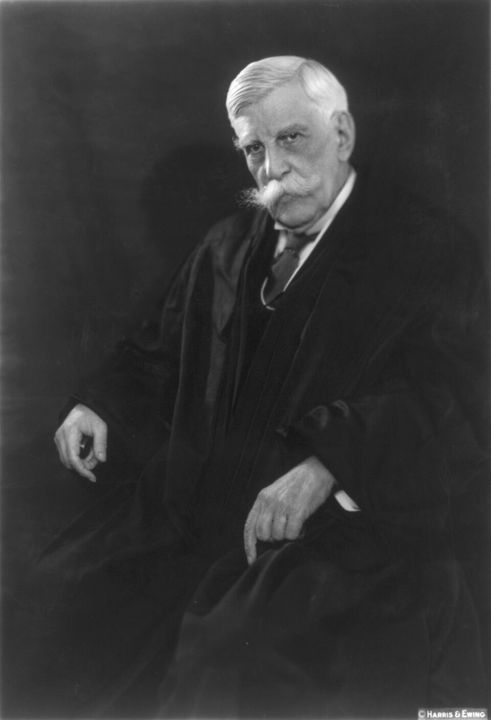
- Oliver Wendell Holmes Jr.: Civil War veteran who wrote for all nine justices
- Edward Douglass White: Louisiana-born Chief Justice presiding over the term

Summary
The United States entered the First World War in April 1917. In May Congress passed the Selective Service Act, providing for conscription, and in June the Espionage Act, which made it a crime during wartime to cause or attempt to cause insubordination in the armed forces or to obstruct recruiting or enlistment. That August the executive committee of the Socialist Party in Philadelphia voted to print fifteen thousand leaflets and mail them to men who had been called up and passed their exemption boards. One side of the leaflet quoted the Thirteenth Amendment, called conscription a form of involuntary servitude and urged readers to petition for repeal of the draft; the other side, headed Assert Your Rights, described the war as serving a few capitalists and called on men to oppose the draft. Charles T. Schenck, the party's general secretary, and Elizabeth Baer, a committee member, were convicted in federal court in Philadelphia on three counts: conspiracy to obstruct recruiting, conspiracy to send unmailable matter, and unlawful use of the mails. The question was whether the convictions violated the First Amendment's protection of speech and the press. The defendants argued that the leaflet advocated only lawful means such as petitions, that citizens had a right to criticize a law and seek its repeal, and that the evidence against them had been seized improperly. The government answered that the leaflet was sent to draftees for no purpose except to discourage them from serving, and that in wartime Congress could punish words intended to obstruct the raising of armies. On 3 March 1919 the Court unanimously affirmed. Justice Holmes first disposed of the evidentiary objections. On the main issue he conceded that in ordinary times the defendants' words would have been protected, but held that the character of every act depends on the circumstances in which it is done. Free speech would not protect a man falsely shouting fire in a theatre. The test was whether the words were used in such circumstances and of such a nature as to create a clear and present danger of bringing about evils Congress may prevent, a matter of proximity and degree. In war, he wrote, much that could be said in peace will not be endured, and a conspiracy to obstruct the draft is punishable even if it does not succeed. The library text contains Holmes's opinion from the United States Reports, with footnotes left out. A week later the Court upheld the convictions of Jacob Frohwerk and Eugene V. Debs on similar grounds. In Abrams v. United States, that November, Holmes dissented, joined by Brandeis, and gave the clear and present danger test a narrower meaning. In Brandenburg v. Ohio (1969) the Court held that advocacy may be punished only when directed to inciting imminent lawless action and likely to produce it, a standard that has since governed.
Virtues in this work
- Prudence: Holmes refuses to judge words in the abstract, insisting that their character depends on the time, place and audience in which they are used.
- Fortitude: Schenck and Baer accepted prosecution rather than abandon a campaign they believed was a lawful defense of constitutional rights.
- Justice: The Court weighs the nation's duty to raise an army in wartime against the citizen's freedom to criticize the law, giving each a place in its test.
Plot or Argument
- The charges and the evidence
Holmes sets out the three counts under the Espionage Act of 1917 and reviews the proof that Schenck, as general secretary, arranged the printing and mailing of the leaflets from the party headquarters on Arch Street.
- The search and the Fifth Amendment
The documents were seized under a warrant directed at the Socialist headquarters. Holmes holds them admissible and rejects the claim that the Fifth Amendment bars all evidence proceeding from a defendant.
- What the leaflet said
Holmes summarizes both sides of the circular: its appeal to the Thirteenth Amendment, its description of conscription as despotism, its call to assert rights and petition for repeal. He concludes that its only expected effect on draftees was to influence them to obstruct the draft.
- Circumstances, fire in a theatre, and clear and present danger
Conceding that such words might be protected in ordinary times, Holmes holds that circumstances determine the character of speech, offers the image of falsely shouting fire in a theatre, and states the clear and present danger test as a question of proximity and degree.
- Attempt, tendency and the meaning of recruiting
Success is not required: if the act, its tendency and its intent are the same, a conspiracy to obstruct is punishable. Recruiting, Holmes adds, includes conscription as well as volunteering. The judgments are affirmed.
Characters
- Charles T. Schenck, plaintiff in error
General secretary of the Socialist Party in Philadelphia, who oversaw the printing and mailing of the leaflets.
- Elizabeth Baer, co-defendant
Member of the party's executive committee, convicted with Schenck.
- Justice Oliver Wendell Holmes Jr., author of the unanimous opinion
Stated the clear and present danger test and the image of a false cry of fire in a theatre.
- Chief Justice Edward Douglass White, presiding justice
Led the unanimous Court that affirmed the convictions.
- Justice Louis D. Brandeis, member of the unanimous Court
Joined Holmes in Schenck and, later in 1919, in his Abrams dissent.
Lessons
Circumstances and the meaning of words
Holmes's central claim is that the same words may be lawful in one setting and punishable in another. A leaflet urging repeal of a law might be ordinary political speech in peacetime, yet in wartime, mailed to men just drafted, the Court treated it as an attempt to obstruct the army.
- What circumstances does Holmes think changed the character of Schenck's leaflet?
- Can you think of words that would be harmless in one place and dangerous in another?
- Should the protection of speech depend on its likely effects, or on its content alone?
A test of proximity and degree
The clear and present danger test asks how close and how likely the feared harm is. Holmes framed it as a matter of degree rather than a bright line, which gave judges and juries room to weigh circumstances and left later courts to decide how close the danger must be.
- What two things must be clear and present under Holmes's test?
- Why might a test of degree be harder to apply than a fixed rule?
- How did the Court's later standard in Brandenburg v. Ohio change the question?
Liberty in time of war
The opinion says that in war many things that might be said in peace will not be endured so long as men fight. The nation's need to raise an army and the citizen's freedom to oppose the war both carry real weight, and Americans have weighed them differently in different conflicts.
- What reasons does Holmes give for treating wartime speech differently?
- What do the defendants claim they were doing by urging a petition for repeal?
- Should the limits on speech change when a nation is at war?
The power of an image in legal argument
The false cry of fire in a crowded theatre became one of the best-known images in American law, often repeated far from its original setting. It shows how a vivid example can persuade, and why careful readers should notice exactly what the example claims.
- Holmes says falsely shouting fire. Why does the word falsely matter?
- How is distributing a leaflet like and unlike shouting in a theatre?
Context
American entry into the First World War divided the country. The Socialist Party, at its St. Louis convention in April 1917, opposed the war, and some opponents of conscription urged resistance or petitioned for repeal. The federal government prosecuted more than two thousand people under the Espionage Act of 1917 and its 1918 amendments, often called the Sedition Act, which reached disloyal or abusive language about the government and the armed forces.
Composition
Schenck and Baer were tried in the federal district court for the Eastern District of Pennsylvania in late 1917. The case was argued in Washington in January 1919, two months after the armistice, and was the first of the wartime speech cases the Court decided. Holmes wrote the opinion for a unanimous bench, and the same Court applied it within a week in Frohwerk v. United States and Debs v. United States.
Reception
Legal scholars, notably Zechariah Chafee Jr. of Harvard, argued that the clear and present danger test should protect much more speech than the Schenck result suggested, and Holmes's dissent in Abrams (November 1919) moved in that direction. Through the 1920s and after, the Court sometimes used a broader standard of bad tendency, as in Gitlow v. New York (1925), and in Dennis v. United States (1951) it reformulated the danger test. Brandenburg v. Ohio (1969) replaced it with the incitement standard. Congress repealed the 1918 amendments in 1920, while the core of the Espionage Act remains federal law.
Comparisons
- gitlow-v-new-york
Six years later the majority treated state laws against advocating violent overthrow as valid without proof of imminent danger, while Holmes in dissent applied the Schenck test to argue for reversal.
- on-liberty
Mill writes that the opinion that corn-dealers starve the poor may be freely printed but punished when shouted to an excited mob outside a corn-dealer's house, an example close to Holmes's reasoning about circumstances.
- ex-parte-milligan
Both cases ask how far wartime necessity reaches into civil liberties; in 1866 the Court held that civilians could not be tried by military commission where the civil courts were open.
- virginia-and-kentucky-resolutions
Madison and Jefferson wrote the resolutions in 1798 against the Sedition Act, the first federal attempt to punish criticism of the government during a time of threatened war.
- tinker-v-des-moines
Fifty years later the Court protected students' silent armbands against the Vietnam War, asking whether the expression caused substantial disruption rather than whether it tended to discourage service.
- near-v-minnesota
Hughes cites Schenck in Near to acknowledge that a government at war may prevent publication of troop movements, while holding that prior restraint is otherwise presumptively forbidden.
Quotes
Frequently cited
“The most stringent protection of free speech would not protect a man in falsely shouting fire in a theatre and causing a panic.”
Frequently cited
“The question in every case is whether the words used are used in such circumstances and are of such a nature as to create a clear and present danger that they will bring about the substantive evils that Congress has a right to prevent. It is a question of proximity and degree.”
“We admit that, in many places and in ordinary times, the defendants, in saying all that was said in the circular, would have been within their constitutional rights. But the character of every act depends upon the circumstances in which it is done.”
“When a nation is at war, many things that might be said in time of peace are such a hindrance to its effort that their utterance will not be endured so long as men fight, and that no Court could regard them as protected by any constitutional right.”
“If the act (speaking, or circulating a paper), its tendency, and the intent with which it is done are the same, we perceive no ground for saying that success alone warrants making the act a crime.”
“If you do not assert and support your rights, you are helping to deny or disparage rights which it is the solemn duty of all citizens and residents of the United States to retain.”
For Students
A reading companion for classical Christian high school students. See the student guide.
Reading Guide
Watch for
- The three counts and how each relates to the mailing of the leaflets.
- Holmes's summary of what the leaflet said on each side.
- The concession about ordinary times and the turn on circumstances.
- The phrase clear and present danger and the words proximity and degree.
- The argument that success is not needed to make an attempt or conspiracy a crime.
Key terms and names
- Espionage Act of 1917
- Federal law that, among other things, punished efforts during wartime to cause insubordination in the armed forces or obstruct recruiting.
- Conspiracy
- An agreement between two or more persons to commit a crime, punishable even if the crime is not completed.
- Clear and present danger
- Holmes's test asking whether words in their circumstances create an immediate risk of harms Congress may prevent.
- Conscription
- Compulsory enrollment in the armed forces, enacted by the Selective Service Act of May 1917.
- Prior restraint
- Government suppression of speech before it is published; Holmes notes the First Amendment is not limited to forbidding it.
- Unanimous opinion
- A decision in which every participating justice joins the Court's judgment and reasoning.
Seminar Questions
- Comprehension What did the leaflet say, and to whom was it sent?
- Comprehension What does Holmes admit about the defendants' words in ordinary times?
- Comprehension According to Holmes, why does it not matter whether the leaflets actually discouraged anyone from serving?
- Interpretation How does the example of falsely shouting fire in a theatre support Holmes's argument, and where does the comparison fit the leaflet less well?
- Interpretation What work do the words clear, present, proximity and degree each do in Holmes's test?
- Big Question Does a citizen's duty to obey the law in wartime include a duty to refrain from urging others to resist it?
Faith Connections
- Romans 13:1-7 (Scripture)
Paul's teaching on submission to governing authorities is central to Christian reflection on obedience to the state, including in time of war.
- Acts 5:27-29 (Scripture)
Peter and the apostles, forbidden to speak, answer that they ought to obey God rather than men, a text often cited in debates over conscience and law.
- James 3:5-6 (Scripture)
James compares the tongue to a small fire that kindles a great matter, an image of speech whose effects outrun its size.
Logic and Rhetoric
Central argument: Because the character of speech depends on its circumstances, words that would be protected in peacetime may be punished when, sent to draftees in wartime, they create a clear and present danger of obstructing recruitment, and a conspiracy to produce that result is criminal whether or not it succeeds.
Rhetorical device: analogy. Holmes compares the leaflet to falsely shouting fire in a theatre (quote 1), using a case everyone would condemn to argue that free speech has limits set by circumstances.
Debate: Resolved: that speech urging opposition to a wartime draft should be protected by the First Amendment unless it incites imminent lawless action.
Memory Work
The question in every case is whether the words used are used in such circumstances and are of such a nature as to create a clear and present danger that they will bring about the substantive evils that Congress has a right to prevent. It is a question of proximity and degree.
The most stringent protection of free speech would not protect a man in falsely shouting fire in a theatre and causing a panic.
Writing Prompts
Essay: Explain how Holmes moves from his concession that the leaflet would be protected in ordinary times to his conclusion that the convictions stand, and judge whether each step follows from the one before.
Comparison with Gitlow v. New York: Compare Holmes's use of the clear and present danger test in Schenck, where he upheld a conviction, with his use of the same test in his Gitlow dissent, where he would have reversed one.
Medical Lens
Holmes's opinion addresses wartime leaflets, conspiracy and the First Amendment; the case has no medical subject matter.
Creative Prompts
- Classroom
Argue the case before a student bench in January 1919: one side for Schenck on the right to petition for repeal of the draft, the other for the United States on the power to raise armies; then have the bench apply Holmes's test and, separately, the Brandenburg test.
- Essay
Write a brief for the defendants arguing that a call to petition Congress cannot be a conspiracy to obstruct recruiting, using only facts given in Holmes's opinion.
- Dialogue
Write a conversation in August 1917 at the Socialist headquarters on Arch Street in which committee members debate whether to mail the leaflets to men who have just been drafted.
- Essay
Explain the difference between the clear and present danger test of 1919 and the imminent lawless action test of 1969, with one example that would come out differently under each.
Further Reading
- Perilous Times: Free Speech in Wartime from the Sedition Act of 1798 to the War on Terrorism, Geoffrey R. Stone
Survey of American free-speech controversies in wartime, with a full chapter on the First World War prosecutions.
- The Great Dissent: How Oliver Wendell Holmes Changed His Mind--and Changed the History of Free Speech in America, Thomas Healy
Account of the months between Schenck and Holmes's Abrams dissent in 1919.
- Free Speech in Its Forgotten Years, David M. Rabban
Study of American free-speech law and thought from the 1870s to 1920.
Verification notes
Every one of the six quotations, all from the short unanimous opinion, was matched exactly by Grep in content/texts/schenck-v-united-states.txt; the last is a sentence from the leaflet as Holmes quotes it. The decision date and unanimous vote were checked against standard references. Details of the trial (court, timing) and the number of Espionage Act prosecutions come from general histories such as Stone's Perilous Times and are approximate. COURT_TASK.md lists schoolBand 9-10; the schema permits only 9-12.
- Confirm the sentences imposed on Schenck and Baer if they are added later; they are not given here.
- Confirm the approximate figure of more than two thousand Espionage Act prosecutions.