Work record
Standard Oil Co. of New Jersey v. United States
1911 · Early 20th Century · Court Decision · English
Abstract
Question Presented. Did the New Jersey holding company and its affiliates unlawfully restrain and monopolize interstate commerce in petroleum under the 1890 antitrust statute, and by what standard should that law be applied?
Arguments. Federal lawyers described four decades of rebates, local price wars, pipeline control and absorbed rivals. The company credited its growth to efficiency and lawful purchases, and warned that treating every combination of property as illegal would outlaw commonplace business arrangements.
Holding. The justices upheld the order breaking up the combination. White reasoned that Congress had adopted common-law language carrying a standard of reason, so the statute reaches only undue restraints, and found that the holding company and its history revealed a purpose to exclude competitors. Harlan joined the breakup but protested that his colleagues had written an exception into the law.
Significance. The enterprise was split into thirty-four companies later that year, with shares of each distributed to the existing stockholders. The rule of reason drew congressional answers in the Clayton and Federal Trade Commission Acts of 1914, which named specific practices and created a standing agency, and it remains the default test in antitrust law.
Text. Both opinions appear in excerpt; White's stops before he applies his test to the trial record, and Harlan's breaks off amid his review of earlier decisions.
Key figures
- John D. Rockefeller: Founder of the oil combination
- Standard Oil Company of New Jersey: Holding company ordered to give up its subsidiaries
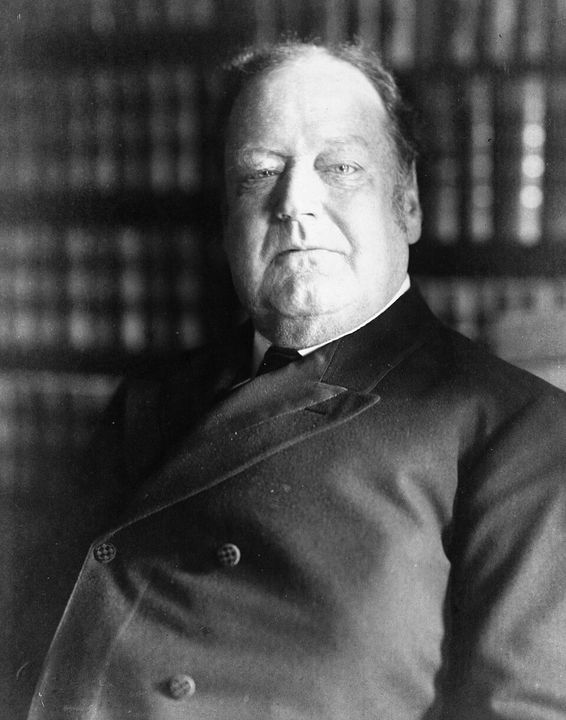
- Edward Douglass White: Chief Justice who announced the rule of reason
- John Marshall Harlan: Justice who joined the breakup but rejected the new rule
- Frank B. Kellogg: Government counsel

Summary
In 1870 John D. Rockefeller, his brother William, Henry M. Flagler and others organized the Standard Oil Company of Ohio to refine crude oil. Over the next decade the company acquired or allied itself with most of its competitors, and in 1882 the stockholders of some forty companies placed their shares with nine trustees, creating the Standard Oil Trust. After the Ohio courts ordered the trust dissolved in 1892, its holdings were reorganized, and in 1899 the Standard Oil Company of New Jersey became a holding company owning the stock of the principal refining, pipeline and marketing companies. In 1906 the United States sued under the Sherman Antitrust Act of 1890, which declares illegal every contract, combination or conspiracy in restraint of interstate trade and makes it a misdemeanor to monopolize or attempt to monopolize any part of that trade. The federal circuit court in St. Louis found violations of both sections and ordered the New Jersey company to give up control of 37 subsidiaries. The government argued that the combination was formed and maintained by railroad rebates, local price cutting, control of pipelines, espionage and the acquisition of rivals, giving it command of most of the country's refining. Standard Oil answered that its growth reflected efficiency and lawful purchases, that the corporate forms it used were authorized by state law, and that the act could not be read to forbid every combination of property, which would make ordinary business unlawful. On 15 May 1911 the Court affirmed the decree with minor modifications, eight to one on the reasoning. Chief Justice White traced the common law of monopoly and contracts in restraint of trade, from English statutes against forestalling and engrossing to American decisions, and concluded that Congress, by using terms the common law had long applied with a standard of reason, meant the courts to apply that standard. The act therefore forbids undue or unreasonable restraints, judged by the rule of reason in light of the statute's purposes. Applying it, White found that the 1899 combination, read with the history of the enterprise, showed an intent to exclude others and dominate the trade. Justice Harlan agreed that Standard Oil had violated the act and must be dissolved, but objected strongly that the Court had inserted the word unreasonable into a statute that contained no such limit, contrary to earlier decisions, and had thereby taken on a legislative role. The library text gives an excerpt of White's opinion, through his discussion of the rule of reason and earlier cases, and an excerpt of Harlan's separate opinion; footnotes are omitted. The decree was carried out later in 1911, distributing the subsidiaries' shares to Standard Oil's stockholders and producing thirty-four separate companies. Congress responded to concerns about the rule of reason by passing the Clayton Act and the Federal Trade Commission Act in 1914, and the rule of reason remains the general standard of American antitrust law.
Virtues in this work
- Prudence: White seeks a reading of the act that forbids combinations unduly restraining trade without making every ordinary business agreement unlawful.
- Justice: Both opinions agree that a combination built to exclude rivals and control a necessary commodity must be undone.
- Fortitude: Harlan, near the end of a long career, stands alone in insisting that the Court enforce the words Congress chose.
Plot or Argument
- The bill and the three periods
White summarizes the government's bill, which traced the alleged conspiracy through three periods: the Ohio company from 1870 to 1882, the trust from 1882 to 1899, and the New Jersey holding company from 1899, along with the means by which control was allegedly gained.
- The decree below and the opposing views
The circuit court found the 1899 combination illegal under both sections and enjoined the New Jersey company from controlling 37 subsidiaries. White contrasts the government's account of a career of wrongful acquisition with the defendants' account of lawful growth.
- The common law of restraint of trade
From English statutes against forestalling, regrating and engrossing to the doctrine that unreasonable restraints on one's own trade are void, White traces how the law came to forbid acts that presumptively caused the wrongs of monopoly, chiefly undue enhancement of prices.
- The standard of reason
Because the Sherman Act uses broad terms drawn from the common law without defining them, White concludes that Congress intended the standard of reason to measure which restraints are undue, and reads the second section as the complement of the first.
- Earlier cases limited
White argues that the Trans-Missouri Freight Association and Joint Traffic decisions, read in context, applied the light of reason, and says frankly that any broader language in them is now limited and qualified.
- Harlan's separate opinion (excerpt)
Harlan concurs in the dissolution but recalls the fear of concentrated capital that produced the act in 1890, quotes the statute and the Court's earlier refusals to read in an exception for reasonable restraints, and charges that the majority has engaged in judicial legislation.
Characters
- Standard Oil Company of New Jersey, appellant
Holding company formed in 1899 that controlled the Standard Oil enterprise's refineries, pipelines and marketing companies.
- John D. Rockefeller, individual defendant and appellant
Founder of the Standard Oil enterprise, named with his brother William and others in the government's bill.
- Chief Justice Edward Douglass White, author of the opinion of the Court
Louisianan who had long argued that the Sherman Act should be read in light of the common-law rule of reason.
- Justice John Marshall Harlan, concurring in part and dissenting in part
Kentuckian who agreed that Standard Oil must be dissolved but rejected the rule of reason as judicial legislation.
- Frank B. Kellogg, special counsel for the United States
Minnesota lawyer who led the government's prosecution of the case.
Lessons
Reading a broad statute
The Sherman Act says every contract in restraint of trade is illegal. White reasons that Congress used common-law terms that had always carried a standard of reason; Harlan answers that every means every and that only Congress may add an exception. The dispute is a classic study in statutory interpretation.
- Why does White think that Congress meant the word restraint to carry its common-law meaning?
- What does Harlan say the plain and ordinary meaning of the statute requires?
- When a law's words seem to reach too far, should judges narrow them or wait for the legislature?
The history behind the law of monopoly
White's opinion surveys centuries of English and American law on monopoly, forestalling and engrossing, showing how older rules about grain and food markets shaped a modern statute aimed at industrial combinations.
- What were forestalling, regrating and engrossing, and why were they forbidden?
- Which harm of monopoly does White treat as the chief concern of the old law?
Freedom of contract and freedom of trade
White argues that the act protects the freedom to contract by forbidding only undue restraints, since a ban on every combination would destroy the right to make agreements at all. Harlan recalls that Congress feared concentrations of capital controlling the necessaries of life.
- In what sense does White say freedom to contract is the essence of freedom from undue restraint?
- What danger does Harlan say the country perceived in 1890?
- Can a large firm be both efficient and a danger to fair competition?
Agreeing on the result, differing on the reason
Harlan joined in dissolving Standard Oil yet wrote a sharp separate opinion. His concern was less the outcome than the rule announced, which he feared would weaken the act in future cases. The opinion shows that the reasoning of a decision can matter as much as its result.
- Why would a justice who agreed with the result still write separately?
- What did Harlan fear the subsidiary companies might do under the Court's reasoning?
Context
The rapid growth of railroads, oil refining, steel and other industries after the Civil War produced large combinations of capital, often organized as trusts or holding companies. Farmers, small producers and reformers feared their power over prices, and Congress passed the Sherman Act in 1890 with nearly unanimous votes. Early enforcement was uneven: the Court in United States v. E. C. Knight Co. (1895) held that manufacturing was not commerce, though it applied the act to railroad rate agreements in 1897 and 1898 and to a railroad holding company in Northern Securities (1904).
Composition
Ida Tarbell's History of the Standard Oil Company (1904) and federal investigations helped prompt the suit, filed in November 1906 under President Theodore Roosevelt. Testimony filled many volumes, and the circuit court ruled for the government in 1909. The case was argued in the Supreme Court in March 1910, reargued in January 1911 after changes in the Court's membership, and decided in May, two weeks before the companion American Tobacco decision.
Reception
Business leaders welcomed the rule of reason as a source of flexibility, while critics, including many in Congress, saw it as weakening the act; the debate shaped the presidential campaign of 1912 and the antitrust legislation of 1914. Economists and historians continue to debate whether Standard Oil's dominance arose chiefly from efficiency or from exclusionary practices, and whether the dissolution increased competition. The rule of reason has governed most antitrust analysis since, alongside categories of conduct treated as unlawful in themselves.
Comparisons
- munn-v-illinois
Munn upheld state control of prices charged by a few firms dominating the grain trade; Standard Oil applied a federal statute to a combination dominating the oil trade.
- the-wealth-of-nations
Smith's criticism of monopolies and of merchants' combinations to raise prices belongs to the tradition of law and thought that White surveys.
- pollock-v-farmers-loan-and-trust
White, a dissenter in Pollock in 1895, wrote for the Court here as Chief Justice, and in both cases weighed long-settled readings of key constitutional and statutory terms.
- schechter-poultry-v-united-states
In 1935 the Court struck down industry codes of fair competition under the National Industrial Recovery Act, a very different federal approach to regulating competition.
- gibbons-v-ogden
Marshall's broad reading of the commerce power in 1824 underlies Congress's authority to forbid restraints of interstate trade.
Quotes
Frequently cited
“And, of course, when the second section is thus harmonized with and made as it was intended to be the complement of the first, it becomes obvious that the criteria to be resorted to in any given case for the purpose of ascertaining whether violations of the section have been committed is the rule of reason, guided by the established law and by the plain duty to enforce the prohibitions of the act, and thus the public policy which its restrictions were obviously enacted to subserve.”
Frequently cited
“The Nation had been rid of human slavery—fortunately, as all now feel—but the conviction was universal that the country was in real danger from another kind of slavery sought to be fastened on the American people, namely, the slavery that would result from aggregations of capital in the hands of a few individuals and corporations controlling, for their own profit and advantage exclusively, the entire business of the country, including the production and sale of the necessaries of life.”
“Thus, not specifying but indubitably contemplating and requiring a standard, it follows that it was intended that the standard of reason which had been applied at the common law, and in this country, in dealing with subjects of the character embraced by the statute, was intended to be the measure used for the purpose of determining whether, in a given case, a particular act had or had not brought about the wrong against which the statute provided.”
“In other words, that freedom to contract was the essence of freedom from undue restraint on the right to contract.”
“I concur in holding that the Standard Oil Company of New Jersey and its subsidiary companies constitute a combination in restraint of interstate commerce, and that they have attempted to monopolize and have monopolized parts of such commerce—all in violation of what is known as the Anti-Trust Act of 1890.”
“This is the more necessary because the court by its decision, when interpreted by the language of its opinion, has not only upset the long-settled interpretation of the act, but has usurped the constitutional functions of the legislative branch of the Government.”
For Students
A reading companion for classical Christian high school students. See the student guide.
Reading Guide
Watch for
- The three periods into which the government divided Standard Oil's history.
- White's survey of English laws against forestalling, regrating and engrossing.
- The phrases undue restraint and standard of reason.
- White's frank admission that earlier opinions are now limited and qualified.
- Harlan's account of what the country feared in 1890.
Key terms and names
- Restraint of trade
- An agreement or act that limits competition or a person's freedom to carry on a business.
- Rule of reason
- The standard announced here: only undue or unreasonable restraints of trade violate the Sherman Act.
- Trust
- An arrangement in which stockholders of several companies transfer their shares to trustees who manage them as one enterprise.
- Holding company
- A corporation that controls other companies by owning their stock.
- Engrossing
- An old English offense of buying up large quantities of a commodity in order to resell at a higher price.
- Decree
- A court's final order in an equity case, here requiring the holding company to give up control of its subsidiaries.
Seminar Questions
- Comprehension What did the circuit court order Standard Oil of New Jersey to do?
- Comprehension What does the Sherman Act's first section prohibit, in Harlan's quotation of it?
- Interpretation How does White use the history of the common law to interpret the Sherman Act?
- Interpretation Why does Harlan think the majority has performed a legislative function?
- Interpretation How does White reconcile the rule of reason with earlier cases that seemed to reject it?
- Big Question Is it better for laws to set clear rules that may sometimes reach too far, or broad standards that require judges' judgment?
Faith Connections
- Isaiah 5:8 (Scripture)
Woe unto them that join house to house, that lay field to field, till there be no place, a prophetic warning against accumulation that leaves no room for others.
- Proverbs 11:26 (Scripture)
The proverb curses one who withholds grain to raise the price, the same concern behind the old offenses of forestalling and engrossing that White describes.
- Leo XIII, Rerum Novarum (1891) (Great Conversation)
Issued a year after the Sherman Act, the encyclical warned against wealth concentrated in few hands while defending private property, a balance relevant to both opinions.
Logic and Rhetoric
Central argument: White reasons that the Sherman Act borrowed common-law terms without defining them, that the common law had always judged restraints by a standard of reason, and that Congress therefore meant to forbid only undue restraints, which Standard Oil's combination was. Harlan agrees on the result but argues that the statute's plain words cover every restraint and that adding the word unreasonable is judicial legislation.
Rhetorical device: metaphor. Harlan describes concentrated capital as another kind of slavery threatening the nation, drawing on the recent memory of emancipation (quote 4).
Debate: Resolved: that the Sherman Act should forbid only unreasonable restraints of trade.
Memory Work
In other words, that freedom to contract was the essence of freedom from undue restraint on the right to contract.
This is the more necessary because the court by its decision, when interpreted by the language of its opinion, has not only upset the long-settled interpretation of the act, but has usurped the constitutional functions of the legislative branch of the Government.
Writing Prompts
Essay: Explain the rule of reason as White states it, and evaluate Harlan's objection that it rewrites the statute Congress passed.
Comparison with Munn v. Illinois: Compare the problem of a few firms controlling a vital trade in Munn v. Illinois and in Standard Oil, and explain how the remedy in each case reflected the powers of the government involved.
Medical Lens
An antitrust case about the oil industry, corporate combination and statutory interpretation; it raises no medical or psychological questions.
Creative Prompts
- Classroom
Hold a mock trial before a student circuit court in 1909, with witnesses playing an independent refiner, a railroad agent and a Standard Oil executive, then let a student bench decide whether the restraint was unreasonable.
- Essay
Write two short judicial opinions on the same hypothetical agreement between two small refiners to share a pipeline, one applying the rule of reason and one applying Harlan's reading of every contract.
- Dialogue
Imagine Ida Tarbell and John D. Rockefeller meeting in 1911 after the decision, each explaining how the Standard Oil enterprise grew and what the breakup means.
- Essay
Research the old English offenses of forestalling, regrating and engrossing and explain how White uses them to interpret a statute passed in 1890.
Further Reading
- The History of the Standard Oil Company, Ida M. Tarbell
The investigative series, published as a book in 1904, that helped bring about the government's suit.
- Titan: The Life of John D. Rockefeller, Sr., Ron Chernow
Full biography of the founder, including the antitrust case and the dissolution.
- The Prize: The Epic Quest for Oil, Money, and Power, Daniel Yergin
History of the oil industry that places the Standard Oil case in its economic setting.
Verification notes
Three quotations from White and three from Harlan were found by Grep as exact substrings of content/texts/standard-oil-v-united-states.txt, including Harlan's em dashes. The three periods of the alleged conspiracy, the 1882 trust, the 1892 dissolution, the 1899 New Jersey holding company and the 37 subsidiaries all appear in the stored text. White's opinion in the library text breaks off during his discussion of earlier cases, before he applies the rule of reason to the facts and modifies the decree. The count of thirty-four successor companies, the decision and argument dates, and Kellogg's role come from standard histories.
- Confirm the argument dates (March 1910; reargued January 1911) and the decision date of 15 May 1911.
- Confirm that the dissolution produced thirty-four companies, as commonly stated, and that the decree's deadline was six months.
- Confirm that Justice Lamar participated in the decision.