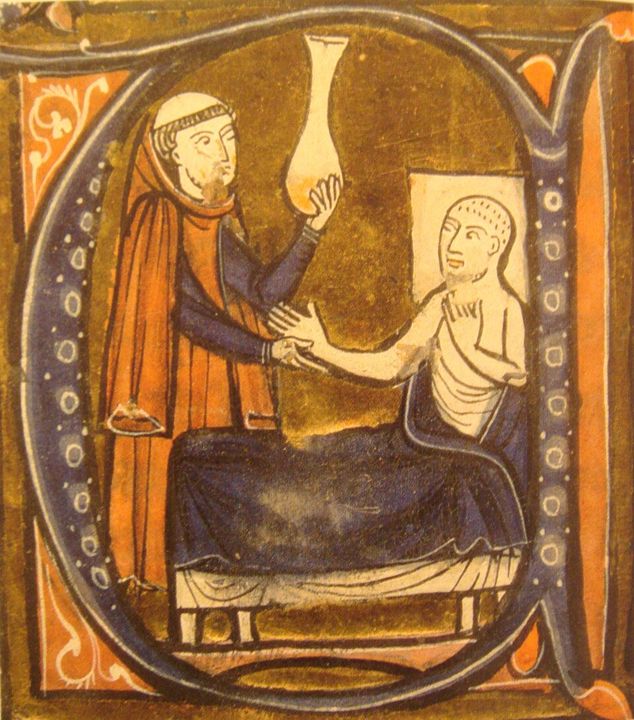
Al-Razi as imagined in a thirteenth-century illumination of Gerard of Cremona's medical translations. Source · Public domain
About Abu Bakr al-Razi (Rhazes)
Abu Bakr Muhammad ibn Zakariya al-Razi (c. 865–c. 925), known in Latin Europe as Rhazes, was born at Rayy, near modern Tehran. He is said to have turned to medicine relatively late, after interests in music, philosophy and alchemy, and studied in Baghdad, the capital of the Abbasid caliphate. He directed hospitals at Rayy and Baghdad, taught students at the bedside, and wrote some two hundred works on medicine, alchemy and philosophy. The best known are the vast clinical notebook al-Hawi (Latin Continens), compiled after his death from his case notes and readings, and the compendium al-Mansuri, dedicated to Mansur ibn Ishaq, governor of Rayy. He combined deep reading in Galen with his own case records, and also wrote a book of Doubts about Galen. Late in life he suffered from failing sight.
Al-Razi's treatise, known in Arabic as Kitab al-Judari wa al-Hasba (The Book of Smallpox and Measles), is a short practical monograph in fourteen chapters by the leading physician of the Abbasid world. It is usually described as the earliest surviving work devoted to these diseases and the first to set out clearly how to tell them apart at the bedside.