Work record
A Treatise on the Smallpox and Measles
c. 910 · Medieval · Essays · Arabic
Abstract
Background. Baghdad's translation movement had made Greek medicine available in Arabic, and city hospitals joined patient care with instruction. A Persian clinician who led such institutions wrote a brief book on two rash fevers that struck nearly every child.
Content. Opening pages review what Galen said and supply a cause in the language of the four humors. The author then describes who falls ill and in which seasons, the early warning signs that separate one disease from the other, and a full program of care: bleeding, cooling diet, protection of eyes and joints, ripening and drying the eruption, removing scabs and scars, feeding, and regulating the bowels. A final chapter forecasts outcome from the appearance and timing of the rash.
Method. Bedside observation is set within Galenic physiology. Remedies come from foods, plants and minerals chosen for their cooling or drying qualities, and the writer often warns which measures suit one disease but harm the other.
Translation. The library text is Greenhill's Victorian English rendering, prepared from the Arabic with Latin and Greek versions consulted, in an OCR transcription.
Significance. Historians of medicine regard it as the first clear clinical separation of smallpox from measles and a landmark of medieval Islamic medicine. It was reprinted in Europe for centuries before vaccination.
Key figures
- Abu Bakr al-Razi: Persian physician and hospital director, the author
- Galen: Greek physician whose scattered remarks open the inquiry
- The unnamed patron: Person who encouraged the composition of the work
- William Alexander Greenhill: Oxford-trained physician who made the 1848 English version
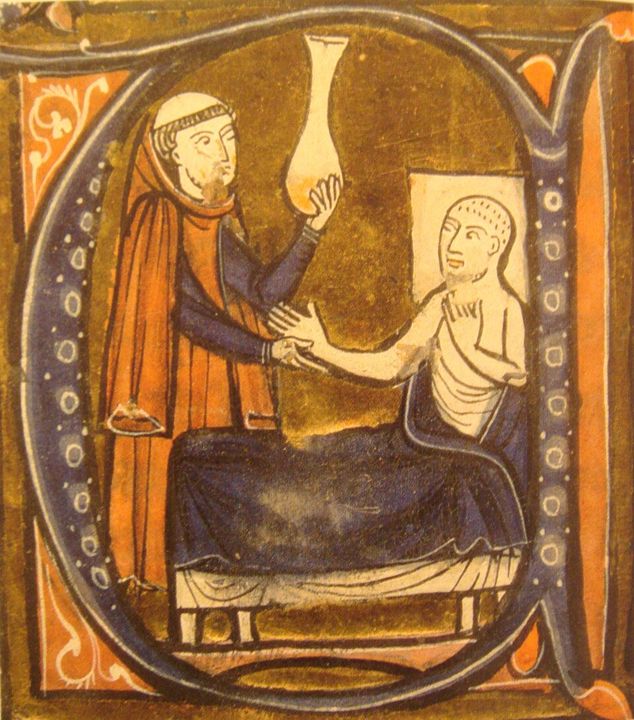

Summary
Al-Razi's treatise, known in Arabic as Kitab al-Judari wa al-Hasba (The Book of Smallpox and Measles), is a short practical monograph in fourteen chapters by the leading physician of the Abbasid world. It is usually described as the earliest surviving work devoted to these diseases and the first to set out clearly how to tell them apart at the bedside. Chapter I opens with a defense of Galen, collecting every passage in which Galen mentions smallpox, while admitting that he gave no complete cause or treatment; al-Razi says he questioned scholars who read Syriac and Greek and found none who could add more. He then gives his own explanation in humoral terms: human life moves from moisture to dryness, the blood of children is like grape must, and smallpox is the fermentation by which it becomes like mature wine. That is why hardly any child escapes it, while young men are seldom attacked and old men only in pestilential air. Chapter II lists the constitutions and seasons most prone to the disease. Chapter III is the most famous. Smallpox is announced by continued fever, pain in the back, itching of the nose and terrors in sleep, with redness of the cheeks and eyes, heaviness, sore throat and cough. Restlessness, nausea and anxiety are more marked in measles, while back pain is more peculiar to smallpox, and measles, al-Razi says, comes from a very bilious blood. Chapter IV outlines the general plan of treatment. The remaining chapters are a manual of care. Chapter V advises preventive bleeding (a vein for those over fourteen, cupping for younger children), cool rooms, cooling acid foods such as lentil soup and pomegranates, and water cooled with snow. Chapter VI deals with bringing out the eruption; Chapter VII with protecting the eyes, throat, ears, joints, and the soles and palms, including rose-water drops for the eyes and opening large pustules. Chapters VIII to XI cover ripening and drying the pustules, removing scabs, and fading the scars. Chapters XII and XIII prescribe diet and the management of the bowels. Chapter XIV gives the prognosis: white, large, distinct pustules that come out easily are the safest, while confluent, hard, green, violet or black ones, sinking of the rash, delirium and fainting are fatal signs. The work closes with praise to God. The treatise circulated in Arabic, in a Byzantine Greek version, and in Latin from the Renaissance onward. The library text is the English translation by William Alexander Greenhill, published by the Sydenham Society in London in 1848, in an OCR transcription.
Virtues in this work
- Humility: Al-Razi defends Galen's reputation against careless critics before stating what Galen left undone.
- Industry: He questions readers of Syriac and Greek and searches Galen book by book before writing his own account of the cause.
- Charity: His careful remedies for the eyes, throat and skin aim to spare sick children blindness, pain and lasting scars.
- Prudence: In Chapter XIV he teaches the physician to read signs of danger and to scarify a threatened limb only if the patient's strength allows.
- Piety: He undertakes the work by God's permission and ends with praise to Him who gave understanding.
Plot or Argument
- Chapter I: Galen and the cause of smallpox
Al-Razi gathers Galen's scattered mentions of smallpox, notes that Galen gave no complete cause or cure, and explains the disease as a fermentation of the moist, hot blood of childhood, like must turning into wine, which is why few escape it.
- Chapter II: who is most liable
Moist, pale, fleshy bodies, those prone to fevers and nosebleeds, and lovers of sweet foods are most liable to smallpox, which prevails in late autumn, early spring, rainy summers and warm winters with southerly winds; lean, hot, dry, bilious bodies and hot, dry seasons dispose to measles.
- Chapter III: the signs of approaching eruption
Continued fever, back pain, itching of the nose, terrors in sleep and redness of the face and eyes herald smallpox; anxiety and nausea are greater in measles and back pain greater in smallpox, which allows the physician to tell them apart.
- Chapters IV–V: plan of treatment and prevention
Al-Razi sets the order of care and advises bleeding or cupping before the fever begins, cool rooms, cooling acid foods and drinks, and remedies to keep the pustules few.
- Chapters VI–VII: bringing out the eruption and guarding the body
Gentle measures bring the eruption out when it lags; rose-water and astringent eye-drops protect the eyes, gargles the throat, and other remedies the ears, nose, joints, soles and palms; very large pustules should be opened at once.
- Chapters VIII–XI: ripening, drying and healing the skin
Al-Razi lists applications to ripen the pustules, to dry them, to remove the dry scabs, and to fade the pits and marks left behind.
- Chapters XII–XIII: diet and the bowels
He prescribes the patient's food through each stage, and explains when to loosen or bind the bowels, warning against purging at the wrong time.
- Chapter XIV: prognosis
General signs of recovery (easy breathing, sound mind, appetite) are followed by signs proper to these diseases: the color, size, spacing and timing of the pustules, the course of the fever, and fatal signs such as sinking of the rash with delirium; the treatise ends with a doxology.
Lessons
Respect for authority, and its limits
Al-Razi begins by defending Galen against careless critics, quoting him book by book. Then he says plainly that Galen gave no full account of smallpox and that he must supply what is missing. Real learning honors the masters and still adds what careful observation shows.
- Why does al-Razi begin a treatise on smallpox by discussing Galen?
- What did he do to find out whether Galen had written more on the subject?
- How can a student both respect a great teacher and go beyond him?
Telling diseases apart
Chapter III shows a physician sorting overlapping symptoms: fever, redness and cough belong to both diseases, but back pain points toward smallpox and anxiety and nausea toward measles. Careful comparison of signs is the beginning of diagnosis.
- Which signs does al-Razi say are shared, and which help distinguish the two diseases?
- Why would it matter for treatment and prognosis to know which disease a child has?
Theory and practice
Al-Razi's explanation of smallpox as a fermentation of children's blood belongs to humoral medicine and was later abandoned. Yet his bedside observations, his attention to the eyes and his prognostic signs remained useful for centuries. The treatise shows how practical knowledge can be sound even when the theory behind it is not.
- How does al-Razi's comparison with must and wine explain why children rarely escape smallpox?
- Which of his observations would a physician of a later century still find accurate?
- Can a wrong theory still lead to good practice? Give an example.
Medicine under Providence
The treatise begins and ends by acknowledging God: the work is undertaken by God's permission and closes with praise to Him who gave understanding. For al-Razi, careful study of nature and reverence are not in competition.
- Where does al-Razi refer to God in the treatise, and what role does he give to God in the physician's work?
- Why might a physician facing a disease that killed many children speak of God at the end of his book?
Context
Smallpox and measles had long been known in the Near East, and Byzantine and Syriac physicians had written on fevers with rashes, but no earlier work devoted to them survives. Al-Razi wrote in the Abbasid world of the late ninth and early tenth centuries, when Baghdad's translators had rendered Galen and Hippocrates into Syriac and Arabic and hospitals (bimaristans) in Baghdad and other cities combined care of the sick with teaching.
Composition
The treatise is usually dated to about 910 and appears to have been written at the request of an unnamed patron mentioned in Chapter I. Al-Razi drew on Galen and on his own clinical experience in the hospitals of Rayy and Baghdad; related passages appear in his al-Hawi and al-Mansuri. A Byzantine Greek translation was made in the Middle Ages, and the work entered Latin Europe in the Renaissance under the title De variolis et morbillis.
Reception
The treatise was printed many times in Latin from the late fifteenth century, edited in Arabic with a Latin version by John Channing in London in 1766, and translated into English by William Alexander Greenhill for the Sydenham Society in 1848. It remained a standard reference until Edward Jenner's vaccination (1798) and the later germ theory transformed the understanding of smallpox. Historians of medicine cite it as a model of clinical description and differential diagnosis in medieval Islamic medicine; the humoral theory of its first chapter is treated as a historical document of Galenic thought. Smallpox was declared eradicated by the World Health Assembly in 1980.
Comparisons
- galen-selected-works
Al-Razi opens by collecting Galen's references to smallpox and builds his humoral explanation on Galen's account of the heat and moisture of children.
- hippocratic-writings
The Hippocratic Prognostic and Epidemics supply the method of judging outcome by signs and critical days that al-Razi applies in Chapter XIV.
- avicenna-canon-of-medicine-book-i
Ibn Sina, writing a century later in the same Persian and Arabic tradition, systematized the humoral medicine that al-Razi practiced and, in later books of the Canon, discussed smallpox and measles.
- harper-the-fate-of-rome
Harper argues that the Antonine Plague of the second century, described by Galen, was probably smallpox; al-Razi's treatise is the next great written witness to the disease.
- pasteur-and-lister-germ-theory-papers
Pasteur and Lister replaced fermentation of the blood with living germs as the cause of infection; al-Razi's must-and-wine analogy shows the older model of fermentation that their work overturned.
Quotes
“As for my own part, I have most carefully inquired of those who use both the Syriac and Greek languages, and have asked them about this matter; but there was not one of them who could add anything to what I have mentioned”
“Now the Small-Pox arises when the blood putrefies and ferments, so that the superfluous vapours are thrown out of it”
“by a continued fever, pain in the back, itching in the nose, and terrors in sleep.”
“the inquietude, nausea, and anxiety are more frequent in the Measles than in the Small-Pox ; while, on the other hand, the pain in the back is more peculiar to the Small-Pox than to the Measles”
“As soon as the symptoms of the Small-Pox appear, drop rose-water into the eyes from time to time ; and wash the face with cold water several times in the day, and sprinkle the eyes with the same.”
“When the pustules of the Small-Pox are white, large, distinct, few in number, and easy in coming out”
“The safest kind of Measles is that where the redness is not very deep”
“and to HIM Who hath given us understanding to accomplish the work be praise and glory without end, even as HE is most worthy and deserving thereof.”
For Students
A reading companion for classical Christian high school students. See the student guide.
Reading Guide
Watch for
- How al-Razi treats Galen in Chapter I: what he defends and what he says is missing.
- The comparison of the blood of children, young men and old men to must, ripe wine and wine losing its strength.
- The list of warning signs in Chapter III, and the parenthesis that separates measles from smallpox.
- The many remedies drawn from foods and plants (lentils, pomegranates, roses, sumach), and the reasoning about hot, cold, moist and dry behind them.
- The prognostic signs in Chapter XIV and the closing words of praise to God.
Key terms and names
- Humors
- In Galenic medicine, the four bodily fluids (blood, phlegm, yellow bile, black bile) whose balance and qualities of hot, cold, moist and dry determine health.
- Must
- Freshly pressed grape juice before fermentation, al-Razi's image for the blood of infants and children.
- Pustule
- A small raised blister on the skin containing fluid or pus; the characteristic eruption of smallpox.
- Confluent
- Running together; pustules that merge and cover large areas, which al-Razi counts a bad and fatal sign.
- Prognosis
- A physician's forecast of the course and outcome of a disease, the subject of Chapter XIV.
- Venesection and cupping
- Opening a vein to draw blood, and drawing blood or fluid toward the skin with heated cups; al-Razi uses them as preventive measures.
- Bimaristan
- The Persian-derived word for a hospital in the medieval Islamic world, where al-Razi practiced and taught.
- Sydenham Society
- A Victorian society that published translations of classic medical works, including Greenhill's 1848 version of this treatise.
Seminar Questions
- Comprehension According to Chapter I, why do almost all children catch smallpox while old men rarely do?
- Comprehension Which symptoms announce an eruption of smallpox, and how does al-Razi distinguish measles?
- Comprehension What signs in Chapter XIV point to recovery, and which point to death?
- Interpretation How do al-Razi's cooling foods and preventive bloodletting follow from his theory of the disease?
- Interpretation Why does al-Razi spend so much effort on protecting the eyes, joints, palms and soles? What does this suggest about what he saw in his patients?
- Interpretation The treatise opens with an appeal to God's permission and closes in praise. How do faith and observation fit together in al-Razi's medicine?
- Big Question Al-Razi described smallpox carefully centuries before anyone knew what caused it. What makes knowledge reliable when its explanation is still incomplete?
Faith Connections
- Sirach 38:1–4, 12 (Scripture)
'Honour a physician with the honour due unto him... for the Lord hath created him.' The deuterocanonical sage, read in the Church's tradition, teaches the honor of medicine as God's gift, as al-Razi's closing praise acknowledges the giver of understanding.
- Mark 10:13–16 (Scripture)
Christ welcomed the little children. Al-Razi's treatise concerns a disease that fell chiefly on children, and its care for their eyes, skin and comfort reflects the same tenderness.
- Proverbs 2:6 (Scripture)
'For the LORD giveth wisdom: out of his mouth cometh knowledge and understanding.' Compare al-Razi's closing praise to Him who gave understanding to accomplish the work.
- Basil the Great, Long Rules 55 (Church Fathers)
Basil, who founded a great hospital at Caesarea, taught that the medical art is a gift of God to be used with gratitude and without placing all hope in it.
Logic and Rhetoric
Central argument: Galen mentioned smallpox but did not explain its cause or treatment; the blood of children is moist and hot like must and must ferment toward maturity, and smallpox is that fermentation; therefore almost all children suffer it, and the physician should cool and moderate the blood, protect vulnerable parts, and judge the outcome by signs that observation has shown to be reliable.
Rhetorical device: analogy. In Chapter I al-Razi compares the blood of infants to must, of young men to wine that has fermented and settled, and of old men to wine losing its strength, so that smallpox becomes the hissing and fermenting of the must.
Debate: Resolved: A physician should treat according to careful observation even when the cause of a disease is unknown.
Memory Work
by a continued fever, pain in the back, itching in the nose, and terrors in sleep.
and to HIM Who hath given us understanding to accomplish the work be praise and glory without end, even as HE is most worthy and deserving thereof.
Writing Prompts
Essay: Explain al-Razi's theory of smallpox and show how it shapes his treatment. Then identify two observations in the treatise that remain valuable even though the theory was abandoned, and explain why.
Comparison with Galen: Selected Works: Compare the way Galen and al-Razi reason from the qualities of hot, cold, moist and dry to treatment. Where does al-Razi follow Galen, and where does his own clinical experience lead him beyond his master?
Medical Lens
This is a founding text in the history of infectious disease and clinical diagnosis. Its importance lies in Chapter III, where al-Razi distinguishes smallpox from measles by their prodromes (back pain and terrors in sleep for smallpox; greater restlessness, nausea and anxiety for measles) and in Chapter XIV, which ranks the forms of eruption by prognosis: discrete, large, white pustules that come out easily are mild, while confluent, hard, dark or haemorrhagic-looking eruptions, sudden sinking of the rash, delirium and fainting are fatal. Later clinicians recognized in these descriptions the difference between discrete and confluent or haemorrhagic smallpox, though such equivalences are retrospective readings. The theory is Galenic: smallpox as a fermentation of the moist, hot blood of childhood, with measles from bilious blood and epidemics favored by putrid, hot and moist air; the treatise does not describe contagion between persons. Therapy follows from the theory: preventive venesection or cupping, a cooling regimen of acid foods and snow-cooled water, measures to bring out or dry the pustules, careful timing of purgation, and remedies to remove scabs and fade scars. Al-Razi's attention to the eyes, with rose-water, sumach and pomegranate drops, reflects the frequency of corneal damage and blindness after smallpox. Among his observations is that those who had only a mild childhood pox may be attacked again as young men, an early hint of the question of immunity.
- Chapter I, §§5–8
The must-and-wine theory of smallpox as fermentation of children's blood, and why young and old are rarely attacked except in putrid air.
- Chapter II
Constitutions, diets and seasons that dispose to smallpox and to measles.
- Chapter III
Prodromal symptoms and the differential diagnosis of smallpox and measles.
- Chapter V
Preventive bloodletting for those over fourteen, cupping for younger children, cool rooms and a cooling diet.
- Chapter VII
Protection of the eyes, throat, joints, soles and palms; eye-drops of rose-water, sumach and pomegranate; opening of large pustules.
- Chapter XIV
Prognostic signs: color, size and spacing of pustules, timing of eruption, fever after eruption, delirium and swooning as fatal signs; scarification of a threatened limb.
Creative Prompts
- Classroom
Make a two-column chart of al-Razi's signs of smallpox and of measles from Chapter III, then mark which signs he says are shared and which help tell them apart.
- Essay
Write a letter from al-Razi to a young physician in Baghdad explaining how to examine a feverish child, drawing only on what the treatise teaches.
- Classroom
Trace the treatise's journey on a timeline and map: Rayy and Baghdad, the Byzantine Greek translation, Renaissance Latin printings, Channing's London edition of 1766, and Greenhill's 1848 translation.
Further Reading
- Medieval Islamic Medicine, Peter E. Pormann and Emilie Savage-Smith
- Arabian Medicine, Edward G. Browne
- Princes and Peasants: Smallpox in History, Donald R. Hopkins
- Galen and Galenism, Owsei Temkin
- Introduction to Islamic Medicine, Manfred Ullmann
Verification notes
Chapter titles, section numbers and content follow the stored OCR text of Greenhill's translation. Although the meta file says Greenhill's notes are omitted, the OCR stream still contains running heads and some of his page footnotes; quotations were chosen from clean passages and copied exactly, including the OCR's spacing before semicolons. All eight quotations were found by search in content/texts/al-razi-treatise-on-smallpox-and-measles.txt. The date c. 910 follows the manifest; the treatise cannot be dated precisely. Al-Razi's birth and death dates vary in the sources (birth c. 854 or 865; death 925 or 935). 'Earliest surviving monograph' on these diseases is the usual description in histories of medicine. Galen's alleged smallpox references are al-Razi's readings of Galen, and modern scholars debate whether Galen's terms refer to smallpox. Edward G. Browne's Arabian Medicine (1921) and Owsei Temkin's Galenism (published 1973 as Galenism: Rise and Decline of a Medical Philosophy) are cited by short title; Ullmann's book is the English version of his Islamic Medicine lectures.
- The exact title of Owsei Temkin's book (Galenism: Rise and Decline of a Medical Philosophy, 1973) and Manfred Ullmann's English title (Islamic Medicine, 1978).
- The date of the first Latin printing (often given as Venice, 1498) and the Greek version's first printing (Paris, 1548).
- Whether Ibn Sina's Canon (Book IV) discusses smallpox and measles in the way summarized in the comparison note.