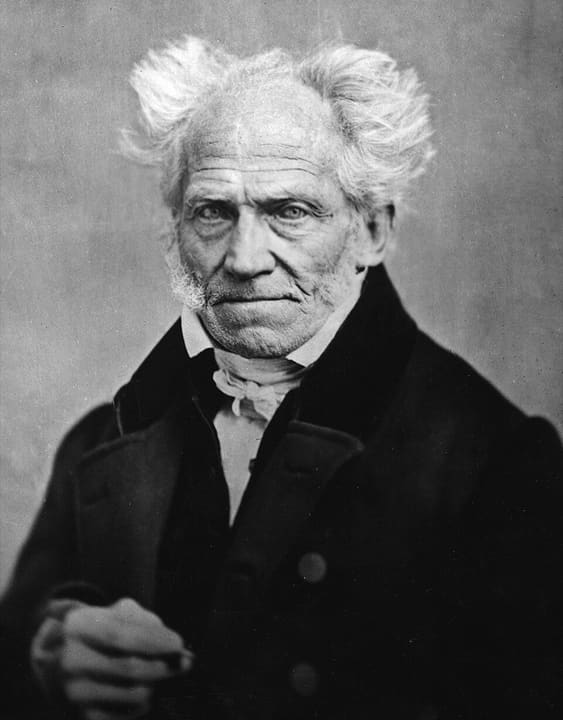
Arthur Schopenhauer (1788–1860) was born in Danzig to a wealthy merchant family; after his father's probable suicide in 1805 he abandoned commerce for philosophy, studying at Göttingen and Berlin. His doctoral dissertation On the Fourfold Root of the Principle of Sufficient Reason (1813) was followed by his major work in 1818. A brief, unsuccessful lectureship in Berlin, where he scheduled his lectures against Hegel's, ended his academic career, and he lived from 1833 as a private scholar in Frankfurt. Fame came only with the essays Parerga and Paralipomena (1851).
On the Fourfold Root of the Principle of Sufficient Reason (1813)
On the Will in Nature (1836)
The Two Fundamental Problems of Ethics (1841)
Parerga and Paralipomena (1851)
Frequently Cited
“The world is my idea:”—this is a truth which holds good for everything that lives and knows, though man alone can bring it into reflective and abstract consciousness”
Die Welt als Wille und Vorstellung, translated by Haldane and Kemp as The World as Will and Idea, is Arthur Schopenhauer's single, systematic statement of a philosophy that he claimed expressed one thought from four sides. It appeared in December 1818 (dated 1819) in four books with an appendix criticising Kant, and in 1844 he added a second volume of fifty supplementary chapters keyed to the first.
Essays and Aphorisms is the title of the selection translated by R. J. Hollingdale from Schopenhauer's Parerga and Paralipomena, the two volumes of 'appendices and omissions' he published in 1851 to make his system available to general readers. The book that resulted is the opposite of a treatise: short, sardonic, quotable pieces on suffering, death, religion, women, reading, noise, ethics and psychology, all resting on the metaphysics of his early masterpiece.