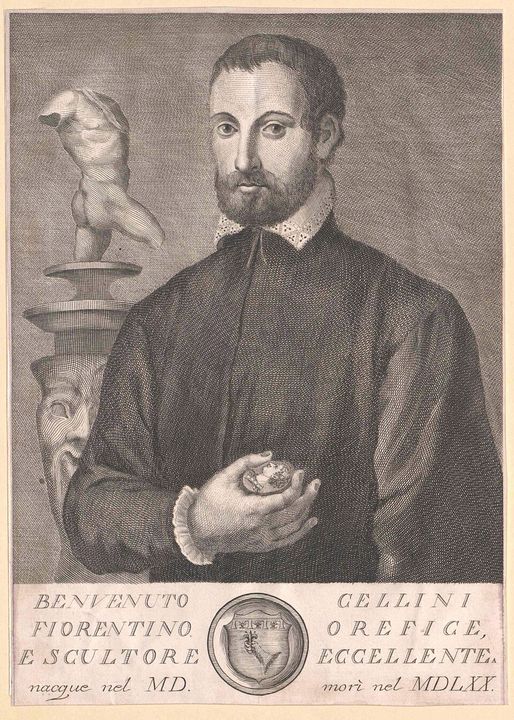
Benvenuto Cellini (1500-1571) was a Florentine goldsmith, sculptor, medallist and musician who worked for Popes Clement VII and Paul III, for King Francis I of France, and for Duke Cosimo I de' Medici. His surviving masterpieces include the gold salt-cellar made for Francis I, now in Vienna, the bronze Perseus with the Head of Medusa in the Loggia dei Lanzi in Florence, and a marble crucifix now in the Escorial. He also wrote treatises on goldsmithing and sculpture.
Frequently Cited
“ALL men of whatsoever quality they be, who have done anything of excellence, or which may properly resemble excellence, ought, if they are persons of truth and honesty, to describe their life with their own hand”
“My dear little boy, I am not striking you for any wrong that you have done, but only to make you remember that that lizard which you see in the fire is a salamander”
The Autobiography of Benvenuto Cellini is the life story of a Florentine goldsmith and sculptor, dictated in his late fifties and carried from his birth on All Saints' night in 1500 to 1562. It opens with Cellini's claim that anyone who has done excellent work and is honest should write his own life after forty, and with his ancestry and childhood: his father Giovanni, a musician and maker of instruments, wants him to be a flute-player, and once boxes his ears so that he will remember the salamander they have seen in the fire.