Work record
The Autobiography of Benvenuto Cellini
1558-1563 · Renaissance Early Modern · Memoir · Italian
Abstract
Background. Nearing sixty and in Florence, the goldsmith began to dictate his story to a young apprentice while he worked, intending to show posterity what he had attempted and against what odds.
Scope. The record moves from a Florentine childhood among musicians through Roman workshops, a famous siege and a papal dungeon to the French court and the Medici duchy, and stops abruptly in 1562.
Content. Readers meet popes haggling over a gold morse, a gunner on a fortress wall, conjurors in a ruined amphitheatre, a jailer who flaps like a bat, an escape on knotted bedding, a solar vision, a king's table ornament and a bronze hero rescued from a curdling furnace with kitchen plates.
Method. Told in quick, colloquial Tuscan, with dialogue, invective and boast, the narrative rarely pauses for reflection and frames every reversal as envy defeated or providence revealed.
Reliability. Some claims, such as the shot that felled Bourbon, cannot be confirmed, and enemies appear only as he saw them; yet patrons, commissions, prices and workshop procedures are often corroborated by documents and surviving objects in Florence, Vienna and Madrid.
Significance. Unpublished for over a century and a half, it became after 1728 a model of self-portraiture, a source for Renaissance workshop practice and patronage, and the basis of Goethe's translation and Berlioz's opera.
Key figures
- Benvenuto Cellini: Goldsmith, sculptor and narrator
- Giovanni Cellini: His father, a musician
- Michelangelo: The master he reveres
- Clement VII and Paul III: Popes who employed, pardoned and imprisoned him
- Francis I: French king, patron of the salt-cellar
- Cosimo I de' Medici: Duke of Florence, patron of the Perseus
- Baccio Bandinelli: Rival Florentine sculptor
- Ippolito d'Este: Cardinal of Ferrara, his rescuer and agent
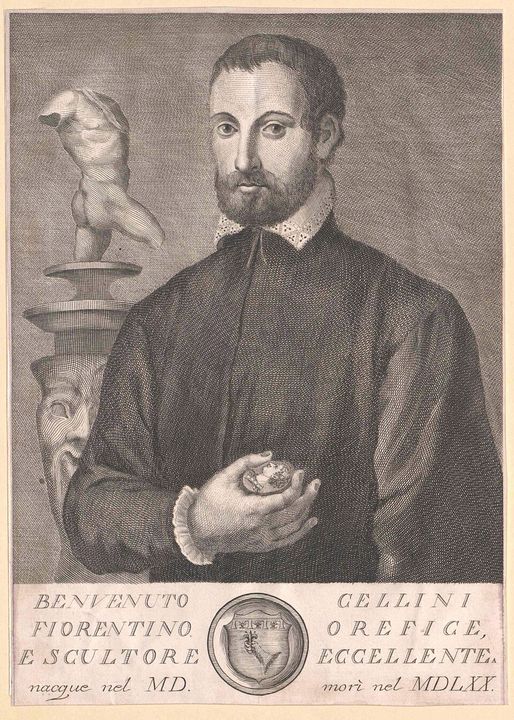

Summary
The Autobiography of Benvenuto Cellini is the life story of a Florentine goldsmith and sculptor, dictated in his late fifties and carried from his birth on All Saints' night in 1500 to 1562. It opens with Cellini's claim that anyone who has done excellent work and is honest should write his own life after forty, and with his ancestry and childhood: his father Giovanni, a musician and maker of instruments, wants him to be a flute-player, and once boxes his ears so that he will remember the salamander they have seen in the fire. Apprenticed to goldsmiths, the boy studies the cartoons of Michelangelo, whom he reveres all his life, and refuses to go to England with the sculptor Torrigiani after hearing him boast of breaking Michelangelo's nose. Book I follows him to Rome, where he makes jewels, medals and vessels for cardinals and for Pope Clement VII, survives the plague of 1523-24, and makes vases for the surgeon Giacomo da Carpi. In the Sack of Rome in 1527 he fights from the walls and from Castel Sant'Angelo, and claims to have shot the Constable of Bourbon and wounded the Prince of Orange. Quarrels, duels and killings follow, including the death of the Milanese jeweller Pompeo, and Cellini is pardoned more than once by Paul III. He joins a priest's necromantic conjuring in the Colosseum, catches and cures himself of the French disease with guaiac wood, and in 1538 is imprisoned in Castel Sant'Angelo on a charge of stealing papal jewels. He escapes down a rope of sheets, breaks his leg, is recaptured, reads the Bible in a dark dungeon, despairs to the point of trying to take his life, and receives a vision of the sun, Christ and the Madonna before an attempt to poison him with powdered diamond fails. Released through the Cardinal of Ferrara for the service of Francis I, he goes to France in Book II, works at Paris and Fontainebleau on the great gold salt-cellar and a colossal Jupiter, and quarrels with the king's mistress Madame d'Étampes. Returning to Florence in 1545, he takes service with Duke Cosimo I and undertakes the bronze Perseus. The casting, which he narrates in a celebrated chapter, is saved during a fever when he throws his household pewter into the furnace; the statue is unveiled in the Loggia in 1554 to public praise. The later chapters record his rivalry with the sculptor Baccio Bandinelli, disputes over pay, a farm bought from a man he accuses of poisoning him, the marble crucifix, and a break-off in 1562. Cellini dictated much of the work to a boy assistant, the manuscript circulated privately, and it was first printed in 1728; Goethe translated it into German, and the library text is John Addington Symonds's English translation of 1888.
Virtues in this work
- Industry: He builds his own furnace and labours through fever to cast the Perseus, feeding the fire and the channels with his own hands.
- Fortitude: With a broken leg after his escape from Castel Sant'Angelo he crawls through Rome on hands and knees seeking refuge.
- Faith: In the dark dungeon he reads the Bible from the beginning, sings the Miserere and trusts God for deliverance.
- Piety: When the mould of the Perseus is filled, he falls on his knees and gives thanks to God before eating or resting.
Plot or Argument
- Sonnet and Book I, Chapters I-XII: Ancestry and boyhood
An introductory sonnet thanks God for his life and regrets time spent in vanity. Cellini traces his family, his father's music and wish that he play the flute, the salamander in the fire, and his apprenticeship as a goldsmith in Florence, Siena, Bologna and Pisa.
- Book I, Chapters XIII-XXXIII: Florence and Rome under the Medici
He hears Torrigiani boast of breaking Michelangelo's nose, studies Michelangelo's cartoon, goes to Rome, works for cardinals and Clement VII, and lives through the plague, making vases for the surgeon Giacomo da Carpi.
- Book I, Chapters XXXIV-XLII: The Sack of Rome
In 1527 he fights on the walls and then in Castel Sant'Angelo as a gunner, claims the shots that killed Bourbon and wounded the Prince of Orange, and melts down papal gold for Clement during the siege.
- Book I, Chapters XLIII-LXXXVII: Medals, quarrels and conjuring
He makes the Pope's morse and coins, avenges his brother's death, kills Pompeo, is pardoned by Paul III, attends the necromancy in the Colosseum, cures himself of the French disease with guaiac wood, and makes a first journey to France.
- Book I, Chapters LXXXVIII-CXXVII: Prison in Castel Sant'Angelo
Accused of stealing jewels, he is imprisoned in 1538 under a castellan subject to yearly delusions, escapes by a rope of sheets and breaks his leg, is recaptured, reads the Bible in darkness, has a vision of the sun, survives powdered diamond, and is released at the Cardinal of Ferrara's request.
- Book II, Chapters I-L: In the service of Francis I
At Paris and Fontainebleau he lives in the Petit Nesle, completes the gold salt-cellar with figures of Sea and Earth, models the silver Jupiter and the Nymph of Fontainebleau, wins the king's favour, and loses ground through Madame d'Étampes and Primaticcio.
- Book II, Chapters LI-XCII: The Perseus
Back in Florence, Duke Cosimo commissions the Perseus. Cellini contends with Bandinelli and court officials, casts the figure in fever by throwing his pewter into the furnace, and unveils it in the Loggia to the crowd's applause.
- Book II, Chapters XCIII-CXIII: Later years in Florence
He records quarrels over payment, the farm bought from Sbietta and an attempted poisoning, the marble crucifix, his hopes of the Queen of France's service, and the Duke's journey on which Cardinal Giovanni de' Medici dies of fever, where the narrative breaks off in 1562.
Characters
- Benvenuto Cellini, author and narrator
Goldsmith and sculptor, boastful, quick to violence, devout in crisis, and a master storyteller.
- Giovanni Cellini, father
Musician and instrument-maker who wanted his son to play the flute.
- Michelangelo Buonarroti, revered master
Called the divine Michel Agnolo; Cellini's model and occasional encourager.
- Pope Clement VII, patron
Medici pope whom Cellini defended during the Sack of Rome and served with jewels and coins.
- Pope Paul III and Pier Luigi Farnese, patron and enemy
The Farnese pope who pardoned and later imprisoned Cellini, and his son, whom Cellini blames for his troubles.
- Francis I, patron
King of France who welcomed Cellini to Paris and commissioned the salt-cellar.
- Madame d'Étampes, adversary
The king's mistress, whose hostility Cellini blames for his difficulties in France.
- Cosimo I de' Medici, patron
Duke of Florence who commissioned the Perseus and was slow to pay.
- Baccio Bandinelli, rival
Florentine sculptor and Cellini's bitter competitor for ducal favour.
- Cardinal Ippolito d'Este (Cardinal of Ferrara), protector
Secured Cellini's release from prison and brought him to France.
Lessons
The discipline behind a masterpiece
The casting of the Perseus in Book II shows years of modelling, a furnace built to Cellini's design, the failure of the metal to flow, and his decision to throw two hundred pewter dishes into the channels. Great art here depends on technical knowledge, risk and stubborn labour as much as on genius.
- What goes wrong during the casting, and how does Cellini respond?
- Why does he describe his assistants and household so fully in that chapter?
- What does the Perseus episode suggest about the relation between talent and hard work?
Pride, honour and the price of anger
Cellini measures himself by honour and answers insults with the dagger, and he narrates his killings and quarrels without shame. The book also shows what this costs him: exile, flight, papal displeasure and the long imprisonment of 1538. Readers watch a gifted man repeatedly undone by his own temper.
- How does Cellini justify his quarrels, and do his explanations persuade you?
- Which of his troubles does he bring on himself, and which come from others' envy?
- Can great gifts excuse a violent temper?
Conversion in the dungeon
In the dark cell of Castel Sant'Angelo Cellini reads the Bible from the beginning, sings psalms, despairs, is held back from self-destruction, and sees a vision of Christ and the Madonna in the sun. He interprets his deliverance as grace, and the prison chapters are the most explicitly religious in the book.
- What does Cellini read and sing in prison, and how does it change him?
- How does he interpret the invisible power that stops him from harming himself?
- Does his later life show the change the prison chapters describe?
Patrons and artists
Popes, a king and a duke compete for Cellini's work, yet he must flatter, plead for payment and guard against courtiers and rivals. The book is a close record of how Renaissance art was commissioned, paid for and judged, and of how dependent the artist was on powerful favour.
- How does Francis I treat Cellini differently from Duke Cosimo?
- What role do rivals such as Bandinelli and Madame d'Étampes play in his career?
- Is an artist freer under a patron or in a market?
Context
Cellini's life spans the High Renaissance and the beginning of the Counter-Reformation: the Medici popes Leo X and Clement VII, the Sack of Rome by imperial troops in 1527, the siege of Florence in 1529-30, the Farnese papacy of Paul III, the court of Francis I at Fontainebleau, and the establishment of Cosimo I as Duke of Florence. Goldsmiths' workshops were training grounds for sculptors and painters, and artists depended on commissions from princes, cardinals and wealthy merchants. Street violence and private vengeance were common, and pardons were often granted to valued servants of the powerful.
Composition
Cellini began the Vita in Florence in 1558, at about fifty-eight, dictating much of it to a boy assistant in his workshop and writing parts himself; the narrative stops in 1562, and work on it ended in the 1560s, with dates given variously as 1562, 1563 or 1566. He showed the manuscript to the scholar Benedetto Varchi. It circulated in manuscript and was first printed at Naples in 1728 under a false Cologne imprint, edited by Antonio Cocchi. Goethe's German translation appeared in 1796-97, and John Addington Symonds's English translation in 1888.
Reception
Once printed, the book was admired for its vivid Tuscan speech and its picture of Renaissance life; Goethe translated it, and Hector Berlioz based his opera Benvenuto Cellini (1838) on it. Historians have long debated its reliability, since some boasts, such as killing Bourbon, cannot be confirmed, while many details of persons and commissions have been corroborated. It is regarded as one of the classic autobiographies and a primary source for the history of goldsmithing and bronze casting.
Comparisons
- vasari-lives-of-the-artists
Vasari, Cellini's Florentine contemporary at Cosimo's court, writes the lives of artists from outside and briefly includes Cellini; reading them together sets an artist's self-portrait beside the period's great collective biography of artists.
- the-prince
Machiavelli wrote for the Medici in the Florence of Cellini's boyhood; Cellini's popes, dukes and cardinals rule by the favour, fear and fortune that The Prince analyses.
- confessions
Augustine and Cellini both tell their lives as a story of God's providence, but Augustine confesses his sins, while Cellini, even in his prison conversion, more often defends his conduct.
- rousseaus-confessions
Both are self-portraits by men convinced of their uniqueness and wronged by enemies; Rousseau analyses his feelings, Cellini narrates deeds.
- essays-montaigne
Montaigne, writing two decades after Cellini, also makes himself his subject, but as a meditative essayist testing his opinions rather than a craftsman recording his triumphs.
Quotes
Frequently cited
“ALL men of whatsoever quality they be, who have done anything of excellence, or which may properly resemble excellence, ought, if they are persons of truth and honesty, to describe their life with their own hand”
Frequently cited
“My dear little boy, I am not striking you for any wrong that you have done, but only to make you remember that that lizard which you see in the fire is a salamander”
Frequently cited
“I felt such vigour fill my veins, that all those pains of fever, all those fears of death, were quite forgotten.”
“Only it grieves me when I understand What precious time in vanity I’ve spent”
“I was always gazing at the masterpieces of the divine Michel Agnolo”
“I BEGAN the Bible from the commencement, reading and reflecting on it so devoutly, and finding in it such deep treasures of delight, that, if I had been able, I should have done naught else but study it.”
“seeing my work finished, I fell upon my knees, and with all my heart gave thanks to God.”
For Students
A reading companion for classical Christian high school students. See the student guide.
Reading Guide
Watch for
- The opening sonnet and Chapter I, where Cellini explains why a man of excellence should write his own life.
- How Cellini speaks of Michelangelo, from the Torrigiani episode to later encounters in Book II.
- The Sack of Rome chapters and the claims he makes there about his own marksmanship.
- The prison chapters of Book I: the escape, the Bible, the despair and the vision of the sun.
- The casting of the Perseus in Book II, step by step, and the unveiling in the Loggia.
Key terms and names
- Goldsmith
- A worker in gold, silver and jewels; in Cellini's Florence the goldsmith's workshop was a school for many sculptors and painters.
- Lost-wax casting
- The method by which Cellini cast the Perseus: a wax model inside a clay mould is melted out and replaced with molten bronze.
- Sack of Rome
- The capture and plunder of Rome by the unpaid army of Emperor Charles V in May 1527, during which Cellini defended Castel Sant'Angelo.
- Castel Sant'Angelo
- The papal fortress on the Tiber where Cellini served as a gunner in 1527 and was imprisoned in 1538-39.
- Perseus with the Head of Medusa
- Cellini's bronze statue for Duke Cosimo I, unveiled in 1554 in the Loggia dei Lanzi in Florence.
- Salt-cellar of Francis I
- The gold and enamel table piece with reclining figures of Sea and Earth that Cellini completed in France.
- Patron
- A pope, prince or noble who commissioned and paid for works of art, on whose favour Cellini's career depended.
Seminar Questions
- Comprehension Why does Cellini's father box his ears when he is a small boy, and how does he make amends?
- Comprehension What does Cellini do during the Sack of Rome in 1527?
- Comprehension How does Cellini escape from Castel Sant'Angelo, and what happens after?
- Interpretation Why does Cellini tell the story of the Perseus casting as a drama of fever, explosion and prayer?
- Interpretation How sincere is the conversion Cellini describes in prison, judged by the rest of the book?
- Interpretation How does Cellini present his rivals, and what does that reveal about him?
- Big Question Should a reader admire the art of a man who boasts of violent deeds?
- Big Question Is it right, as Cellini claims, for a person who has done excellent work to tell his own story?
Faith Connections
- Exodus 31:1-5 (Scripture)
God fills Bezalel with skill to work in gold, silver and bronze for the tabernacle. Cellini, thanking God in his sonnet for the gifts that made his work possible, stands in the line of craftsmen whose skill Scripture calls a gift of the Spirit.
- Proverbs 16:18 (Scripture)
Cellini's boasts and quarrels repeatedly end in flight, exile and the cell in Castel Sant'Angelo, as the proverb on pride and destruction would predict; his own opening sonnet regrets time spent in vanity.
- Psalm 51 (Scripture)
Cellini sings the Miserere in the dungeon of Castel Sant'Angelo; David's psalm of repentance gives words to the most penitent stretch of his life.
- Augustine, Confessions VIII (Church Fathers)
Augustine's turning to Scripture in the garden is the classic Christian account of conversion; Cellini's reading of the Bible in the dark cell invites comparison, though his narrative soon returns to self-defence.
Logic and Rhetoric
Central argument: A man who has done excellent things and is honest has the right and duty to tell his own life. Cellini has made works admired by popes, kings and dukes, and has survived war, prison and poisoning by God's protection. Therefore his life, told in his own words, deserves to be known as proof of both his skill and God's favour.
Rhetorical device: hyperbole. Cellini repeatedly overstates his feats, as when he claims in Book I, Chapter XXXIV that one of his shots killed the Constable of Bourbon through the fog, and in Book II, Chapter LXXVII when he says he had brought the dead to life again in the furnace.
Debate: Resolved: that Cellini's Autobiography is more valuable as a record of Renaissance life than as a truthful account of Cellini himself.
Memory Work
seeing my work finished, I fell upon my knees, and with all my heart gave thanks to God.
Only it grieves me when I understand What precious time in vanity I’ve spent
Writing Prompts
Essay: Cellini presents himself as both a devout Christian and a man of the sword. Using the Sack of Rome, the prison chapters and the Perseus casting, argue how he reconciles these, or whether he does.
Comparison with Lives of the Most Eminent Painters, Sculptors and Architects (Volume 1): Compare how Vasari and Cellini describe Michelangelo, and explain what each writer's purpose leads him to emphasize.
Medical Lens
Cellini's book is a lay patient's record of sixteenth-century Italian medicine. He lives through plague in Rome and Florence, describes his dealings with the surgeon and anatomist Giacomo Berengario da Carpi, whose treatment of the French disease made his fortune, and reports his own syphilis: rose-coloured blisters appearing months after infection, physicians who would not name it, and his cure by the decoction of guaiac wood, the New World remedy then in fashion, with strict diet, against the advice of leading Roman doctors. The castellan of Castel Sant'Angelo suffers yearly fits in which he believes himself an oil-jar, a frog, a dead man or a bat; Cellini calls these hypochondriac notions in the older sense and records the doctors' use of distraction, a period example of what would later be called periodic psychosis, though any modern label is a reading. In prison Cellini despairs and tries to end his life before an invisible force throws him back, then sees visions of the sun, Christ and the Madonna; readers have interpreted these as religious experience, as effects of darkness and deprivation, or both. He describes the setting of his broken leg after the escape, an attempted poisoning with powdered diamond (which he believes was ground too coarsely, a period belief about diamond dust), a later suspected poisoning by sublimate, fever during the Perseus casting, and the malarial fever of the Maremma that kills Cardinal Giovanni de' Medici at the close.
- Book I, Chapters XXVII-XXX
Plague in Rome and Cellini's work for the surgeon Giacomo da Carpi, famous for treating the French disease.
- Book I, Chapter LIX
Cellini's own case of the French disease and his fifty-day cure by guaiac wood and abstinence.
- Book I, Chapter LXIV
The necromantic conjuring in the Colosseum and the terror of the participants.
- Book I, Chapter CVII
The castellan's yearly delusions that he is an oil-jar, a frog, dead, or a bat, and the doctors' attempts to distract him.
- Book I, Chapters CVIII-CIX
The escape down a rope of sheets, the broken leg and its treatment.
- Book I, Chapters CXVIII-CXXII
Despair in the dark dungeon, an attempt at self-destruction stopped by an unseen force, and the vision of the sun.
- Book I, Chapters CXXV-CXXVI
The plot to kill him with pounded diamond in his food and his examination of the powder.
- Book II, Chapters LXXV-LXXVII
Fever and expectation of death during the casting of the Perseus, followed by sudden recovery.
- Book II, Chapter CXIII
The bad air of the Sienese Maremma and the fatal fever of Cardinal Giovanni de' Medici.
Creative Prompts
- Classroom
Using the casting chapter of Book II, draw and label a cross-section of Cellini's furnace and mould, marking where the pewter went in and where the cap blew off.
- Dialogue
Write a conversation between Cellini and Vasari in Cosimo's palace in which each defends his account of the Perseus and of Bandinelli.
- Essay
Cellini claims to have shot the Constable of Bourbon. Weigh what he says against what he could have seen in the fog, and decide how far to trust his narration elsewhere.
- Fiction
Tell the night of the Perseus casting from the point of view of Cellini's housekeeper, who brings him a capon the next morning.
Further Reading
- The Lives of the Artists, Giorgio Vasari
- The Treatises of Benvenuto Cellini on Goldsmithing and Sculpture, Benvenuto Cellini, trans. C. R. Ashbee
Cellini's own technical treatises.
- The Civilization of the Renaissance in Italy, Jacob Burckhardt
- The Renaissance in Italy, John Addington Symonds
By the translator of the library text.
Verification notes
Episodes and chapter numbers (sonnet, salamander, Torrigiani, plague and Giacomo da Carpi, the Sack of Rome, the French disease and guaiac wood, the castellan's delusions, the escape, the Bible and vision, the diamond powder, the Perseus casting and unveiling, the sublimate suspected in Sbietta's household in Book II, Chapter CV, the final fever) were checked against the attached Gutenberg text, which reproduces the Harvard Classics edition of Symonds's translation with notes. Chapter ranges in plotOrArgument are approximate groupings. The manifest gives 1558-1563; the edition's introductory note says composition ran from 1558 to 1566, and scholars differ. Publication history (Naples 1728 with a false Cologne imprint, Cocchi as editor, Goethe's translation) and Berlioz's opera are standard facts not checked against a primary source. Quotes were checked against the attached text.
- End date of composition (1562, 1563 or 1566).
- Exact chapter numbers for the killing of Pompeo and the avenging of Cellini's brother.
- Book I has 127 numbered chapters in the library text; some editions number 128.