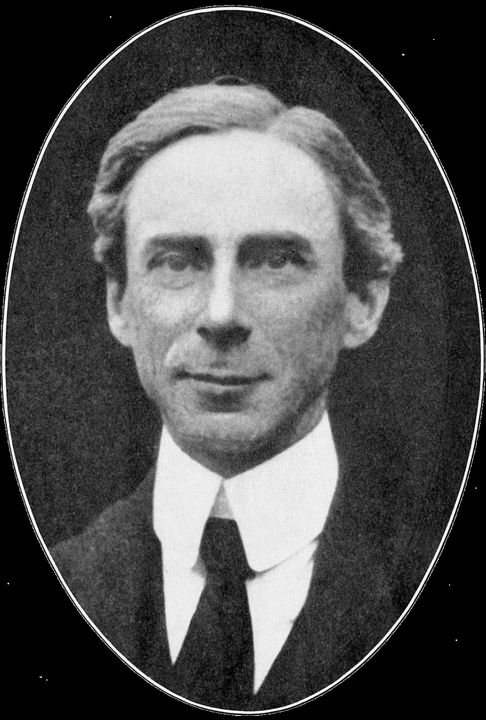
Bertrand Arthur William Russell (1872–1970), later third Earl Russell, was born in Monmouthshire into a leading Whig family; his grandfather Lord John Russell had twice been prime minister. He studied mathematics and philosophy at Trinity College, Cambridge, and with Alfred North Whitehead wrote Principia Mathematica (1910–13), an attempt to derive mathematics from logic. A pacifist during the First World War, he lost his Trinity lectureship and was imprisoned in 1918. He wrote widely on philosophy, education, politics and religion, received the Nobel Prize in Literature in 1950, and died in Wales in 1970.
Frequently Cited
“Is there any knowledge in the world which is so certain that no reasonable man could doubt it?”
“The man who has fed the chicken every day throughout its life at last wrings its neck instead, showing that more refined views as to the uniformity of nature would have been useful to the chicken.”
“The man who has no tincture of philosophy goes through life imprisoned in the prejudices derived from common sense, from the habitual beliefs of his age or his nation, and from convictions which have grown up in his mind without the co-operation or consent of his deliberate reason.”
“Philosophy is to be studied, not for the sake of any definite answers to its questions, since no definite answers can, as a rule, be known to be true, but rather for the sake of the questions themselves”
The Problems of Philosophy is a short introduction to philosophy, chiefly to the theory of knowledge, written for a general reader. Russell opens by asking whether there is any knowledge so certain that no reasonable person could doubt it, and the fifteen chapters work toward a qualified answer.