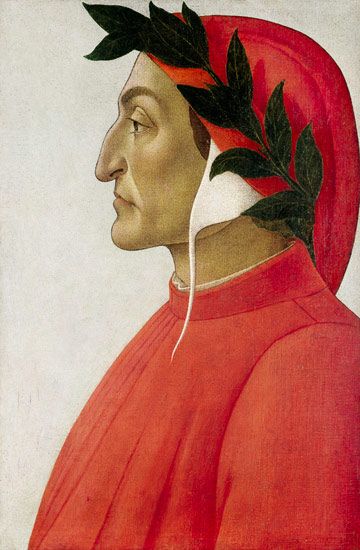
Dante Alighieri, painted by Sandro Botticelli (1495). Source · Public domain
About Dante Alighieri; R. W. Church
Dante Alighieri (1265–1321) was born in Florence, where he wrote the Vita Nuova in praise of Beatrice, studied philosophy, served as a cavalryman at Campaldino (1289) and held office as one of the city's priors in 1300. As a White Guelf he was condemned and exiled in 1302 and spent the rest of his life in other Italian cities, including Verona and Ravenna, where he died. In exile he wrote the Convivio, De vulgari eloquentia, De Monarchia, letters supporting the Emperor Henry VII's descent into Italy (1310–1313), and the Divine Comedy. Richard William Church (1815–1890), author of the essay that opens this volume, was a Fellow of Oriel College, Oxford, a friend of John Henry Newman during the Oxford Movement, and Dean of St Paul's from 1871 until his death; his son Frederick John Church made the translation of De Monarchia.
De Monarchia is Dante's Latin treatise on universal temporal government, written in exile and generally dated between Henry VII's expedition into Italy (1310-1313) and the years when Dante was finishing the Paradiso. In three books it asks three questions: whether a single temporal monarchy is necessary for the well-being of the world, whether the Roman people acquired the office of empire by right, and whether the emperor's authority comes directly from God or through the pope.