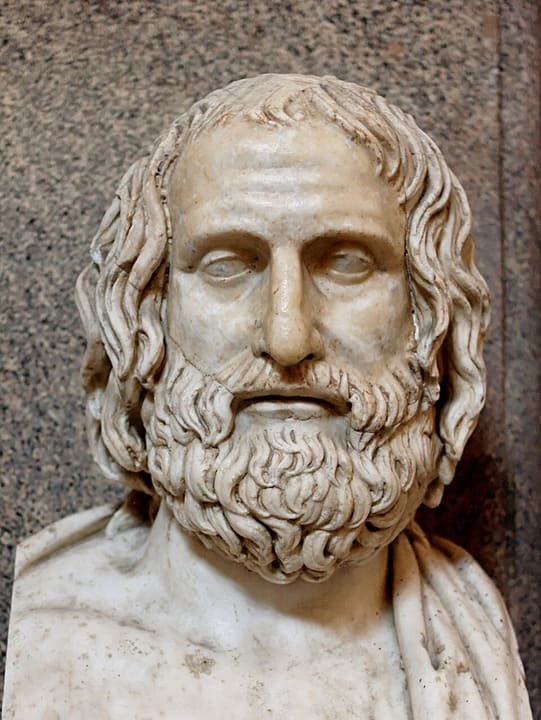
Euripides (c. 480–406 BCE) was the youngest of the three major Athenian tragedians. Ancient critics often found him unsettling because his plays give sharp voices to women, slaves, foreigners and skeptics of heroic ideology. His surviving works show intense interest in rhetoric, emotion, social outsiders and the destructive intelligence of wounded people.
“But when the laws are written down, rich and poor alike have equal justice, and it is open to the weaker to use the same language to the prosperous when he is reviled by him, and the weaker prevails over the stronger if he have justice on his side.”
“How are ye blind, Ye treaders down of cities, ye that cast Temples to desolation, and lay waste Tombs, the untrodden sanctuaries where lie The ancient dead; yourselves so soon to die!”
“thou high Throne Above the World, whoe'er thou art, unknown And hard of surmise, Chain of Things that be, Or Reason of our Reason; God, to thee I lift my praise”
Medea and Other Plays centers on Euripides’ art of making the socially powerless terrifyingly articulate. Medea begins after Jason has abandoned his foreign wife and children to marry the Corinthian princess.
This volume gathers three Euripides plays about what the Trojan War left behind: The Trojan Women and Iphigenia in Tauris in Gilbert Murray's rhyming verse, and Hecuba in Michael Wodhull's blank verse of 1782. The Trojan Women opens on the smoking ruins of Troy.
This volume completes the library's surviving plays of Euripides with eleven works in Edward P. Coleridge's prose translation of 1891. Iphigenia in Aulis, produced after the poet's death in 405 BC, opens at night on the shore of Aulis, where the Greek fleet is held back by windless weather.
The Bacchae and Other Plays presents Euripides at his most dangerous: gods are real, but that does not make them gentle. The Bacchae begins when Dionysus arrives at Thebes in disguise to punish the royal house for denying his divinity and slandering his mother Semele.