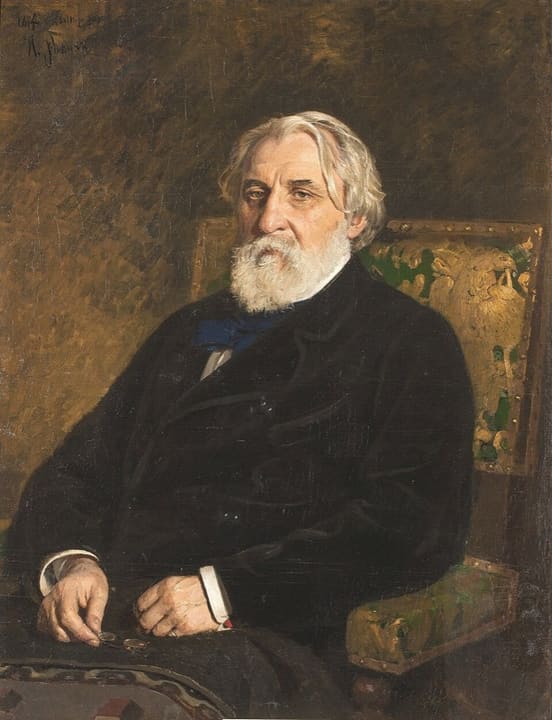
Ivan Turgenev (1818–1883) was a Russian novelist, playwright and story writer from a wealthy landowning family in Oryol province, whose tyrannical mother owned thousands of serfs. His A Sportsman's Sketches (1852) was credited with influencing opinion against serfdom. Living much of his later life in Germany and France, close to the singer Pauline Viardot, he was the first Russian writer widely read in the West and a friend of Flaubert and Henry James.
“A nihilist is a man who does not bow down before any authority, who does not take any principle on faith, whatever reverence that principle may be enshrined in.”
Fathers and Sons is set in the Russian countryside in the spring and summer of 1859, two years before the emancipation of the serfs. Arkady Kirsanov, a newly graduated student, returns to his father's modest, poorly run estate, Maryino, bringing his friend and mentor Yevgeny Bazarov, a brusque, brilliant medical student of humble origins who calls himself a nihilist: he accepts no principle on authority and values only what is useful, especially natural science.