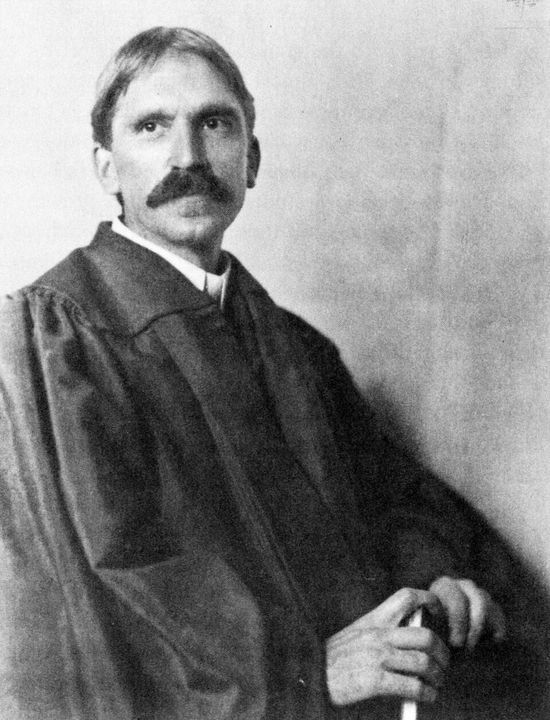
John Dewey (1859–1952) was an American philosopher and educator born in Burlington, Vermont. After graduating from the University of Vermont and taking a doctorate at Johns Hopkins, he taught at Michigan and at the University of Chicago, where in 1896 he founded the Laboratory School to test his ideas about learning. From 1904 he taught at Columbia University in New York. A leading figure of American pragmatism with William James and Charles Sanders Peirce, he wrote The School and Society (1899), Democracy and Education (1916), Experience and Nature (1925), Art as Experience (1934) and A Common Faith (1934), and was active in many public causes until his death in New York in 1952.
Frequently Cited
“The belief that all genuine education comes about through experience does not mean that all experiences are genuinely or equally educative.”
Experience and Education is a short book of eight chapters in which John Dewey, then nearly eighty, restates his philosophy of education and answers both its opponents and some of its followers. By the 1930s progressive education, often associated with Dewey's name, had become a broad movement in American schools, and critics charged it with neglecting knowledge, discipline and the inherited wisdom of the past.