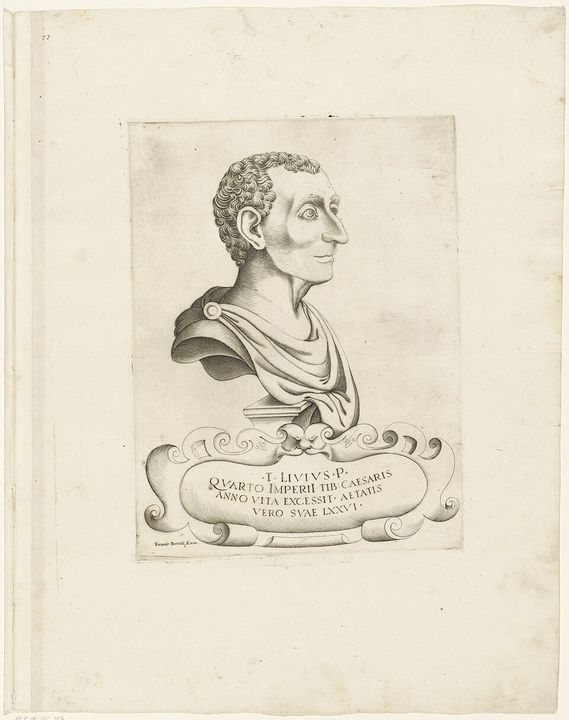
Livy as imagined in a sixteenth-century engraving. Source · CC0
About Livy (Titus Livius)
Titus Livius (c. 59 BC-AD 17) was born at Patavium (modern Padua) in northern Italy and spent most of his working life in Rome under Augustus. He held no public office and is not known to have commanded troops; he devoted some forty years to a single history of Rome, Ab Urbe Condita, in 142 books, of which 35 survive. Tacitus records that Augustus teased him as a Pompeian for his warm praise of the republican past, and Suetonius says he encouraged the young Claudius to write history.
Frequently Cited
“This it is which is particularly salutary and profitable in the study of history, that you behold instances of every variety of conduct displayed on a conspicuous monument”
Books I-V are the first pentad of Livy's vast history of Rome from its foundation, carrying the story from the arrival of Aeneas in Italy to the recovery of the city after the Gallic sack of about 390 BC. Livy opens with a preface that admits the earliest traditions are closer to poetry than to record, and then states his purpose: history sets before the reader examples of every kind of conduct, to be imitated or avoided, and Rome, he believes, was richer in good examples than any other state until luxury and avarice came late.