Work record
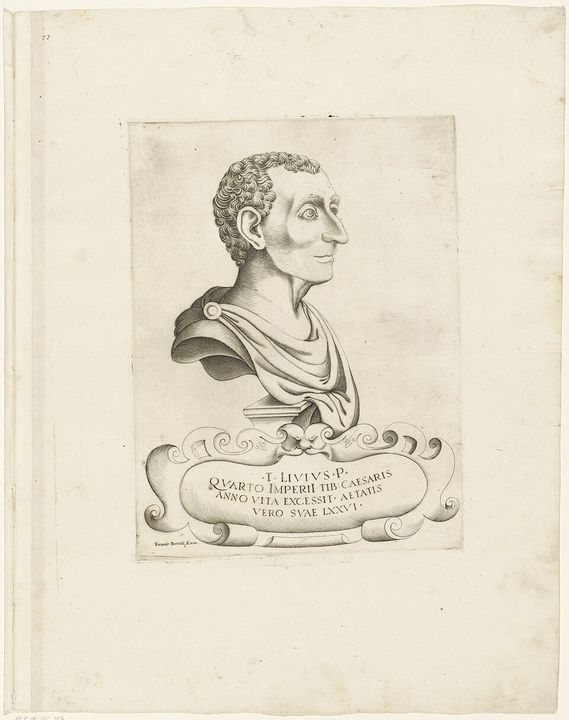
The History of Rome, Books I-V
c. 27-9 BC · Ancient · History · Latin
Abstract
Background. A native of Padua writing in Rome soon after Actium, Livy began a year-by-year history of the city that would fill 142 books. The opening pentad drew on older annalists and on family and religious tradition.
Scope. These books span roughly four centuries of tradition: the seven kings, the founding of consular government in 509 BC, and the first hundred and twenty years of the Republic down to the Gallic catastrophe. The preface, one of the most quoted in ancient historiography, frames the whole as a study of rising and declining manners.
Content. Episodes include the twins and the wolf, the Sabine women, the duel of the Horatii, Lucretia's death and Brutus's revolt, Mucius before Porsena, the first secession, Cincinnatus at his plough, the Twelve Tables and Verginia, the capture of Veii, and Camillus driving the Gauls from a ransomed city.
Method. Livy admits that his oldest material is legend and often reports variant versions without choosing. He composes speeches for leaders of both orders and frames events as moral exempla, attending closely to omens, vows and rites. Spillan's 1853 rendering keeps close to the Latin word order, which makes it slow going but faithful.
Significance. These books fixed the Western image of early Rome. Augustine argued with them, Machiavelli wrote his Discourses on them, and painters and republican statesmen took Lucretia, Brutus and Cincinnatus as lasting emblems.
Key figures
- Romulus: Legendary founder and first king of Rome
- Numa Pompilius: Second king, founder of Roman religious institutions
- Lucretia: Roman matron whose death ends the monarchy
- Lucius Junius Brutus: Expels the Tarquins and becomes one of the first consuls
- Cincinnatus: Farmer-dictator who saves an army and resigns
- Verginia: Plebeian girl whose death topples the decemvirs
- Camillus: Conqueror of Veii and restorer of Rome after the Gauls
- Brennus: Gallic leader who besieges the Capitol

Summary
Books I-V are the first pentad of Livy's vast history of Rome from its foundation, carrying the story from the arrival of Aeneas in Italy to the recovery of the city after the Gallic sack of about 390 BC. Livy opens with a preface that admits the earliest traditions are closer to poetry than to record, and then states his purpose: history sets before the reader examples of every kind of conduct, to be imitated or avoided, and Rome, he believes, was richer in good examples than any other state until luxury and avarice came late. Book I tells of the twins Romulus and Remus, nursed by a she-wolf, the founding of the city, the rape of the Sabine women and their intervention between their fathers and husbands, the religious institutions of Numa, the combat of the Horatii and Curiatii, the reforms of Servius Tullius, and the tyranny of Tarquin the Proud. It closes with the rape of Lucretia by Sextus Tarquin, her death by her own hand before her husband and father, and the oath of Lucius Junius Brutus to drive out the kings. Book II follows the young Republic: Brutus condemns his own sons for conspiring to restore the Tarquins, Horatius Cocles holds the bridge, Mucius Scaevola thrusts his hand into the fire before Porsena, the plebeians secede and are won back by Menenius Agrippa's fable of the belly and the limbs, and Coriolanus turns back from Rome at his mother's plea. Book III centres on Cincinnatus, summoned from his four-acre farm to be dictator and laying down the office on the sixteenth day, and on the decemvirs who wrote the Twelve Tables until Appius Claudius's attempt on Verginia provoked her father to kill her rather than see her enslaved. Book IV treats the struggle over intermarriage and the consulship, the killing of Spurius Maelius, wars with Veii and Fidenae, and repeated pestilence and famine. Book V narrates the ten-year siege and capture of Veii under Camillus, his exile, the disaster at the Allia, the Gauls' occupation of the city, the geese that woke the defenders of the Capitol, Brennus's cry over the ransom gold, and Camillus's speech persuading the Romans to rebuild rather than migrate to Veii. The library text is D. Spillan's literal prose translation of 1853 (Bohn's Classical Library), Books I-V only.
Virtues in this work
- Fortitude: Mucius holds his right hand in Porsena's altar fire in Book II to show that Romans can suffer as bravely as they act.
- Humility: Cincinnatus in Book III accepts the dictatorship from his small farm and returns to it after sixteen days.
- Piety: Camillus in Book V argues that Rome cannot be moved to Veii because its gods, rites and auspices belong to its own ground.
- Justice: Brutus in Book II sits in judgment on his own sons for plotting to restore the Tarquins and does not spare them.
Plot or Argument
- Preface
Livy asks whether the labour is worthwhile, grants that the earliest tales are poetic rather than documentary, and sets out his moral method: watch how Rome's manners were formed, how discipline declined, and choose examples to follow or shun.
- Book I: Kings (traditional 753-509 BC)
Aeneas and Alba Longa; Romulus and Remus; the founding and the Sabine women; Numa's religion; Tullus Hostilius and the Horatii; Ancus Marcius; Tarquinius Priscus; Servius Tullius and the census; Tarquin the Proud; Lucretia and the expulsion of the kings.
- Book II: The early Republic
The first consuls; Brutus executes his sons; the war with Porsena, Horatius Cocles, Mucius and Cloelia; Lake Regillus; the first secession of the plebs and the tribunate; Coriolanus and Veturia; the Fabii at the Cremera.
- Book III: Cincinnatus and the decemvirs
Plague and Aequian wars; Cincinnatus called from the plough; the ten men and the Twelve Tables; Appius Claudius and Verginia; the second secession and the restoration of consuls and tribunes.
- Book IV: Orders in contest
The Canuleian law on intermarriage; military tribunes with consular power and the new censorship; Spurius Maelius and Servilius Ahala; Cossus and the spolia opima; Veii and Fidenae; pestilence and scarcity.
- Book V: Veii, the Gauls and Camillus
The long siege and fall of Veii; the evocation of Juno; Camillus's exile; the Allia and the sack of Rome; the Capitol saved; the ransom interrupted; Camillus's speech against leaving the city for Veii.
Characters
- Romulus, Founder and first king
Son of Rhea Silvia, raised with Remus by a shepherd; founds the city, kills his brother, and is said to be taken up into heaven.
- Numa Pompilius, Second king
Sabine lawgiver who gives Rome its priesthoods, calendar and the temple of Janus, closed in peace.
- Lucretia, Wife of Collatinus
Violated by Sextus Tarquin; she calls her kin to swear vengeance and kills herself, an act that ends the monarchy.
- Lucius Junius Brutus, Liberator and first consul
Leads the expulsion of Tarquin the Proud and later presides over the execution of his own sons for treason.
- Caius Mucius (Scaevola), Young Roman assassin
Captured in Porsena's camp, he burns his right hand in the altar fire to show Roman resolve.
- Menenius Agrippa, Envoy to the plebs
Wins the seceding plebeians back with a fable comparing the state to a body whose limbs starve the belly.
- Lucius Quintius Cincinnatus, Dictator in 458 BC
Called from his small farm, he rescues a trapped army and resigns his dictatorship on the sixteenth day.
- Appius Claudius, Decemvir
Leader of the second decemvirate whose attempt to seize Verginia brings down the board of ten.
- Marcus Furius Camillus, Dictator and general
Takes Veii, is exiled, returns to drive off the Gauls, and persuades Rome to rebuild on its own site.
- Brennus, Chieftain of the Gauls
Besieges the Capitol and throws his sword onto the scales when the Romans protest the false weights.
Lessons
History as a gallery of examples
Livy's preface makes history a school of conduct: the reader looks at Lucretia, Brutus, Cincinnatus and Camillus and decides what to imitate and what to avoid. He is frank that the earliest stories are legend, yet he thinks their moral force does not depend on precise fact.
- Can a story be useful as an example even if the historian admits it may be legend?
- Which figure in Books I-V would Livy most want a young Roman to imitate, and why?
- Does choosing examples to imitate make a historian less trustworthy about facts?
Public duty and private loss
Brutus watches his sons executed, Verginius kills his daughter to keep her from Appius, and Horatius kills his sister for mourning an enemy. Livy records these as hard cases where the claims of the city press against family, and he shows Romans arguing over them, as in the trial of Horatius.
- Why does Livy have the people pardon Horatius rather than simply praise or condemn him?
- What does Brutus's face at his sons' execution tell us about how Livy wants the scene read?
Power laid down
Cincinnatus leaves his plough, saves the army and returns home within sixteen days, while the decemvirs refuse to lay down power and fall. Livy measures leaders by their willingness to give back authority once its purpose is served.
- What makes Cincinnatus's resignation more memorable than his victory?
- How do the decemvirs show the danger of power without a term?
- Why did later republics, including the early United States, admire Cincinnatus?
Concord between the orders
Much of Books II-IV is the struggle between patricians and plebeians over debt, office and marriage. Livy gives both sides speeches and shows Rome surviving through compromises such as the tribunate and the Canuleian law, with Menenius's fable as the emblem of mutual dependence.
- What does the fable of the belly argue, and what does it leave out from the plebeians' point of view?
- Which compromise in these books seems to Livy most important for Rome's survival?
Context
Livy wrote after a century of civil wars had ended with Octavian's victory at Actium (31 BC) and his settlement as Augustus (27 BC). Augustus was promoting the restoration of temples, old religious rites and traditional morals, and Livy's portrait of early Roman piety, frugality and discipline answered the same longing for recovery, though he wrote as a private man rather than a court historian.
Composition
The first pentad is usually dated between 27 and 25 BC, since Book I calls Octavian Augustus and mentions the closing of the temple of Janus after Actium but not the second closing of 25 BC. Livy worked from earlier Roman annalists such as Fabius Pictor, Valerius Antias and Licinius Macer, whom he names and sometimes doubts, rather than from documents. He continued writing until near his death, reaching 9 BC in Book 142.
Reception
Livy was read throughout antiquity and the Middle Ages; Dante called him the Livy who does not err. Petrarch collected his manuscripts, and Machiavelli built his Discourses on the first ten books. His stories of Lucretia, Horatius, Mucius, Cincinnatus and Camillus supplied painters, dramatists and political writers for centuries, and the American founders admired Cincinnatus as a model for Washington. Spillan's 1853 translation for Bohn's Classical Library was one of the standard English cribs of the Victorian period.
Comparisons
- plutarch-lives
Plutarch's lives of Romulus, Numa, Publicola, Coriolanus and Camillus retell the same legends as Books I-V, but arrange them as paired moral biographies rather than a year-by-year history.
- machiavelli-discourses-on-livy
Machiavelli takes Livy's first decade as his text, drawing political lessons from Brutus's sons, the tribunes, the decemvirs and Camillus that Livy told as moral examples.
- the-aeneid
Written in the same Augustan years, Virgil's epic and Livy's prose both treat Aeneas and Rome's founding as a story of piety and destiny after civil war.
- polybius-histories-book-vi
Polybius explains Rome's success by its mixed constitution; Livy shows the same consuls, senate and tribunes being built through the quarrels of Books II-IV.
- city-of-god
Augustine, in Books I-III, reads Lucretia, Brutus and the Gallic sack from Livy and asks whether Roman glory was true virtue, writing after the Gothic sack of 410.
- sallust-catiline-and-jugurtha
Sallust, a generation earlier, shares Livy's theme that wealth and ambition corrupted Roman manners, but writes about his own century rather than the distant origins.
Quotes
Frequently cited
“This it is which is particularly salutary and profitable in the study of history, that you behold instances of every variety of conduct displayed on a conspicuous monument”
Frequently cited
“when we can neither endure our vices, nor their remedies”
Frequently cited
“Both to act and to suffer with fortitude is a Roman's part.”
Frequently cited
“Woe to the vanquished!”
“But the body only has been violated, the mind is guiltless; death shall be my witness.”
“Thence it became apparent that the service of the belly was by no means a slothful one; that it did not so much receive nourishment as supply it”
“It is worth those persons' while to listen, who despise all things human in comparison with riches”
“to recover their country with steel, not with gold”
For Students
A reading companion for classical Christian high school students. See the student guide.
Reading Guide
Watch for
- The preface, where Livy admits the founding legends are poetic and still claims they teach; keep his purpose in mind at every famous episode.
- The paired scenes of private violation and public revolution: Lucretia in Book I and Verginia in Book III each bring down a government.
- Speeches given to both patricians and plebeians in Books II-IV; notice how Livy lets each side argue its case.
- Religious detail: auspices, vows, prodigies, the evocation of Juno from Veii, and the sacred geese. Livy treats neglect of the gods as a cause of disaster.
- Camillus's long speech at the end of Book V against moving to Veii, which gathers the whole pentad's themes of place, piety and continuity.
Key terms and names
- Exemplum
- A model of conduct drawn from the past. Livy's preface says history's use is to set such examples before the reader to imitate or avoid.
- Patricians and plebeians
- The two orders of early Roman citizens. Their quarrels over debt, land, office and intermarriage drive much of Books II-IV.
- Tribune of the plebs
- An office created after the first secession (Book II) to protect plebeians against magistrates; its holders were sacrosanct.
- Dictator
- An emergency magistrate with supreme power for at most six months. Cincinnatus and Camillus hold the office and give it up.
- Decemvirs
- The board of ten who drew up the Twelve Tables of law in 451-450 BC; the second board's abuse of power ends with Verginia's death.
- Spolia opima
- Spoils taken by a Roman commander who killed the enemy commander in single combat, dedicated to Jupiter Feretrius; Romulus and Cossus win them.
- Lectisternium
- A rite in which couches and food were set before images of the gods; Livy records the first at Rome in 399 BC during a pestilence.
Seminar Questions
- Comprehension In the preface, what two uses of history does Livy name, and how does he describe the state of Rome in his own day?
- Comprehension What happens at Collatia and Rome after Sextus Tarquin's crime, and what oath does Brutus swear over Lucretia's body?
- Comprehension How is Cincinnatus found by the senate's envoys, what does he accomplish, and when does he lay down the dictatorship?
- Interpretation Lucretia says her mind is guiltless yet refuses to excuse herself from punishment. What does she fear would follow if she lived, and why does Livy make her death the start of the Republic?
- Interpretation Menenius Agrippa's fable persuades the plebs to return. Is it a fair argument, a clever evasion, or both, and what do the tribunes created afterward suggest about Livy's view?
- Interpretation Why does Livy give Camillus such a long speech against leaving Rome for Veii, and what does it say about the relation between a people, its gods and its land?
- Big Question Livy believes a nation's history should form its citizens' character. Should the stories a people tells about its founding be judged chiefly by their accuracy, by their moral power, or by both?
Faith Connections
- Augustine, City of God I.19 (Church Fathers)
Augustine takes Livy's account of Lucretia and argues that if her mind was innocent she should not have punished herself, so her death came from Roman love of honour rather than guilt. It is the classic Christian response to one of Livy's central examples.
- Proverbs 14:34 (Scripture)
Righteousness exalts a nation, but sin is a reproach to any people. Livy's preface makes a similar claim about Rome's rise through frugality and its decline through avarice, though he grounds it in Roman custom and the favour of the gods.
- 1 Corinthians 12:12-26 (Scripture)
Paul's image of the church as one body whose members cannot say to one another I have no need of you sets beside Menenius Agrippa's fable of the belly and limbs in Book II, ch. 32; both use the body to teach mutual dependence, Paul adding special honour for the weaker members.
- Augustine, City of God V.18 (Great Conversation)
Augustine lists Brutus, Mucius, Camillus and others from Livy as Romans who sacrificed much for earthly glory, and urges Christians not to boast when they endure things for the heavenly city.
Logic and Rhetoric
Central argument: History sets before the reader examples of every kind of conduct; Rome was richer in good examples and slower to admit luxury and avarice than any other state; its rise came from piety, frugality, discipline and concord, and its present troubles from their decline; therefore the study of early Rome is the best training for citizens who would choose what to imitate and what to avoid.
Rhetorical device: fable (apologue). In Book II, ch. 32, Menenius Agrippa persuades angry plebeians not by argument but by a short story of limbs that conspire against the belly and starve themselves, a speech Livy says was told in an old and rough style.
Debate: Resolved: Cincinnatus's resignation of the dictatorship was a greater service to Rome than his victory over the Aequi.
Memory Work
Both to act and to suffer with fortitude is a Roman's part.
This it is which is particularly salutary and profitable in the study of history, that you behold instances of every variety of conduct displayed on a conspicuous monument
Writing Prompts
Essay: Livy places a woman's violation at the turning point of Book I and again in Book III. Compare the stories of Lucretia and Verginia and argue what Livy means to show about the connection between private honour and political liberty.
Comparison with Lives of the Noble Grecians and Romans: Read Plutarch's Life of Camillus alongside Book V. Compare how each writer presents Camillus's exile and return, and argue whether the biographer or the historian gives the more convincing account of his character.
Medical Lens
Livy is not a medical writer, but Books I-V record a recurring pattern of pestilence and famine in early Rome and the religious responses to them. Plague is reported under Tullus Hostilius and again and again in Books III-V; the Romans respond with vows, a temple to Apollo for the people's health (433 BC, Book IV) and, in 399 BC, the first lectisternium, a banquet set before images of the gods (Book V, ch. 13). These passages show disease understood as a public and religious event, with no physicians in view. Menenius Agrippa's fable (Book II, ch. 32) uses the physiology of its time, in which the belly perfects food into blood that is distributed through the veins, to argue for civic concord; it is an early instance of the body-politic metaphor. Lucretia's death (Book I, ch. 58) has been discussed for two millennia as a question of honour, guilt and suicide; Augustine's critique in City of God I is the classic Christian reading. The Gauls' sickness in the burnt and unburied city (Book V, ch. 48) is an early account of disease following siege. Any modern identification of these plagues is speculation.
- Book I, ch. 31
A pestilence strikes under Tullus Hostilius, and the warlike king, himself falling ill, turns anxiously to neglected rites.
- Book I, ch. 58
Lucretia distinguishes the violated body from the guiltless mind and kills herself before her kin.
- Book II, ch. 32
Menenius Agrippa's fable of the limbs that starve the belly, with its account of food made into blood for the veins.
- Book III, chs. 6-8 and 32
Pestilence kills consuls, augurs and much of the people while the Aequi and Volsci press on the city; later plague and famine come together.
- Book IV, ch. 25; Book V, ch. 13
A temple vowed to Apollo for the health of the people, and the first lectisternium held to end an intractable pestilence.
- Book V, ch. 48
Disease among the Gauls camped in the ruined city amid ashes and unburied dead during the siege of the Capitol.
Creative Prompts
- Dialogue
Write the conversation on the Sacred Mount after Menenius Agrippa finishes his fable, in which a plebeian debtor answers him with a fable of his own.
- Classroom
Assign each student one exemplary figure (Lucretia, Brutus, Horatius, Mucius, Cloelia, Cincinnatus, Verginius, Camillus) to present as Livy would, then as a critic like Augustine would.
- Essay
Livy says Rome was the last state into which luxury and avarice entered. Trace that claim through Cincinnatus in Book III and Camillus in Book V.
Further Reading
- The Early History of Rome (Books I-V), Livy, trans. Aubrey de Sélincourt
A widely read modern translation of the same five books.
- Rome and the Mediterranean (Books XXXI-XLV), Livy
- A Commentary on Livy, Books 1-5, R. M. Ogilvie
The standard English commentary.
- The Beginnings of Rome, T. J. Cornell
- Discourses on Livy, Niccolò Machiavelli
Verification notes
All eight quotations were found by search in the stored Spillan text (content/texts/livy-history-of-rome-books-i-v.txt) and copied exactly; book and chapter numbers follow that text's numbered sections. The outline follows the standard contents of Books I-V. Livy's dates (59 BC-AD 17) are traditional; some scholars prefer 64 BC for his birth. The dating of the first pentad to c. 27-25 BC rests on internal evidence in Book I and is the usual view. Traditional Roman dates (753 BC founding, 509 BC Republic, 390 BC sack, which Greek reckoning puts at 387/386) are Livy's or Varro's, not secure history.
- The Dante reference (Inferno XXVIII, 'Livio che non erra') should be checked against the canto before it is quoted.
- Spillan's first name is usually given as Daniel; confirm against the Bohn title page.