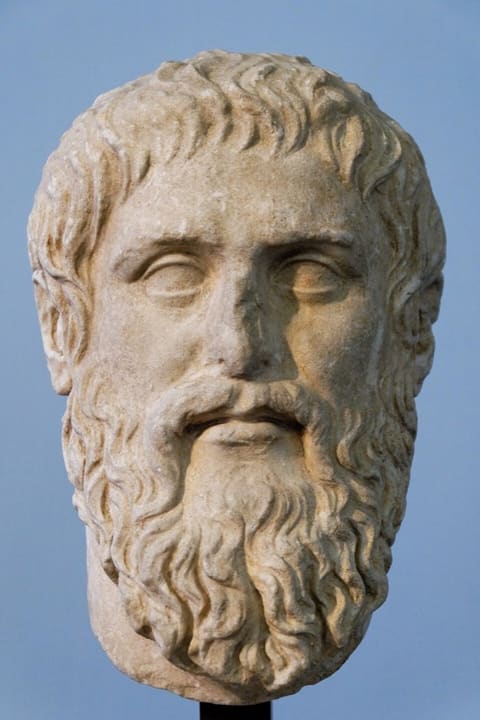
Plato (c. 428/427–348/347 BCE) was an Athenian aristocrat who became the devoted follower of Socrates. After Socrates' execution in 399 BCE he travelled, then founded the Academy in Athens, where Aristotle studied. His dialogues, almost all featuring Socrates, laid the foundations of Western philosophy in ethics, politics, metaphysics and the theory of knowledge.
“Can you tell me, Socrates, whether virtue is acquired by teaching or by practice; or if neither by teaching nor by practice, then whether it comes to man by nature, or in what other way?”
“you seem to me both in your appearance and in your power over others to be very like the flat torpedo fish, who torpifies those who come near him and touch him”
“You argue that a man cannot enquire either about that which he knows, or about that which he does not know; for if he knows, he has no need to enquire; and if not, he cannot; for he does not know the very subject about which he is to enquire”
“But the law is always striving to make one;--like an obstinate and ignorant tyrant, who will not allow anything to be done contrary to his appointment, or any question to be asked”
“never to allow temperate natures to be separated from the brave, but to weave them together, like the warp and the woof, by common sentiments and honours and reputation, and by the giving of pledges to one another”
“Until philosophers are kings, or the kings and princes of this world have the spirit and power of philosophy, and political greatness and wisdom meet in one, and those commoner natures who pursue either to the exclusion of the other are compelled to stand aside, cities will never have rest from their evils”
“He who has been instructed thus far in the things of love, and who has learned to see the beautiful in due order and succession, when he comes toward the end will suddenly perceive a nature of wondrous beauty”
The Last Days of Socrates gathers four dialogues by Plato that together tell the story of Socrates' trial and death in Athens in 399 BCE: the Euthyphro, the Apology, the Crito and the Phaedo. In the Euthyphro, Socrates meets Euthyphro outside the court where Socrates must answer an indictment for impiety and corrupting the young.
The Meno opens without any scene-setting. Meno, a rich young Thessalian from Pharsalus who has studied with the orator Gorgias, asks Socrates whether virtue comes by teaching, by practice, by nature, or in some other way.
The Symposium is a framed dialogue about eros, memory and ascent. Apollodorus repeats what Aristodemus told him about a banquet at Agathon’s house after the poet’s tragic victory.
The Republic begins with a question that never stays small: what is justice, and is the just life happier than the unjust? Socrates meets Cephalus, Polemarchus, Thrasymachus, Glaucon and Adeimantus in the Piraeus.
This volume pairs one of Plato's most literary dialogues with two letters attributed to him. The Phaedrus takes place outside the walls of Athens, where Socrates, who rarely leaves the city, walks with the young Phaedrus along the river Ilissus and sits under a plane tree on a hot summer day.
The Statesman (Politikos) is one of Plato's late dialogues, usually dated to the 360s or 350s BC. It continues the conversation of the Sophist, held the day before: a visitor from Elea, a follower of Parmenides, has defined the sophist, and now, at Socrates' request, he undertakes to define the statesman or king.
Timaeus offers Plato's most elaborate cosmological account, framed by Socrates' wish to see the ideal city in motion and Critias's story of ancient Athens and Atlantis. Timaeus then delivers a likely story about the cosmos, not a demonstration with mathematical certainty.
The Laws is Plato's last and longest dialogue, twelve books of conversation in which three elderly men design the constitution and legal code of a new city. On a midsummer day an unnamed Athenian Stranger walks from Knossos toward the cave and shrine of Zeus with Cleinias, a Cretan, and Megillus, a Spartan.