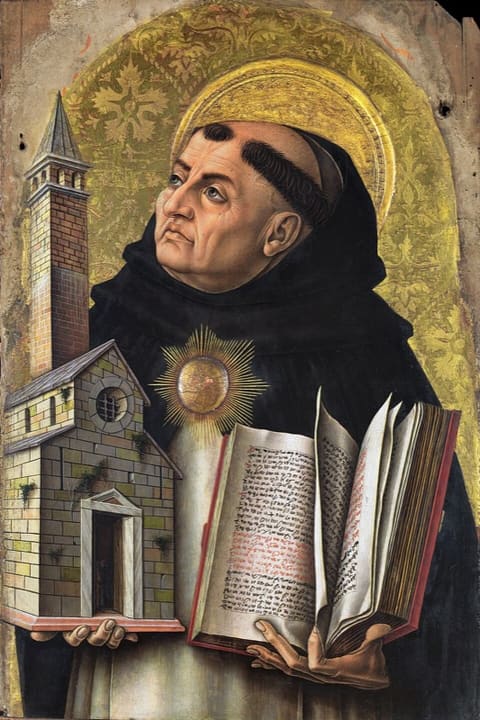
Thomas Aquinas was a Dominican theologian and philosopher whose synthesis of Christian doctrine and Aristotelian philosophy shaped Catholic intellectual life. His political writings place rule under natural law, common good, and divine providence.
“Since therefore grace does not destroy nature but perfects it, natural reason should minister to faith as the natural bent of the will ministers to charity”
“Since God is the highest good, He would not allow any evil to exist in His works, unless His omnipotence and goodness were such as to bring good even out of evil”
De Regno is Aquinas's unfinished treatise on kingship, addressed to the king of Cyprus and concerned with why political rule exists, how it can serve the common good, and how it can decay into tyranny. Aquinas begins from the social nature of human beings.
The Summa Theologiae, traditionally called the Summa Theologica, is Aquinas's unfinished synthesis of Christian theology, written, as its prologue says, for beginners who were confused by the disorder and repetition of existing textbooks. It contains some 512 questions divided into about 2,600 articles, each built on the same disciplined form inherited from university disputation.