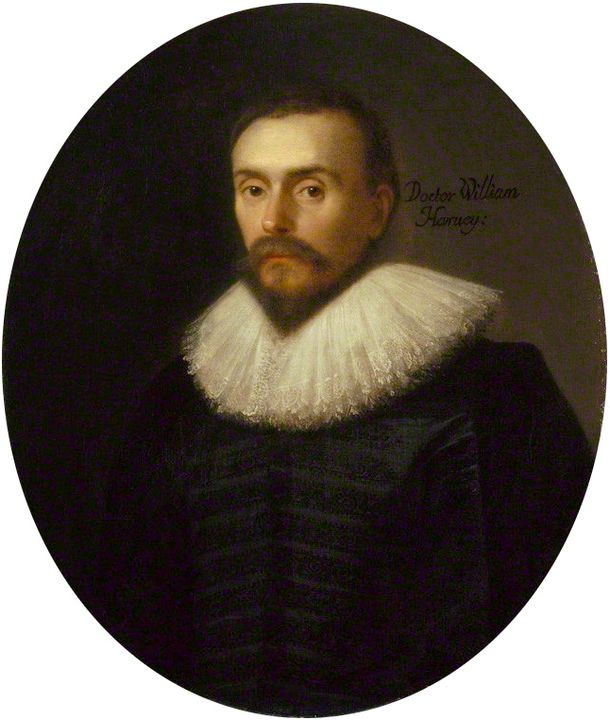
William Harvey (1578–1657) was born at Folkestone in Kent, educated at the King's School, Canterbury, and Gonville and Caius College, Cambridge, and took his medical degree at Padua in 1602, where he studied under the anatomist Hieronymus Fabricius of Aquapendente. Back in London he became a Fellow of the College of Physicians, physician to St Bartholomew's Hospital, and from 1615 Lumleian lecturer in anatomy and surgery, presenting his first account of the circulation in lectures of 1616. He served as physician to James I and Charles I, attended the king during the Civil War, and was briefly Warden of Merton College, Oxford (1645–46). His other major book, On the Generation of Animals (1651), studies embryology, chiefly in the hen's egg and the deer.
On the Motion of the Heart and Blood in Animals is the short Latin treatise, printed at Frankfurt in 1628, in which William Harvey argued that the blood moves continuously in a circuit, driven out by the heart through the arteries and returned to it by the veins. The library text is Robert Willis's English translation of 1847, as revised by Alexander Bowie and reprinted in 1910 in the Harvard Classics, with that series' introductory note on Harvey's life.