Work record
On the Motion of the Heart and Blood in Animals (De Motu Cordis)
1628 · Renaissance Early Modern · Essays · Latin
Abstract
Background. Physicians of the early seventeenth century followed Galen: food became blood in the liver, the veins distributed it to be consumed, and the arteries carried a vital spirit. Harvey, trained at Padua, tested this teaching through years of animal vivisection and public demonstration in London.
Content. After criticising the inherited doctrine, Harvey describes the beating heart in living creatures, establishes contraction as its working stroke, and follows blood from the right ventricle across the lungs. A calculation of output per beat shows that the body's blood must be the same blood returning. Bandages on the forearm and the one-way flaps inside veins prove the outward route through arteries and the homeward route through veins.
Method. The book combines comparative observation across eels, frogs, fish, birds and mammals with experiment on the human limb and simple arithmetic. Harvey infers connections between arteries and veins that he could not see.
Translation. The library reproduces the 1847 English version by Robert Willis, revised by Alexander Bowie, from the 1910 Harvard Classics.
Significance. Contested by Riolan and Primrose and endorsed by Descartes, the doctrine was generally accepted within Harvey's lifetime. Malpighi's 1661 sighting of capillaries completed it, and the treatise became a model for experimental physiology and quantitative reasoning in medicine.
Key figures
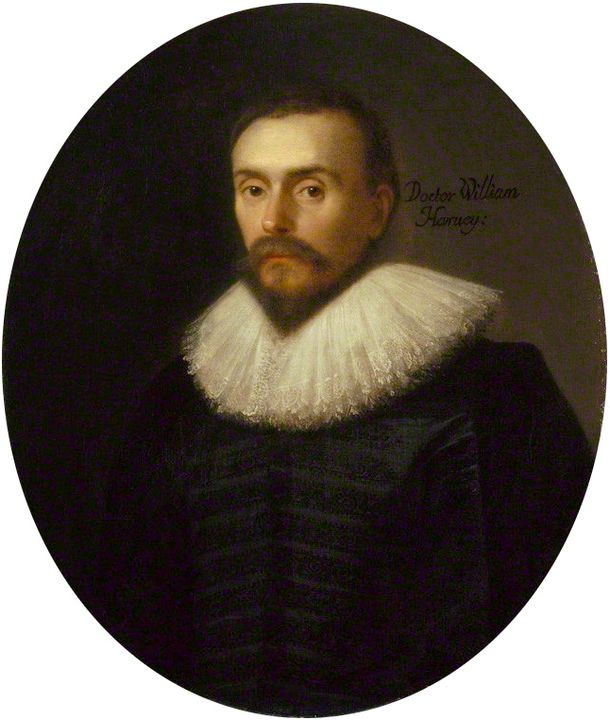
- William Harvey: English physician and anatomist, Padua-trained, physician to two kings
- Dr. Argent: President of the College of Physicians, to whom the work is dedicated
- Galen: Ancient authority whose physiology of blood and spirit Harvey revises
- Hieronymus Fabricius of Aquapendente: Harvey's teacher at Padua, who figured the valves of the veins
- Realdus Columbus: Italian anatomist cited for the passage of blood through the lungs
- Aristotle: Philosopher whose account of the heart and of circular motion Harvey invokes

Summary
On the Motion of the Heart and Blood in Animals is the short Latin treatise, printed at Frankfurt in 1628, in which William Harvey argued that the blood moves continuously in a circuit, driven out by the heart through the arteries and returned to it by the veins. The library text is Robert Willis's English translation of 1847, as revised by Alexander Bowie and reprinted in 1910 in the Harvard Classics, with that series' introductory note on Harvey's life. The book opens with a dedication to Dr. Argent, President of the College of Physicians, reminding the Fellows that they had watched Harvey's demonstrations for more than nine years. He declares that he learns and teaches anatomy from dissections, not books, and that he means no disrespect to the ancients. A long Introduction then reviews the received teaching, largely Galen's: arteries draw in air and spirits, blood is made in the liver and seeps outward through the veins to nourish the body, and some passes from the right to the left ventricle through pores in the septum. Harvey raises objection after objection, asking why the arteries of fish, whales and the unborn child should draw in air at all. Chapters I to V record what he saw in living animals, chiefly cold-blooded ones whose hearts beat slowly: the heart contracts, hardens and grows pale as it expels blood, and the arteries swell because they are filled, not because they expand of themselves. Chapters VI and VII trace the passage of blood from the right ventricle through the lungs to the left, drawing on the fetal heart and on Realdus Columbus. Chapter VIII states the novelty Harvey fears to announce, and Chapter IX supplies the famous calculation: even if the heart expels only a drachm per beat, a thousand beats in half an hour move more blood than food could ever replace, so the same blood must return. Chapters X to XIII prove three propositions by experiment, including ligatures on the human arm and the valves in the veins first figured by his teacher Fabricius, which let blood flow only toward the heart. Chapter XIV states the conclusion in one sentence, and Chapters XV to XVII add supporting reasons from heat, from the spread of contagion and of externally applied medicines through the body, and from comparative anatomy. The argument persuaded slowly. Jean Riolan the Younger and others opposed it, Descartes accepted the circulation while disagreeing about the heartbeat, and the capillaries Harvey had to infer were seen by Marcello Malpighi in 1661.
Virtues in this work
- Industry: Harvey confirmed his views by repeated demonstrations before the College for more than nine years and studied the hearts of many kinds of animals before publishing.
- Fortitude: In Chapter VIII he admits he fears making mankind his enemies and publishes anyway, declaring that the die is cast.
- Humility: The dedication refuses to take from the ancients any honor due to them and calls error a common human lot rather than a crime.
- Prudence: In Chapter IX he grants his opponents the smallest estimates so that his conclusion cannot be escaped by disputing the numbers.
Plot or Argument
- Dedication to the College of Physicians
Harvey addresses Dr. Argent and his colleagues, recalls nine years of demonstrations before them, and professes to learn anatomy from dissection and from the fabric of nature rather than from books, while refusing to take from the ancients the honor due to them.
- Introduction: the received doctrine examined
He surveys the common teaching that arteries draw in air and give off sooty vapours, that the pulse serves cooling like respiration, and that blood crosses the septum of the heart through invisible pores, and he shows each claim to be inconsistent with Galen's own experiments or with observation.
- Chapters I–V: the heart seen in living animals
Admitting that the motion of the heart first seemed almost beyond understanding, Harvey describes vivisections of eels, frogs, snakes, fish and dogs. He concludes that the heart's active motion is contraction, that the auricles contract before the ventricles, and that the arterial pulse is the effect of blood driven into the arteries.
- Chapters VI–VII: passage through the lungs
Using the fetal openings between the chambers and the structure of the pulmonary vessels, he argues that blood passes from the right ventricle through the substance of the lungs into the pulmonary veins and left ventricle, as Columbus had taught.
- Chapters VIII–IX: the quantity of blood
Harvey announces the circulation and supports it by calculation: the volume the heart expels in half an hour far exceeds what the food could supply or the veins could hold, so the blood must make a circuit and return.
- Chapters X–XIII: three propositions proved
Experiments with tight and medium ligatures on the arm, the bleeding of slaughtered animals, and the one-way valves of the veins show that blood enters the limbs by the arteries, leaves by the veins, and is carried back only toward the heart.
- Chapter XIV: the conclusion
In a single paragraph he states that the blood is impelled in a circle and is in ceaseless motion, and that this is the function of the heart's pulse.
- Chapters XV–XVII: confirming reasons
He adds arguments from the heart as the hearth of native heat, from the way poisons, contagion and medicines applied to the skin act on the whole body, from fever, and from the comparative structure of hearts in many animals.
Lessons
Counting can overturn a theory
Harvey's decisive argument in Chapter IX is arithmetic. By granting his opponents the smallest plausible output of the heart and multiplying by the number of beats, he shows that the liver could not possibly make so much new blood. The lesson is that a simple measurement, honestly carried through, can decide between explanations that observation alone leaves open.
- Why does Harvey deliberately choose low estimates for the amount of blood expelled at each beat?
- What would an opponent have to deny in order to escape the conclusion of the calculation?
- Can you think of another question that a rough calculation could settle more quickly than a long debate?
Respect for the ancients and the duty to correct them
Harvey honors Galen, borrows his experiments and calls Fabricius a venerable teacher, yet he concludes that the inherited account of the blood is wrong. He shows that one can correct a master in the master's own manner, by observation and argument, without contempt.
- Where in the Introduction does Harvey use Galen's own experiments against the common teaching?
- How does the dedication prepare readers to accept a new doctrine without feeling that their teachers are being insulted?
- What does it look like to disagree with a respected authority well?
Seeing and inferring
Harvey could not see the tiny vessels that join arteries to veins; he inferred that blood passes through the 'porosities of the flesh' because the quantities and the valves required it. Good science often affirms what reasoning demands before instruments can show it, while remaining open to confirmation.
- Which parts of the circulation did Harvey observe directly, and which did he infer?
- Was it reasonable for him to publish before anyone had seen the connecting vessels?
Courage to publish
In Chapter VIII Harvey admits that he trembles lest he make all mankind his enemies, because custom becomes a second nature. He publishes anyway, trusting in his love of truth. The book is a model of intellectual courage joined to careful preparation.
- Why did Harvey wait so many years after his 1616 lectures before printing his book?
- What risks did a physician of his time run by challenging accepted teaching?
Context
Harvey worked in the generation after Vesalius had reformed anatomical description by dissecting human bodies himself, and he trained at Padua, the leading medical school of Europe, under Fabricius. Galenic physiology still governed teaching: blood was thought to be made continually in the liver from food, to ebb and flow in the veins, and to cross the heart's septum, while the arteries carried a vital spirit. Earlier writers, among them Ibn al-Nafis in the thirteenth century, Michael Servetus (1553) and Realdo Colombo (1559), had described the passage of blood through the lungs, but no one had proposed a complete circuit through the whole body.
Composition
Harvey presented the circulation in his Lumleian lectures at the College of Physicians from 1616, and his surviving lecture notes are in the British Library. He continued vivisections and demonstrations for years and published the Exercitatio Anatomica de Motu Cordis et Sanguinis in Animalibus with William Fitzer at Frankfurt in 1628, a small quarto of 72 pages dedicated to Charles I and to the College. Willis's English translation appeared in 1847 in the Sydenham Society's edition of Harvey's works.
Reception
The book provoked controversy. James Primrose and Jean Riolan the Younger defended the older teaching, and Harvey answered Riolan in two anatomical essays of 1649. Descartes endorsed the circulation in the Discourse on Method (1637), though he explained the heartbeat by heat rather than muscular contraction. By the time of Harvey's death the circulation was widely accepted, and Malpighi's microscopic observation of capillaries in the frog's lung (1661) supplied the link Harvey had inferred. The book is often counted among the founding works of experimental physiology.
Comparisons
- galen-selected-works
Harvey reasons with and against Galen throughout, citing his ligature experiments on arteries while rejecting the liver-centred system of blood-making and the pores in the septum.
- hippocratic-writings
The Hippocratic writers explain health by the balance of humours; Harvey keeps humoral language for fever and temperament but makes the heart a pump and the blood a single circulating fluid.
- vesalius-on-the-fabric-of-the-human-body
Vesalius corrected anatomical description by dissecting human bodies himself; Harvey extends the Paduan tradition from structure to function, from what parts look like to how they move.
- discourse-on-method
In Part V Descartes takes up Harvey's circulation as an example of mechanical explanation, while proposing his own account of the heartbeat that Harvey did not accept.
- novum-organum
Bacon, who was Harvey's patient, called for natural knowledge built from experiment; De Motu Cordis is one of the clearest early examples of a theory established that way.
- bernard-introduction-to-experimental-medicine
Claude Bernard, writing two centuries later, treats vivisection and quantitative experiment as the method of physiology and looks back to Harvey as one of its founders.
Quotes
“I profess both to learn and to teach anatomy, not from books but from dissections; not from the positions of philosophers but from the fabric of nature”
“I found the task so truly arduous, so full of difficulties, that I was almost tempted to think, with Fracastorius, that the motion of the heart was only to be comprehended by God.”
“so much doth wont and custom become a second nature. Doctrine once sown strikes deep its root, and respect for antiquity influences all men. Still the die is cast, and my trust is in my love of truth and the candour of cultivated minds.”
“I began to think whether there might not be a MOTION, AS IT WERE, IN A CIRCLE.”
“The heart, consequently, is the beginning of life; the sun of the microcosm, even as the sun in his turn might well be designated the heart of the world”
“It could be furnished in no other way than by making a circuit and returning.”
“it is absolutely necessary to conclude that the blood in the animal body is impelled in a circle, and is in a state of ceaseless motion”
For Students
A reading companion for classical Christian high school students. See the student guide.
Reading Guide
Watch for
- The dedication, where Harvey reminds the College that they have watched his demonstrations for nine years. Notice how he presents himself as a colleague offering evidence rather than a rebel overturning tradition.
- The questions in the Introduction about fish, whales and the unborn child. Ask why these creatures are such strong evidence against the idea that arteries draw in air.
- Chapter I, where Harvey admits that the beating heart at first seemed too fast to understand, and how he solved the problem by studying cold-blooded and dying animals whose hearts beat slowly.
- The arithmetic of Chapter IX, where Harvey deliberately chooses the smallest estimates, followed by the ligature experiments of Chapter XI and the valves of Chapter XIII, which you can repeat on your own arm.
- The images of the heart as the sun of the little world and the household hearth, which show that Harvey's new physiology still speaks in older Aristotelian language.
Key terms and names
- Systole and diastole
- The contraction and relaxation of the heart. Harvey argues that systole, not diastole, is the heart's active work, and that the pulse in the arteries follows from it.
- Vena cava
- The great vein that returns blood to the right side of the heart. In Harvey's circuit all venous blood is finally discharged into it.
- Pulmonary transit
- The passage of blood from the right ventricle through the lungs to the left ventricle. Harvey defends it against the older idea of pores in the septum.
- Ligature
- A cord or bandage tied around a limb or vessel. Harvey uses tight and medium ligatures on the arm to separate the work of arteries from the work of veins.
- Valves of the veins
- Small membranous flaps inside the veins, described by Fabricius, that Harvey shows allow blood to move only toward the heart.
- Drachm
- An apothecary's weight of one eighth of an ounce. Harvey uses it to estimate how much blood the heart expels with each beat.
- Vivisection
- Dissection of a living animal to observe its organs at work. It was Harvey's chief means of seeing the heart in motion.
- Microcosm
- The 'little world' of the human body, thought to mirror the great world of the cosmos. Harvey calls the heart the sun of the microcosm.
Seminar Questions
- Comprehension What did the received teaching of Harvey's day say about where blood is made and how it moves, and which parts of that teaching does the Introduction attack?
- Comprehension Walk through the calculation in Chapter IX. What numbers does Harvey assume, and what does he conclude from them?
- Comprehension What happens to the arm below a tight ligature and below a medium one, and what does each result show about arteries and veins?
- Interpretation Harvey says he learns anatomy 'not from books but from dissections', yet he quotes Aristotle and Galen often. How do you reconcile these two facts?
- Interpretation Why might Harvey have feared that his teaching would make 'mankind at large' his enemies? What did the circulation threaten in medicine as it was then practised?
- Interpretation Harvey never saw the vessels that connect arteries to veins. Is his argument incomplete, or is inference from quantity and structure a sufficient proof?
- Big Question Harvey's discovery depended on cutting open many living animals. How should a scientist weigh the knowledge gained by such experiments against the suffering of creatures that are part of God's creation?
- Big Question If a tradition as respected as Galen's could be wrong about something as basic as the blood, what attitude should students take toward the authorities they are taught today?
Faith Connections
- Leviticus 17:11 (Scripture)
'The life of the flesh is in the blood.' Harvey, who calls the blood the foundation of life and the heart the beginning of life, gives a physiological account of a truth Scripture had long taught in the language of sacrifice.
- Psalm 139:14 (Scripture)
'I am fearfully and wonderfully made.' Harvey's wonder at the valves, the auricles and the ordered circuit of the blood is a kind of praise for design in the body, though he speaks of nature doing nothing in vain.
- Proverbs 25:2 (Scripture)
'It is the glory of God to conceal a thing: but the honour of kings is to search out a matter.' Harvey's admission that the heart's motion seemed comprehensible only to God, followed by years of patient searching, fits this proverb closely.
- Francis Bacon, Novum Organum (Great Conversation)
Bacon urged natural philosophers to replace reverence for ancient authority with experiment. Harvey, Bacon's physician, practised what Bacon preached, though he is reported to have thought little of Bacon's own science.
Logic and Rhetoric
Central argument: The heart expels into the arteries at every beat a quantity of blood that, multiplied by the number of beats, far exceeds what food could supply or the veins contain; ligature experiments show blood entering limbs by the arteries and leaving by the veins; the valves of the veins allow flow only toward the heart; therefore the same blood must pass continuously from the heart through the arteries to the body and back through the veins to the heart, in a circle.
Rhetorical device: concession (concessio). In Chapter IX Harvey grants his opponents the lowest possible figures, a single drachm per beat and only a thousand beats in half an hour, so that the conclusion follows even on their most favourable assumptions.
Debate: Resolved: A theory supported by calculation and experiment should be accepted before its every mechanism has been directly observed.
Memory Work
I profess both to learn and to teach anatomy, not from books but from dissections; not from the positions of philosophers but from the fabric of nature
I began to think whether there might not be a MOTION, AS IT WERE, IN A CIRCLE.
Writing Prompts
Essay: Explain the three propositions Harvey sets out in Chapter IX and how each is proved in Chapters X to XIII. Then argue which of his proofs is the strongest and why.
Comparison with Galen: Selected Works: Compare Galen's ligature of the ureters in On the Natural Faculties with Harvey's ligatures on the arm. How does each physician use a simple experiment to defeat rivals, and what does each experiment assume about how the body works?
Medical Lens
De Motu Cordis is a foundation text of physiology and of experimental medicine. Its method joins vivisection of many animals, ligature experiments on the living human arm, the anatomy of venous valves, and a quantitative estimate of cardiac output. Harvey's account displaced the Galenic model in which the liver continually makes blood and the arteries carry spirit, though he kept much traditional vocabulary: native heat, spirits, concoction and the heart as the seat of life. The clinical observations are drawn from the phlebotomy of his day: the fillet tied above the elbow, the fainting patient whose blood only drips. Chapter XVI uses the circulation to explain why a bite or venereal infection in one place can affect the whole body and why medicines applied to the skin act internally, an early physiological account of how disease and drugs spread through the whole body. Harvey also notes that the speed of the circulation varies with sleep, food, exercise and the affections of the mind, and that fear and faintness weaken the heart's action. Later physiology, including Malpighi's capillaries and Lower's work on the colour of blood, completed what Harvey left unexplained.
- Introduction
Harvey sets out and examines the Galenic teaching on arteries, spirits, pores in the septum and the uses of the pulse.
- Chs. II–V
Observations from vivisection of cold-blooded and warm-blooded animals establish that the heart's active phase is contraction.
- Ch. IX
The calculation of blood expelled per beat and per half hour, which makes a circulation necessary.
- Chs. XI–XII
Tight and medium ligatures on the arm, as used in bloodletting, show arterial inflow and venous return; the fainting patient whose blood only drips is explained.
- Ch. XIII
The valves of the veins, figured by Fabricius, are shown to permit flow only toward the heart.
- Ch. XVI
Contagion, poisoned wounds, rabies, the lues venerea, tertian fever and externally applied medicines are explained by the returning current of blood.
Creative Prompts
- Classroom
Redo Harvey's Chapter IX estimate with a modern resting heart: take a stroke volume and pulse rate, compute the blood moved in half an hour, and compare it with the five or so litres in an adult body.
- Essay
Write the letter Jean Riolan might have sent Harvey after reading the book, defending the Galenic system as strongly as he could, and then Harvey's reply.
- Classroom
Demonstrate Harvey's venous-valve experiment from Chapter XIII on a volunteer's forearm: press a finger along a visible vein toward the hand and away from it, and record what happens to the filling.
Further Reading
- On the Generation of Animals, William Harvey
Harvey's 1651 work on embryology, with his preface on method.
- The Anatomical Exercises: De Motu Cordis and De Circulatione Sanguinis, William Harvey, ed. Geoffrey Keynes
Includes the two replies to Riolan of 1649.
- The Life of William Harvey, Geoffrey Keynes
- William Harvey's Biological Ideas, Walter Pagel
- The Greatest Benefit to Mankind, Roy Porter
Verification notes
Chapter structure, the dedication to Argent and all seven quotations follow the stored Harvard Classics text (Willis's translation as revised by Alexander Bowie); each quotation was found by search in content/texts/harvey-on-the-motion-of-the-heart-and-blood.txt and copied exactly, including the capitals of 'MOTION, AS IT WERE, IN A CIRCLE'. The stored text prints only the dedication to Argent and the College; the 1628 edition also opens with a dedication to Charles I. Biographical dates, the 1616 Lumleian lectures, the Frankfurt printer William Fitzer, the Riolan replies of 1649 and Malpighi's 1661 observation of capillaries are standard. The remark that Harvey thought little of Bacon's science rests on John Aubrey's Brief Lives.
- The year Harvey began the Lumleian lectures (1615 is usual) and the 1616 date of the first lectures on the circulation.
- Page count of the 1628 Frankfurt edition (usually given as 72 pages).
- That Willis's translation first appeared in the Sydenham Society's Works of William Harvey (1847).