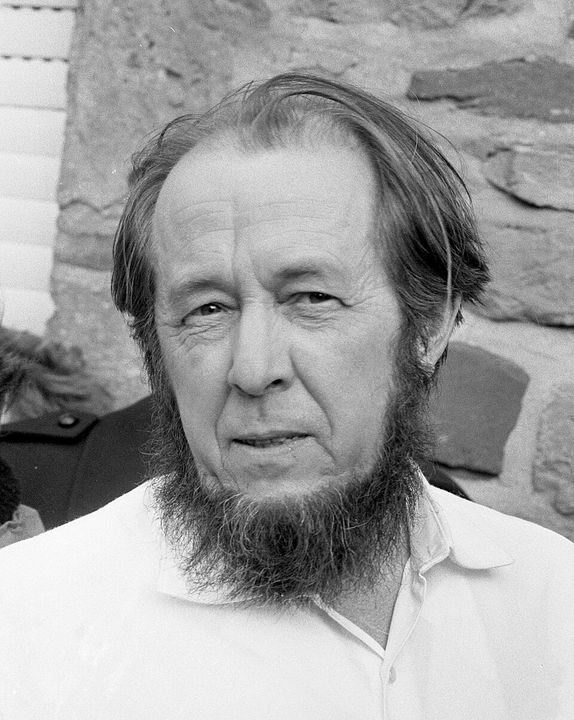
1918-2008 · Russian novelist and historian who wrote about the Soviet Gulag labor camps
Portrait of Aleksandr Solzhenitsyn (1974-02-14). Source · CC0
About Aleksandr Solzhenitsyn
Aleksandr Solzhenitsyn (1918–2008) was born in Kislovodsk and studied mathematics and physics at Rostov. An artillery officer decorated in the Second World War, he was arrested at the front in February 1945 for remarks about Stalin in letters to a friend and spent eight years in the Gulag, including a prison research institute (the sharashka) and the special camp at Ekibastuz in Kazakhstan, where he worked as a bricklayer. After internal exile and recovery from cancer he taught school in Ryazan. One Day made him famous in 1962; later works, including The First Circle, Cancer Ward and The Gulag Archipelago, were banned at home. He received the Nobel Prize in Literature in 1970, was expelled from the Soviet Union in 1974, lived in Cavendish, Vermont, and returned to Russia in 1994. He was a committed Orthodox Christian.
1962 (Russian; English trans. 1963) · Postwar Contemporary · Novella
One Day in the Life of Ivan Denisovich follows a single winter day, from reveille at five in the morning to lights-out, in a Soviet special labour camp on the steppe of Kazakhstan in the early 1950s. Ivan Denisovich Shukhov, a peasant from the village of Temgenyovo, was captured by the Germans in 1942, escaped back to his own lines, and was charged with treason as a supposed German spy; he signed a confession because refusing meant being shot.
The Gulag Archipelago, 1918–1956: An Experiment in Literary Investigation is Aleksandr Solzhenitsyn's history of the Soviet system of prisons, labour camps and exile, which he likened to an archipelago of islands scattered across the country, visible only to those taken there. Written in secret between 1958 and 1968, it draws on Solzhenitsyn's own eight years as a prisoner and on the testimony of some two hundred and twenty-seven other former prisoners, together with published Soviet sources.