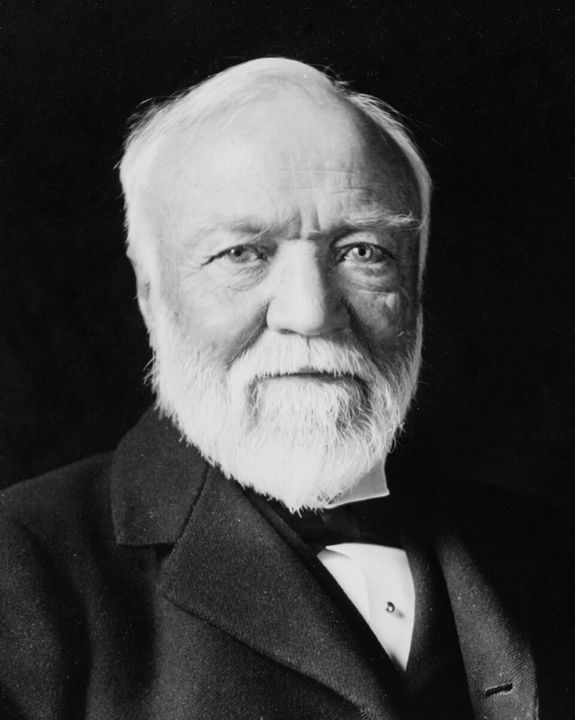
Andrew Carnegie (1835-1919) was born in Dunfermline, Scotland, the son of a hand-loom weaver, and emigrated with his family to Allegheny City, Pennsylvania, in 1848. He rose from bobbin boy and telegraph messenger to railroad superintendent, then built an iron and steel business that became the Carnegie Steel Company, sold to J. P. Morgan's new United States Steel Corporation in 1901. He spent his last eighteen years giving away most of his fortune, funding more than 2,800 library buildings, the Carnegie Institute in Pittsburgh, the Carnegie Institution of Washington, the Hero Fund, teachers' pensions, the Peace Palace at The Hague and the Carnegie Corporation of New York. He died at Lenox, Massachusetts, in 1919.
Frequently Cited
“I have made millions since, but none of those millions gave me such happiness as my first week's earnings.”
The Autobiography of Andrew Carnegie is the steel manufacturer's own story of his life, written mostly in summers at a cottage in the Scottish Highlands after his retirement and left unfinished when the First World War began in August 1914. His widow, Louise Whitfield Carnegie, contributes a preface, and Professor John C. Van Dyke, who arranged the manuscript, adds an editor's note and footnotes; the book appeared in 1920, the year after Carnegie's death.