Work record
Autobiography of Andrew Carnegie
1920 · Early 20th Century · Memoir · English
Abstract
Background. Begun in retirement at his wife's urging and set aside at the outbreak of war in 1914, the manuscript was ordered for print by a friend after its author's death.
Scope. It follows an immigrant weaver's son from a Scottish attic through Pittsburgh's mills, telegraph rooms and railroad offices to the head of America's largest steel concern, and then into two decades of giving.
Content. Notable episodes include the family's emigration, a Saturday lending library, train orders sent in a superior's name, wartime telegraph work, the leap from bridges to Bessemer steel, a double bereavement during typhoid, the 1892 conflict at Homestead, the 1901 sale, and gifts of libraries, research institutions and a palace for international arbitration. Sketches of British and American statesmen, writers and a German emperor close the book.
Method. Carnegie writes anecdotally and optimistically, quoting Burns and Shakespeare, offering business maxims, and defending his own conduct where it was disputed. His editor kept interference to a minimum, so the exuberance and occasional exaggeration of the original voice remain on the page.
Significance. Among the best-known American rags-to-riches narratives, it is a primary source for the industrial age and for the philosophy of large-scale philanthropy, to be read alongside other accounts of its labor conflicts.
Key figures
- Andrew Carnegie: Scottish-born steelmaker and philanthropist, narrator
- Margaret Morrison Carnegie: His mother, the family's mainstay
- Colonel James Anderson: Lent his books to Allegheny's working boys
- Thomas A. Scott: Railroad officer who launched Carnegie's career
- Henry Clay Frick: Partner and company chairman in 1892
- J. Pierpont Morgan: Banker who bought the steel company in 1901
- John C. Van Dyke: Editor who arranged the manuscript
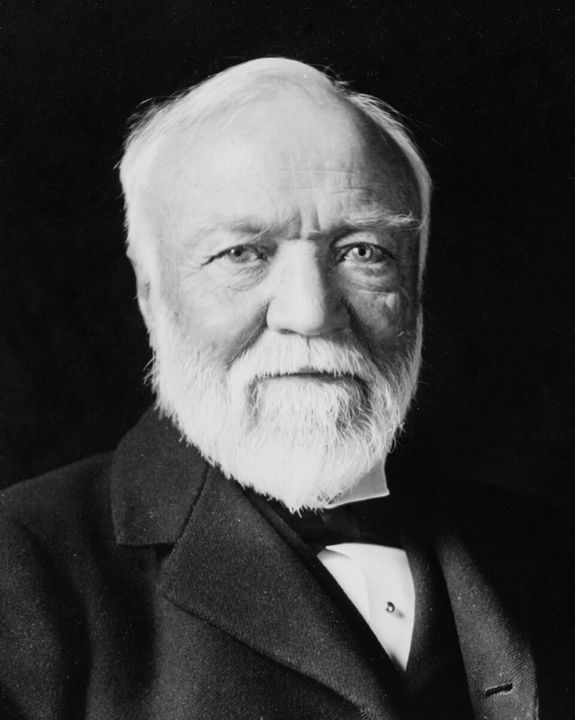

Summary
The Autobiography of Andrew Carnegie is the steel manufacturer's own story of his life, written mostly in summers at a cottage in the Scottish Highlands after his retirement and left unfinished when the First World War began in August 1914. His widow, Louise Whitfield Carnegie, contributes a preface, and Professor John C. Van Dyke, who arranged the manuscript, adds an editor's note and footnotes; the book appeared in 1920, the year after Carnegie's death. Carnegie begins in Dunfermline, where he was born in 1835 in a weaver's attic. He describes his radical, book-loving father and uncles, his capable mother Margaret, his cousin George Lauder, called Dod, with whom he memorized Scottish history and Burns, and the collapse of hand-loom weaving that drove the family to emigrate in 1848. In Allegheny City he works as a bobbin boy for one dollar and twenty cents a week, then fires a boiler in a cellar, and at fourteen becomes a telegraph messenger in Pittsburgh, which feels to him like being lifted into paradise. Colonel James Anderson lends his four hundred books to working boys on Saturdays, and young Andrew writes to the newspaper to have messengers included. He learns to take telegraph messages by ear, becomes secretary and operator for Thomas A. Scott of the Pennsylvania Railroad, and at twenty-four succeeds him as superintendent of the Pittsburgh division. During the Civil War he helps organize military railways and telegraphs around Washington. Investments in sleeping cars, oil and bridges lead him into iron works and, after seeing the Bessemer process in Britain, into steel with the Edgar Thomson works, whose policy he states as putting all good eggs in one basket and watching that basket. Later chapters describe his partners, including his brother Tom, Henry Phipps, Henry Clay Frick and Charles Schwab; the deaths of his mother and brother in 1886 while he lay ill with typhoid fever; his marriage to Louise Whitfield in 1887; his relations with workmen; and the Homestead strike of 1892, which he says wounded him more deeply than anything else in his career. After the sale of his company to J. P. Morgan in 1901 he turns to what he calls wise distribution: libraries, institutes, the Hero Fund, pensions for teachers and the Peace Palace at The Hague. The final chapters are portraits of friends and public figures, among them Matthew Arnold, Gladstone, John Morley, Herbert Spencer, James G. Blaine, John Hay and Kaiser Wilhelm II.
Virtues in this work
- Industry: As a messenger boy he memorizes the firms along Pittsburgh's streets and learns to read telegraph messages by sound.
- Charity: Remembering Colonel Anderson's books, he spends his later years funding thousands of public libraries.
- Prudence: He withdraws from scattered ventures to concentrate on steel, putting his good eggs in one basket and watching it.
- Friendship: His lifelong partnership with his cousin Dod began in their Dunfermline boyhood and continued in the firm.
Plot or Argument
- Chapters I-II: Dunfermline
Carnegie describes his family of weavers and radicals, his mother's strength, his schooling, his cousin Dod and their love of Wallace, Bruce and Burns, the coming of steam looms, and the family's emigration to America in 1848.
- Chapters III-V: Pittsburgh, books and the telegraph
Work as bobbin boy and boiler tender, the move to the telegraph office as messenger, Colonel Anderson's library for working boys, the Swedenborgian society and its music, and learning to read telegraph messages by sound.
- Chapters VI-VIII: Railroad service and the Civil War
As Thomas A. Scott's assistant on the Pennsylvania Railroad he risks his job by giving train orders in Scott's name during a wreck, becomes superintendent, and during the war helps run military railways and telegraphs, suffering a sunstroke in Virginia.
- Chapters IX-XIII: Bridges, iron and steel
Investments in the Woodruff sleeping car and oil, the Keystone Bridge Company and the Union Iron Mills, the move to New York, business negotiations abroad, and the building of steel works under the motto of watching one basket.
- Chapters XIV-XVI: Partners, travel, marriage and the men
His partners and reading, a journey round the world that changes his outlook, the coaching trip through Britain, the deaths of his mother and brother in 1886, his marriage to Louise Whitfield, and his principles for dealing with workmen.
- Chapters XVII-XVIII: Homestead and labor
His account of the Homestead strike of 1892, which occurred while he was in Scotland, and reflections on the sliding scale, unions and the relations of capital and labor.
- Chapters XIX-XXI: The Gospel of Wealth and giving
After the sale to J. P. Morgan in 1901 he sets out to distribute his fortune: libraries, the Carnegie Institute, the Carnegie Institution of Washington, the Hero Fund, pension funds, the Peace Palace and the Pittencrieff Glen in Dunfermline.
- Chapters XXII-XXIX: Friends and statesmen
Portraits of Matthew Arnold, British political leaders, Gladstone and Morley, Herbert Spencer, Blaine and Harrison, diplomacy in Washington, Hay and McKinley, and a meeting with the German Emperor, ending with Carnegie's hopes for peace.
Characters
- Andrew Carnegie, author and narrator
Cheerful, energetic Scottish-American who tells his rise from poverty to great wealth and philanthropy.
- Margaret Morrison Carnegie, mother
Hard-working and devoted mother whom Carnegie calls a heroine.
- William Carnegie, father
Hand-loom weaver ruined by steam looms; gentle, devout and fond of singing.
- Thomas M. Carnegie, brother and partner
Younger brother who manages much of the business in Pittsburgh and dies in 1886.
- George Lauder (Dod), cousin and partner
Childhood companion in Dunfermline and later an engineer in the firm.
- Colonel James Anderson, benefactor
Opens his library to working boys in Allegheny on Saturdays.
- Thomas A. Scott, employer and mentor
Pennsylvania Railroad superintendent who takes Carnegie as his operator and secretary.
- Henry Clay Frick, partner
Coke manufacturer and later chairman of the steel company during the Homestead strike.
- Charles M. Schwab, partner
Steel manager who carries J. P. Morgan's offer to buy the company.
- J. Pierpont Morgan, financier
Buys Carnegie Steel in 1901 to form the United States Steel Corporation.
- Louise Whitfield Carnegie, wife
Married Carnegie in 1887 and wrote the preface to the memoir.
- Herbert Spencer, friend
English philosopher of evolution whom Carnegie admired as a teacher.
Lessons
Work as service to one's family
Carnegie's first job as a bobbin boy was hard and dull, but he says no later millions gave him such happiness as his first week's pay, because it made him a helper of the family. His mother's washing of his one white shirt every Saturday night and his father's long hours appear as acts of love. The book links early work with gratitude and duty at home.
- Why did the bobbin boy's first wages make Carnegie so happy?
- What did his mother and father each do to help the family in America?
- Can hard work you do not enjoy still be satisfying? Why?
Books open doors
Colonel James Anderson's Saturday library gave the working boys of Allegheny the use of four hundred books, and Carnegie wrote his first letter to a newspaper so that messenger boys would be included. He later founded libraries so that other boys might gain what he had gained. The lesson is that a single generous act can shape a whole life and be repaid many times over.
- What did Carnegie argue in his letter to the Pittsburgh Dispatch?
- How did Colonel Anderson's library lead to Carnegie's later gifts?
- What do you think a library gives that money alone cannot?
Seizing responsibility
In Chapter VI young Carnegie finds the railroad tied up by an accident while Scott is away and, against the rules, sends out train orders in Scott's name to clear the line. He presents this as the moment he showed he could be trusted with authority, and he admits the risk he took. The episode shows both initiative and its dangers.
- What did Carnegie do the morning he found the trains stopped?
- Why was it risky, and how did Scott respond?
- When is it right to act beyond your orders?
The duties of wealth
Carnegie argued in his essays later collected as The Gospel of Wealth that a rich man should spend his later years distributing his surplus wisely for the public good. After 1901 he tried to do exactly this, funding libraries, science, heroes' families, teachers' pensions and peace. Readers can weigh his reasoning, his methods and the questions about wealth and labor that his life raised for his contemporaries.
- What did Carnegie decide to do after he sold his company?
- Which of his gifts seems to you most useful, and why?
- Is giving money away wisely harder than earning it, as Carnegie claims?
Facing a painful failure
Carnegie writes that the Homestead strike of 1892 wounded him more deeply than anything else in his career. He defends his firm's offer and blames the union leaders and an inexperienced superintendent, while admitting that the works should not have been reopened with new men. Many in his own day, especially the workers and their supporters, saw the event very differently, so the chapter is best read alongside other accounts.
- Where was Carnegie when the strike began, and when did he hear of it?
- What does he say should have been done differently?
- Why is it important to read more than one account of a conflict like Homestead?
Context
Carnegie's life spans the industrial transformation of the United States after the Civil War. The telegraph and the railroads, where he learned management, were the first great national networks; the Bessemer process made cheap steel for rails, bridges and buildings; and Pittsburgh became the center of American steelmaking. His era also saw bitter disputes between employers and organized labor. At Homestead in 1892, with Carnegie in Scotland and Henry Clay Frick in charge, the company locked out members of the Amalgamated Association of Iron and Steel Workers; a gun battle on 6 July between strikers and Pinkerton guards brought by barge left men dead on both sides, the state militia took control, and the union was defeated. Carnegie's account in Chapter XVII is his own version of these events; historians have drawn on his letters to argue that he had approved the firm's firm stand before he left, while others stress his long record of good relations with workmen.
Composition
Carnegie wrote the chapters in fragments after his retirement, chiefly at his cottage at Aultnagar near Skibo Castle in the Highlands, and stopped when war was declared in August 1914. After his death in August 1919 his widow asked John C. Van Dyke, a Rutgers professor of art history and Carnegie's friend, to arrange the manuscript; Van Dyke ordered the material chronologically, added footnotes and illustrations, and wrote an editor's note. It was published in 1920 by Houghton Mifflin in Boston and Constable in London. The library text is Project Gutenberg #17976.
Reception
The autobiography became a classic American success story, often read beside Franklin's, and has stayed in print. Readers have admired its energy, gratitude and plain storytelling and its picture of a boy educated by work and books. Biographers such as Joseph Frazier Wall and David Nasaw have compared it with the documentary record, noting where Carnegie's memory or self-presentation differs, especially on Homestead and on his business methods. His philanthropy, particularly the public libraries, has been widely praised, and his Gospel of Wealth remains a starting point for discussions of the responsibilities of the rich.
Comparisons
- franklin-autobiography-and-poor-richard
Both are self-made men's life stories built on early work, reading and maxims; Franklin's founding of a subscription library in Philadelphia and Carnegie's debt to Colonel Anderson's library are close parallels.
- up-from-slavery
Washington names Carnegie among the Northern donors who helped Tuskegee; both men teach thrift, thoroughness and self-help, and both write as builders of institutions.
- twenty-years-at-hull-house
Jane Addams worked among industrial laborers in Chicago in the same decades and wrote about strikes and the poor from the side of the settlement house, offering a contrasting view of the industrial city.
- theodore-roosevelt-an-autobiography
Roosevelt, a contemporary whom Carnegie knew, writes of the same age of trusts and big business from the side of government regulation.
- the-wealth-of-nations
Smith's pin factory and division of labor and Carnegie's specialized steel works, with his rule of concentrating on one line of business, invite comparison on how wealth is produced.
Quotes
Frequently cited
“I have made millions since, but none of those millions gave me such happiness as my first week's earnings.”
Frequently cited
“I was lifted into paradise, yes, heaven, as it seemed to me, with newspapers, pens, pencils, and sunshine about me.”
Frequently cited
“Colonel James Anderson--I bless his name as I write--announced that he would open his library of four hundred volumes to boys”
Frequently cited
“to put all good eggs in one basket and then watch that basket.”
Frequently cited
“Nothing I have ever had to meet in all my life, before or since, wounded me so deeply.”
Frequently cited
“I resolved to stop accumulating and begin the infinitely more serious and difficult task of wise distribution.”
“the cloud had a silver lining, as it gave me the feeling that I was doing something for my world--our family.”
For Students
A reading companion for classical Christian high school students. See the student guide.
Reading Guide
Watch for
- The reasons Carnegie gives in Chapter II for his family leaving Dunfermline in 1848.
- Every job Carnegie takes in Chapters III-VI and what he learns from each.
- Colonel Anderson's library in Chapter IV and how Carnegie connects it to the libraries he later built.
- The morning in Chapter VI when Carnegie gives train orders in Scott's name.
- How Carnegie explains the Homestead strike in Chapter XVII and whom he holds responsible.
Key terms and names
- Bobbin boy
- A child worker in a cotton mill who changed and carried the bobbins of thread; Carnegie's first job, at one dollar and twenty cents a week.
- Telegraph messenger
- A boy who carried telegrams from the office to businesses and homes; Carnegie memorized Pittsburgh's streets and firms to do it well.
- Bessemer process
- A method of making steel cheaply by blowing air through molten iron, which Carnegie saw in Britain and adopted for his works.
- Homestead
- A steel works on the Monongahela River near Pittsburgh where a strike and lockout in 1892 led to deadly violence.
- The Gospel of Wealth
- Carnegie's essays arguing that the rich should give away their surplus during their lives for the public good.
- Hero Fund
- A fund Carnegie founded in 1904 to honor and support people injured, and the families of those killed, while saving others.
Seminar Questions
- Comprehension Why did the Carnegie family leave Scotland, and what jobs did Andrew and his father find in Allegheny City?
- Comprehension How did Carnegie get his chance to borrow books, and what did he do when messengers were left out?
- Comprehension What did Carnegie decide to do with his money after he sold his company in 1901?
- Interpretation Why does Carnegie describe the telegraph office as paradise after the boiler cellar?
- Interpretation What does Carnegie's rule about putting good eggs in one basket show about how he ran his business?
- Interpretation How does Carnegie try to explain the Homestead strike, and what parts of his account might other people have told differently?
- Big Question Does a person who becomes very rich have a special duty to help others? Why or why not?
Faith Connections
- Luke 12:48 (Scripture)
To whom much is given, of him much shall be required. Carnegie's teaching that wealth is a trust to be distributed wisely echoes this saying, though he grounds it in his own philosophy as much as in Scripture.
- 1 Timothy 6:17-19 (Scripture)
Paul charges the rich not to trust in riches but to be ready to distribute. Students can compare this with Carnegie's resolve in Chapter XIX to stop accumulating and give.
- James 5:4 (Scripture)
James warns employers who keep back the wages of laborers. The verse frames the questions of just wages and fair dealing that Carnegie discusses in Chapters XVI-XVIII.
- Leo XIII, Rerum Novarum (1891) (Great Conversation)
Issued the year before Homestead, the encyclical defends both private property and workers' associations and calls for just wages; it is a useful companion to Carnegie's views on capital and labor.
Logic and Rhetoric
Central argument: A poor boy who works hard, reads widely and seizes responsibility can rise in America. Wealth gained this way is a trust, not merely a possession. Therefore the man who has gathered great wealth should spend his later life distributing it wisely for the good of others, as Carnegie says he tried to do.
Rhetorical device: antithesis. In Chapter XII Carnegie reverses the proverb not to put all one's eggs in one basket, setting the old saying against his own rule to sharpen the point.
Debate: Resolved: that giving away a great fortune for public purposes is the best answer to criticism of how it was made.
Memory Work
I have made millions since, but none of those millions gave me such happiness as my first week's earnings.
to put all good eggs in one basket and then watch that basket.
Writing Prompts
Essay: Carnegie credits his rise to several teachers: his parents, Colonel Anderson's books, Thomas Scott and hard work. Which do you think mattered most, and why? Use scenes from Chapters II-VI.
Comparison with Autobiography and Poor Richard's Almanack: Compare how Franklin and Carnegie describe their early jobs and their love of books. What habits do the two self-made men share?
Medical Lens
The memoir has a few medical episodes. During the Civil War Carnegie suffers what he calls something like a sunstroke in Virginia and afterward breaks down from overwork; he says the heat always wilted him and that his physician insisted he avoid American summers, hence his Highland holidays. In November 1886 he lies dangerously ill with typhoid fever, attended by a physician, a consultant from New York and a trained nurse, while his mother and his brother Tom die within days of each other; he describes a calm, painless resignation when he was thought to be dying and only later learns of their deaths. Louise Carnegie's preface records that after 1914 an attack of influenza and two of pneumonia brought on his old age, and that grief at the war broke his heart, in her words. The Hero Fund, founded after a mine disaster near Pittsburgh in 1904, and the pension and relief funds for workmen and teachers belong to the history of social provision for injury and old age.
- Chapter VIII
A sunstroke on the railway line in Virginia and a breakdown from overwork after his Washington service.
- Chapter XV
His typhoid fever of 1886 and the deaths of his mother and brother within a few days while he was ill.
- Preface (Louise Whitfield Carnegie)
Influenza and pneumonia after 1914 and the patience with which he bore old age.
Creative Prompts
- Classroom
Make a timeline of Carnegie's jobs from bobbin boy to steel master, with his weekly pay where the book gives it, and mark what he learned in each job.
- Fiction
Write Colonel Anderson's diary entry on the Saturday he reads young Carnegie's letter in the Pittsburgh Dispatch asking that messenger boys be allowed to borrow books.
- Essay
Carnegie says it is harder to give money away wisely than to earn it. Using his Chapters XIX-XXI, explain what he meant and whether his own gifts support the claim.
- Dialogue
Write a conversation between Carnegie and a Homestead steelworker in 1893, each explaining what happened in July 1892 from his own side.
Further Reading
- The Gospel of Wealth and Other Timely Essays, Andrew Carnegie
- Andrew Carnegie, David Nasaw
- Andrew Carnegie, Joseph Frazier Wall
- The River Ran Red: Homestead 1892, David P. Demarest Jr. (ed.)
Verification notes
Chapter titles, names, sums and dates given by Carnegie (birth November 1835, bobbin-boy wages, the telegraph post of 1850, the 1886 deaths, the Homestead strike of July 1892, the sale of March 1901) and all quotations were checked against the stored Project Gutenberg #17976 text, which includes Louise Carnegie's preface and Van Dyke's editor's note. Facts about Homestead not given in the memoir (the lockout, the Pinkerton barges on 6 July, the state militia) are standard historical accounts. Chapter locators in medicalLens for the sunstroke and typhoid are assigned by the chapter in which the passages fall in this text. The figure of more than 2,800 library buildings comes from Chapter XX.
- The number of deaths at Homestead on 6 July 1892 (usually given as seven workers and three Pinkerton agents).
- Whether the David P. Demarest Jr. collection on Homestead is correctly titled The River Ran Red (1992).