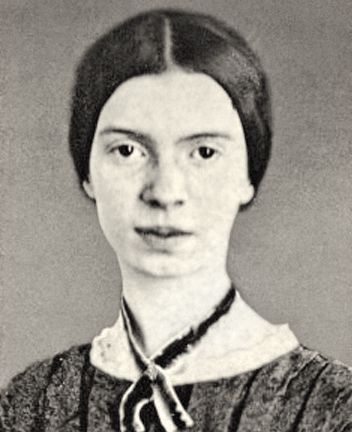
Emily Dickinson (1830-1886) lived almost all her life in her family's house in Amherst, Massachusetts, writing nearly 1,800 poems, most of them copied into hand-sewn booklets (fascicles) and fewer than a dozen printed in her lifetime. Raised in a Congregationalist household during New England revivals, she never made a public profession of faith yet wrote constantly about God, death, and immortality. Her sister Lavinia found the poems after her death, and editions edited by Mabel Loomis Todd and Thomas Wentworth Higginson began appearing in 1890.
written c. 1862-1863; published 1890 · 19th Century · Poetry
Because I could not stop for Death is Emily Dickinson's most famous poem about dying, written in Amherst around 1862-1863, the years of her greatest productivity and of the Civil War. It was not printed until 1890, four years after her death, when Mabel Loomis Todd and Thomas Wentworth Higginson included it in the first collection of her Poems under the title The Chariot.
This volume gathers the three books that first introduced Emily Dickinson's poetry to the public, all published in Boston in the decade after her death in 1886. Poems (1890) was edited by Mabel Loomis Todd, a young Amherst neighbor, and Thomas Wentworth Higginson, the man of letters with whom Dickinson had corresponded since 1862; Poems: Second Series followed in 1891 under the same two editors, and Poems: Third Series in 1896, edited by Todd alone.