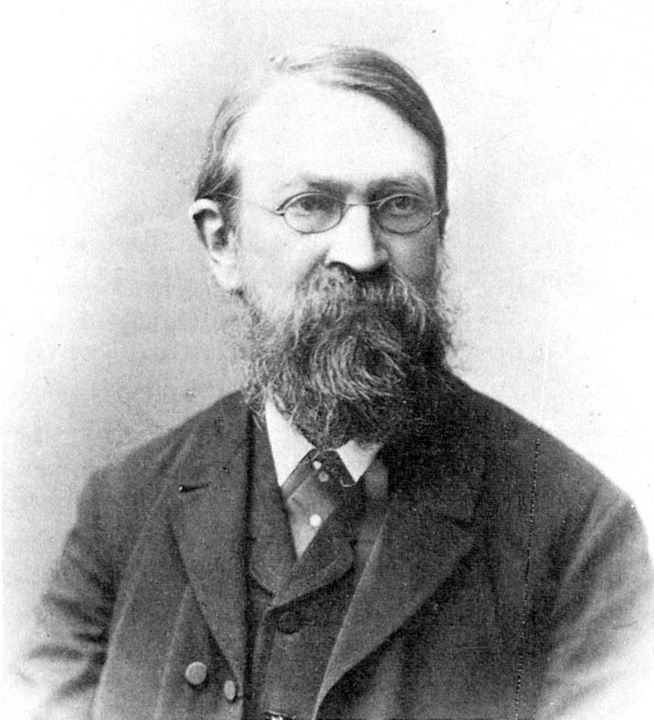
Ernst Mach (1838–1916) was born at Chirlitz (Chrlice) near Brünn in Moravia, studied at the University of Vienna, and taught physics at Graz and then, from 1867 to 1895, at the German university in Prague, which he served as rector. His experimental work ranged from acoustics and optics to the perception of contrast (Mach bands), the sense of balance in the semicircular canals, and the photography of shock waves around supersonic bullets, from which the later term 'Mach number' derives. His Science of Mechanics (1883) criticized Newton's absolute space and time. In 1895 he took a new chair in the history and theory of the inductive sciences at Vienna; after a stroke in 1898 he retired from teaching, and he was named to the Austrian upper house in 1901.
Frequently Cited
“Physics is experience, arranged in economical order.”
Popular Scientific Lectures gathers fifteen lectures and addresses that the Austrian physicist Ernst Mach gave between the 1860s and 1897 to general audiences, learned societies and university gatherings. They were first collected in English, translated by Thomas J. McCormack for the Open Court Publishing Company of Chicago in 1894–95; the library text is the enlarged third edition of 1898, whose proofs Mach read himself.