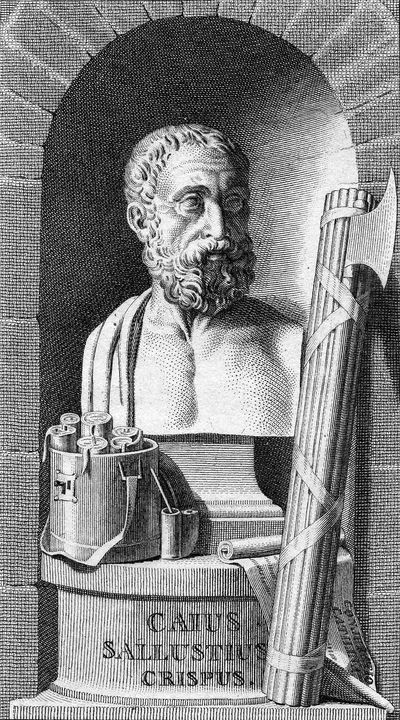
Sallust, from an eighteenth-century engraving (imagined likeness). Source · Public domain
About Sallust (Gaius Sallustius Crispus)
Gaius Sallustius Crispus (c. 86–35 BC) was born at Amiternum in the Sabine country of central Italy, a 'new man' without senatorial ancestors. He served as tribune of the plebs in 52 BC, was expelled from the senate by the censors in 50 BC, and joined Julius Caesar in the civil war. Caesar restored his career: Sallust was praetor in 46 BC, commanded in the African campaign, and became the first governor of the new province of Africa Nova. On his return he faced charges of extortion but was not brought to trial, and after Caesar's murder in 44 BC he withdrew from public life to his famous gardens in Rome and turned to history. He wrote the two monographs in this volume and a larger Histories covering 78–67 BC, which survives only in fragments and four speeches and two letters.
Sallust wrote two short monographs on episodes of the late Roman Republic, each opened by a philosophical preface and each meant to show how ambition and greed were corrupting the state. The library text is the Rev. John Selby Watson's literal English version, with his argument (chapter outline) before each work and his explanatory notes after it.