Work record
Catiline's War and The Jugurthine War
c. 42-40 BC · Ancient · History · Latin
Abstract
Background. Writing after Caesar's assassination, a retired Caesarian senator chose two episodes to explain why the Republic was failing. He traced the trouble to wealth and power pursued without restraint once Rome had no rival left.
Content. The first monograph follows a desperate noble's plot of 63 BC: recruitment of debtors and veterans, a betrayal by informers, Cicero's vigilance, arrests in the city, a decisive senate session and a final battle in Etruria. The second recounts a North African prince who climbed to the Numidian throne by murder and purchased Roman favor until popular anger, two capable commanders and a neighbor king's treachery ended his resistance.
Form. Each narrative opens with a reflection on the mind and on history. Composed speeches, balanced portraits and digressions on early Roman virtue, African geography and factional strife give the moral argument shape. The style is terse, archaic and pointed.
Translation. The library text is Watson's close Victorian rendering, with chapter outlines and many explanatory notes on Latin words and Roman institutions.
Significance. These are the earliest surviving Latin historical monographs. Augustine relied on them, medieval and Renaissance schools taught from them, and later republican thinkers borrowed their account of corruption. Scholars still debate how his Caesarian loyalties and moral design color the record.
Key figures
- Catiline: Bankrupt patrician who plotted to seize Rome in 63 BC
- Cicero: Consul who exposed the plot
- Caesar and Cato: Rival speakers in the senate's debate on punishment
- Jugurtha: Numidian king who corrupted Roman envoys and commanders
- Metellus: Aristocratic general who rebuilt the African army
- Marius: Consul from outside the old nobility who finished the African war
- Sulla: Quaestor who negotiated the Numidian's capture
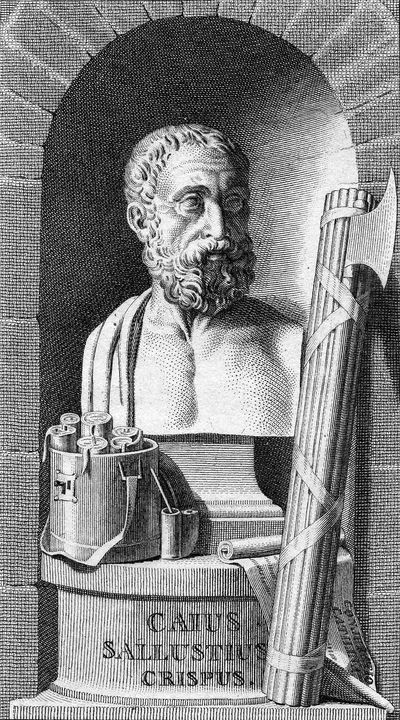

Summary
Sallust wrote two short monographs on episodes of the late Roman Republic, each opened by a philosophical preface and each meant to show how ambition and greed were corrupting the state. The library text is the Rev. John Selby Watson's literal English version, with his argument (chapter outline) before each work and his explanatory notes after it. Catiline's War (61 chapters) tells of the conspiracy of 63 BC. Sallust first sketches Lucius Sergius Catiline, a noble of great endurance and daring but depraved character, and then pauses for a history of Roman morals: the early city, he says, was held together by courage and justice, but after the destruction of Carthage in 146 BC avarice and ambition took hold, and Sulla's army learned luxury in Asia. Catiline gathers debtors, ruined young nobles and Sulla's old veterans, including the clever and dissolute Sempronia. Fulvia, mistress of the conspirator Quintus Curius, leaks the plot, and alarm helps elect Marcus Tullius Cicero consul. Catiline sends Gaius Manlius to raise troops in Etruria, plans to murder Cicero, and, after Cicero denounces him in the senate, leaves Rome for the army. The conspirators left in the city, led by Publius Lentulus Sura and Gaius Cethegus, approach envoys of the Gallic Allobroges, who betray them; letters are seized at the Mulvian Bridge. In the senate debate of 5 December, Julius Caesar argues against the death penalty and Marcus Porcius Cato demands it; Sallust gives both speeches at length and then compares the two men. The prisoners are strangled in the Tullian dungeon, and early in 62 BC Catiline dies fighting near Pistoria, found far ahead of his men among the enemy dead. The Jugurthine War (114 chapters) covers Rome's war of 112-105 BC against Jugurtha, grandson of Masinissa and adopted heir of King Micipsa of Numidia. Trained under Scipio at Numantia, Jugurtha murders his cousin Hiempsal, besieges and kills Adherbal at Cirta, and repeatedly bribes Roman envoys and generals. The tribune Gaius Memmius rouses the people; Jugurtha, summoned to Rome, has his rival Massiva assassinated there and leaves calling Rome a city for sale. After the disgrace of Aulus Albinus's army, sent under the yoke, the honest aristocrat Quintus Metellus restores discipline and fights at the Muthul. His officer Gaius Marius, a new man, wins the consulship with a fiery speech against the nobility, takes Capsa, and carries the war toward Mauretania, where Marius's quaestor Lucius Sulla persuades King Bocchus to hand Jugurtha over. Marius triumphs on 1 January 104 BC. Watson's translation was published in Bohn's Classical Library in the mid-nineteenth century; Project Gutenberg's transcription keeps both monographs complete with the notes.
Virtues in this work
- Justice: Caesar urges the senate to judge the conspirators without hatred, affection, anger or pity, so that the punishment fits Roman precedent and not passion.
- Fortitude: Cato stands against the momentum of the debate and persuades the senate that the safety of the state must come first.
- Temperance: Sallust says Cato's ambition was for temperance, discretion and austerity, contending with the modest in simplicity and with the temperate in abstinence.
- Prudence: Micipsa on his deathbed tells his sons that a kingdom is kept by faithful friends won through good offices, not by armies or treasure.
- Industry: Metellus restores the slack army in Africa by daily marching, fortified camps and strict discipline before he risks battle.
Plot or Argument
- Catiline I–IV: why write history
Sallust argues that the mind, shared with the gods, should seek lasting glory, defends the writing of history as a worthy work for a man shut out of politics, and explains that he chose the conspiracy of Catiline as a crime memorable for its novelty and danger.
- Catiline V–XIII: the portrait and the decline of morals
After sketching Catiline's character, Sallust narrates Rome's growth from Trojan and native founders under kings and consuls, the virtue of the early republic, and the turn after Carthage fell, when love of money and of power spread and Sulla's soldiers learned plunder and luxury.
- Catiline XIV–XXXVI: the conspiracy forms
Catiline collects the indebted and the reckless, murders his stepson for Aurelia Orestilla's sake and is tormented in mind, holds a secret meeting with oaths, recruits Sempronia, loses the consular election to Cicero, sends Manlius to Etruria, and, after Cicero's denunciation in the senate, leaves for Manlius's camp and is declared a public enemy.
- Catiline XXXVII–XLVII: the plot exposed
Sallust reflects on the discontent of the urban populace and the old quarrels of the orders; Lentulus tries to enlist the Allobroges, whose envoys tell their patron and then Cicero, and the conspirators are arrested with their letters at the Mulvian Bridge.
- Catiline XLVIII–LV: the senate debate
Caesar urges that passion not govern punishment and proposes confinement in the towns of Italy with confiscation; Cato answers that the state must secure itself and calls for execution; Sallust compares the virtues of the two men, and the prisoners are put to death in the Tullianum.
- Catiline LVI–LXI: the battle at Pistoria
Trapped between the armies of Metellus Celer and Antonius, Catiline addresses his men and dies in battle against Petreius; his followers fall at their posts, and the victors find friends and kinsmen among the dead.
- Jugurtha I–XVI: the heir of Numidia
After a preface on the mind and fortune, Sallust traces Jugurtha's rise at Numantia, Micipsa's deathbed advice on concord, the murder of Hiempsal, Adherbal's appeal to the senate, and the bribed division of Numidia.
- Jugurtha XVII–XXXV: Cirta and corruption
A description of Africa precedes the siege of Cirta, the death of Adherbal and the Italians in the town, the bought peace of Calpurnius Bestia, Memmius's speech to the people, and Jugurtha's visit to Rome, where Massiva is murdered.
- Jugurtha XXXVI–XLII: disgrace and party strife
Aulus Albinus's army is surprised and sent under the yoke; the Mamilian inquiry is voted, and Sallust digresses on the factions of nobility and people since the Gracchi.
- Jugurtha XLIII–LXXXIII: Metellus in command
Metellus restores discipline, wins the battle at the Muthul, besieges Zama and Thala, and resists Jugurtha's tricks, while Marius, his lieutenant, seeks the consulship over Metellus's objection.
- Jugurtha LXXXIV–CXIV: Marius, Sulla and Bocchus
Marius answers the nobles in his speech to the people, enrolls volunteers, takes Capsa and the fortress near the Muluccha, and fights two battles with Jugurtha and Bocchus; Sulla's negotiations lead Bocchus to surrender Jugurtha, and Marius triumphs.
Characters
- Lucius Sergius Catiline, conspirator
Patrician conspirator of great physical endurance and ruinous ambition.
- Marcus Tullius Cicero, consul
Consul of 63 BC who uncovers and suppresses the conspiracy.
- Gaius Julius Caesar, senator and speaker
Praetor-elect who argues against executing the conspirators.
- Marcus Porcius Cato, senator and speaker
Tribune-elect whose speech persuades the senate to impose death.
- Publius Cornelius Lentulus Sura and Gaius Cethegus, conspirators
Leaders of the conspirators left inside Rome.
- Sempronia, accomplice
Accomplished and reckless noblewoman drawn into the plot.
- Jugurtha, king and antagonist
Numidian prince, brave and gifted, who seizes the kingdom by murder and bribery.
- Micipsa, Adherbal and Hiempsal, Numidian royal family
The old king of Numidia and his two sons, Jugurtha's rivals.
- Quintus Caecilius Metellus, Roman commander
Upright noble commander who restores Roman discipline.
- Gaius Marius, Roman commander and consul
New man from Arpinum who wins the consulship and ends the war.
- Lucius Cornelius Sulla, quaestor and envoy
Marius's quaestor, who secures Jugurtha's surrender from Bocchus.
- Bocchus, king of Mauretania
King of Mauretania, Jugurtha's father-in-law and finally his betrayer.
Lessons
Prosperity can be harder to bear than danger
Sallust's history of Roman morals in Catiline X turns on a paradox: the Romans who had endured toil and peril easily found ease and wealth a burden once Carthage was gone. Love of money came first and love of power after, and with them came deceit, contempt of religion and venality. He presents Catiline not as a monster dropped from the sky but as the product of a city that had changed its loves.
- Why does Sallust think success, not defeat, began Rome's decline?
- How does the long digression on early Rome prepare the reader to understand Catiline?
- Can you think of a person or institution weakened more by comfort than by hardship?
Two kinds of greatness
After the debate of 5 December Sallust sets Caesar and Cato side by side: Caesar famed for generosity, mercy and energy, Cato for integrity, firmness and austerity. He praises both. Cato wished rather to be good than to seem so, and glory followed him the less he sought it. Readers can weigh the two speeches, Caesar's appeal to precedent and calm judgment and Cato's appeal to the safety of the state, on their own merits.
- What argument does Caesar make about passion and judgment, and what argument does Cato make about danger and delay?
- Why does Sallust praise both men instead of naming a winner?
- What does it mean to wish to be virtuous rather than to appear virtuous?
Money that buys a state
In the Jugurthine War, Jugurtha's gold opens senators' doors, buys a partition of Numidia and a peace from a consul, and leads him to call Rome a city for sale. Sallust uses the war to show how private bribery becomes public weakness, and how men like Memmius and Metellus, in different ways, refuse it.
- Trace the stages by which Jugurtha's bribery succeeds and then fails.
- Why does Micipsa tell his sons that friends cannot be bought with gold?
- What protects a community against corruption, in Sallust's view: laws, leaders, or character?
Merit and birth
Marius's speech in Jugurtha LXXXV contrasts nobles who boast of ancestors' portraits with a new man who can show only his own scars and service. Sallust, himself a new man, gives the speech force while also showing Metellus as an honest noble and Sulla as a gifted one. The work asks how a republic should recognize ability.
- What does Marius claim to offer the people instead of famous ancestors?
- Does Sallust present Metellus fairly? What evidence supports your answer?
Context
Both monographs look back from the years after Caesar's assassination, when the Republic was collapsing into the rule of the triumvirs. The Jugurthine War (112–105 BC) belongs to the age after the Gracchi, when the quarrel between the senatorial nobility and popular leaders sharpened and Marius rose to power; the Catilinarian conspiracy (63 BC) came during Cicero's consulship, when debt, the ruined veterans of Sulla and frustrated ambition threatened Rome itself. Sallust sees both episodes as stages in a moral decline that began with the fall of Carthage in 146 BC.
Composition
Sallust wrote Catiline's War about 42–41 BC and the Jugurthine War about 41–40 BC, then began his Histories. He modeled his compressed, archaic and abrupt style on Thucydides and on the elder Cato, and wove into the narrative speeches composed in the manner of ancient historians, character portraits and digressions on morals, geography and party conflict. He drew on Cicero's published speeches and probably on his own memories of 63 BC, when he was in his early twenties.
Reception
Sallust was one of the most read Latin historians in antiquity and the Middle Ages. Martial called him the first of Roman historians, Quintilian praised his brevity, and Augustine quoted him often in The City of God for the Romans' own account of their virtue and its decay. The monographs were school texts through the Renaissance and shaped Tacitus and, much later, Machiavelli and the republican political writers of the seventeenth and eighteenth centuries. Scholars continue to debate how far Sallust's portraits of Caesar and Cato reflect his own Caesarian loyalties and how far his moral scheme shapes his facts; his chronology is sometimes loose, and his account of an earlier 'first conspiracy' in 66–65 BC is disputed.
Comparisons
- cicero-first-catilinarian
Cicero's speech of November 63 BC is the denunciation that Sallust mentions in Catiline XXXI as a brilliant oration later published; the two give the consul's and the historian's views of the same crisis.
- julius-caesar
Shakespeare's Caesar and Cato's son-in-law Brutus belong to the next act of the drama whose earlier scene Sallust records in the debate of 5 December.
- the-fall-of-the-roman-republic
Plutarch's lives of Marius, Sulla, Caesar and Cicero retell many of the same events from biography rather than monograph, with different emphases on character.
- livy-history-of-rome-books-i-v
Livy's early Rome is the virtuous city Sallust praises in Catiline VI–IX; both historians write to show how character rises and falls with the fortunes of the state.
- city-of-god
Augustine draws on Sallust's account of Roman virtue and its decline to argue that Rome's greatness rested on love of glory and was not a gift of its gods.
- the-history-of-the-peloponnesian-war
Thucydides was Sallust's chief stylistic model; his paired speeches and his analysis of civil strife at Corcyra stand behind the Caesar and Cato debate and the digression on factions.
Quotes
“For the glory of wealth and beauty is fleeting and perishable; that of intellectual power is illustrious and immortal.”
“At first the love of money, and then that of power, began to prevail, and these became, as it were, the sources of every evil.”
“For his guilty mind, at peace with neither gods nor men, found no comfort either waking or sleeping; so effectually did conscience desolate his tortured spirit.”
“When the mind is freely exerted, its reasoning is sound; but passion, if it gain possession of it, becomes its tyrant, and reason is powerless.”
“for to lavish the property of others is called generosity, and audacity in wickedness is called heroism; and hence the state is reduced to the brink of ruin.”
“he was more desirous to be, than to appear, virtuous; and thus, the less he courted popularity, the more it pursued him.”
“for by concord even small states are increased, but by discord, even the greatest fall to nothing.”
“That it was a venal city, and would soon perish, if it could but find a purchaser!”
For Students
A reading companion for classical Christian high school students. See the student guide.
Reading Guide
Watch for
- The prefaces to both works, where Sallust explains why history is worth writing and what the mind is for.
- The digression on early Roman virtue and later decline in Catiline VI–XIII, and how it frames Catiline as a product of his times.
- The paired speeches of Caesar and Cato (Catiline LI–LII) and the comparison of the two men that follows.
- Every time money changes hands in the Jugurthine War, and who refuses it.
- The endings of both works: Catiline among the enemy dead, and Marius's triumph with the hope of the state resting on him.
Key terms and names
- Conscript Fathers
- The formal address to the members of the Roman senate, used by Caesar and Cato in their speeches.
- New man (novus homo)
- A Roman who reached the consulship without consular ancestors, like Cicero and Marius; Sallust himself was a new man in the senate.
- Nobility
- In Sallust, the families whose ancestors had held the consulship and who tended to keep high office among themselves.
- Senatus consultum ultimum
- The senate's emergency decree directing the consuls to see that the state came to no harm; Sallust describes it in Catiline XXIX.
- Virtus
- The Latin word Watson renders by 'intellectual power', 'merit' or 'virtue': manly excellence of mind and action, the key term of both prefaces.
- Allobroges
- A Gallic people whose envoys at Rome were approached by the conspirators and instead revealed the plot.
- Numidia
- The North African kingdom west of Carthage, roughly modern Algeria, ruled by Masinissa's descendants.
- Passing under the yoke
- A ritual humiliation for a defeated army, forced to walk beneath a frame of spears; Aulus Albinus's men suffer it in Jugurtha XXXVIII.
Seminar Questions
- Comprehension What kinds of people join Catiline, and what does each group hope to gain?
- Comprehension How is the conspiracy discovered, and what role do Fulvia and the Allobroges play?
- Comprehension Why does Jugurtha's bribery work in the early years of the war, and what finally brings him down?
- Interpretation Caesar argues for life imprisonment and Cato for death. Which arguments in each speech are about justice, and which are about the safety of the state?
- Interpretation Catiline dies bravely, and his men fall with wounds in front. Why might Sallust end his account of a villain with this scene?
- Interpretation Sallust says the Jugurthine War was the first time the people resisted the arrogance of the nobility. How does the rest of the monograph support or complicate this claim?
- Big Question Sallust believes that the moral condition of citizens decides the fate of a state. Is a republic preserved mainly by good laws or by good people?
Faith Connections
- 1 Timothy 6:10 (Scripture)
'For the love of money is the root of all evil.' Paul's words, written about a century later, echo Sallust's judgment in Catiline X that love of money and of power became the sources of every evil in Rome.
- Isaiah 48:22; 57:20–21 (Scripture)
'There is no peace, saith the LORD, unto the wicked.' Sallust's description of Catiline's guilty mind, finding no rest waking or sleeping, matches the prophet's image of the troubled sea that cannot rest.
- Proverbs 17:23 (Scripture)
'A wicked man taketh a gift out of the bosom to pervert the ways of judgment.' Jugurtha's gifts to senators and consuls are a sustained example.
- Augustine, The City of God, Books I, II and V (Church Fathers)
Augustine quotes Sallust repeatedly, using his account of early Roman virtue and later corruption, and his phrase about the lust of domination, to contrast the earthly city's love of glory with the city of God.
Logic and Rhetoric
Central argument: A state rises while its citizens love virtue and glory more than wealth and ease; once victory removes danger, avarice and ambition corrupt both nobles and people; therefore the conspiracy of Catiline and the venality exposed by Jugurtha are symptoms of a moral decline, and only men of real virtue, whether old nobles like Metellus and Cato or new men like Marius, can check it.
Rhetorical device: antithesis in a paired character sketch (syncrisis). In Catiline LIV Sallust balances Caesar and Cato clause by clause: Caesar renowned for giving, relieving and pardoning, Cato for bestowing nothing; in Caesar a refuge for the unfortunate, in Cato destruction for the bad.
Debate: Resolved: The Roman senate was right to follow Cato and execute the captured conspirators without a trial before the people.
Memory Work
he was more desirous to be, than to appear, virtuous; and thus, the less he courted popularity, the more it pursued him.
for by concord even small states are increased, but by discord, even the greatest fall to nothing.
Writing Prompts
Essay: Sallust says that the minds of men were corrupted by prosperity rather than by adversity. Using Catiline, Jugurtha and the Roman leaders in both monographs, explain his argument and evaluate whether the evidence he gives supports it.
Comparison with First Oration Against Catiline: Compare Cicero's speech against Catiline with Sallust's account of the same weeks. What does each emphasize about Catiline, about Cicero, and about the danger to Rome, and how do their purposes explain the differences?
Medical Lens
Sallust is not a medical writer, but Catiline XV gives one of the best-known ancient portraits of a guilty conscience expressed in the body: sleeplessness, pallor, haggard eyes, a walk alternately hurried and slow, and visible distraction. It belongs to a long classical and Christian tradition, running through Plato's account of the tyrant's soul and later through Macbeth, in which crime disorders sleep and bearing; it is a moral portrait rather than a clinical one, and any retrospective label would be interpretive. Catiline V records his extraordinary tolerance of hunger, cold and lack of sleep. Catiline XXXI describes the collective fear that seized Rome as each citizen 'measured the public danger by his own fear'. In LIX the consul Antonius is said to be unable to fight because of lameness of the feet, which Watson's note discusses as possibly gout or a convenient pretext; LXI notes that Catiline's men fell with wounds in front.
- Catiline's War, ch. XV
Catiline's guilty conscience: no rest waking or sleeping, pale complexion, haggard eyes, irregular gait.
- Catiline's War, ch. V
Catiline's bodily endurance of hunger, cold and want of sleep beyond belief.
- Catiline's War, ch. XXXI
Gloom and alarm spread through the city; citizens feel safe nowhere and with no one.
- Catiline's War, ch. LIX and Watson's note 298
Antonius absent from the battle through lameness of the feet; the translator weighs whether it was gout or a pretext.
Creative Prompts
- Classroom
Stage the senate debate of 5 December 63 BC: students read Caesar's and Cato's speeches aloud, then other 'senators' rise to support one proposal, and the class votes before reading what the senate decided.
- Essay
Write a character sketch of a public figure, ancient or modern, in Sallust's manner: a short paragraph of balanced contrasts naming both gifts and vices without exaggeration.
- Classroom
On a map of North Africa, trace the campaigns of the Jugurthine War: Cirta, Vaga, the Muthul, Zama, Thala, Capsa and the Muluccha, noting what Sallust says about the land and water of each.
- Dialogue
Write the conversation between Sulla and Bocchus on the night before Bocchus decides whether to betray Jugurtha, drawing on the speeches in Jugurtha CII–CXIII.
Further Reading
- Sallust, Ronald Syme
- Catiline and Jugurtha (translated with notes), A. J. Woodman
- Orations against Catiline, Marcus Tullius Cicero
- The Roman Revolution, Ronald Syme
- Rubicon: The Last Years of the Roman Republic, Tom Holland
Verification notes
Chapter divisions, names and episodes follow the stored Watson translation, which prints an argument (chapter outline) before each monograph and numbered notes after each. All eight quotations were found by search in content/texts/sallust-catiline-and-jugurtha.txt and copied exactly, avoiding the footnote markers in the text; whitespace across line breaks has been collapsed. Watson renders Latin virtus variously ('intellectual power', 'merit'), which his own notes explain. Dates of composition (c. 42-40 BC) are the usual scholarly estimates. Watson's Sallust appeared in Bohn's Classical Library (with Florus and Velleius Paterculus); the meta file gives no year. A. J. Woodman's English translation of the two monographs is cited in furtherReading by its general description because its published title varies by edition.
- The year of first publication of Watson's translation in Bohn's Classical Library (usually given as 1852).
- The exact title and edition of A. J. Woodman's translation of the two monographs.
- Whether Sallust's account of a 'first conspiracy' of 66-65 BC (Catiline XVIII-XIX) should be described as disputed in the abstract as well as in historicalContext.