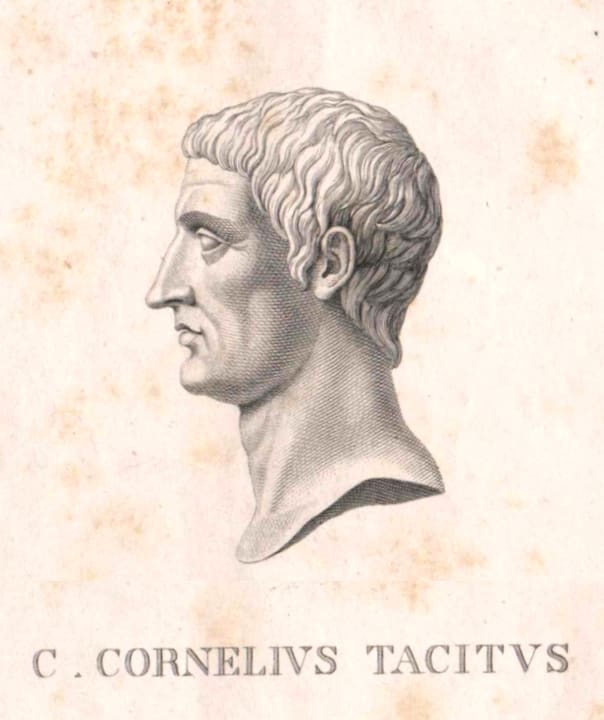
Publius (or Gaius) Cornelius Tacitus (c. 56–after 117 CE) was a Roman senator, orator and historian who rose through the offices of state under the Flavian emperors and was consul in 97 CE. He married the daughter of Gnaeus Julius Agricola. His short works, the Agricola, Germania and Dialogue on Orators, were followed by the Histories and the Annals, which made him the greatest historian of the early Roman Empire.
This volume contains Tacitus' two earliest works, both written in 98 CE, soon after the assassination of the emperor Domitian. The Agricola is a biography and eulogy of the author's father-in-law, Gnaeus Julius Agricola, who died in 93.
The Histories is Tacitus's narrative of the Roman Empire from 1 January AD 69 onward. It originally ran to Domitian's death in 96, but only Books I-IV and the first part of Book V survive, covering about eighteen months.
The Annals of Imperial Rome narrates the Julio-Claudian empire from the death of Augustus through Tiberius, Claudius and Nero, though parts are lost. Tacitus writes history as the psychology of autocracy.