Work record
The Histories
c. AD 100-110 · Ancient · History · Latin
Abstract
Background. A senator who had prospered under the Flavians, Tacitus wrote this account of his own lifetime under Trajan, after the Agricola and Germania and before the Annals. One manuscript in Florence carries what remains.
Scope. The surviving text spans roughly eighteen months, from New Year's Day of AD 69 to the summer of 70. Galba, Otho and Vitellius fall in turn; Vespasian's partisans take Rome amid street fighting and the loss of Jupiter's temple.
Content. Alongside the civil wars run the Batavian rising led by Civilis, with its short-lived Gallic empire and Cerialis's speech defending Roman government, and the opening of Titus's campaign against Jerusalem. Book V's excursus on Jewish origins and customs repeats hostile Greek and Egyptian traditions, and the text stops during talks on the Rhine.
Method. Tacitus arranges events by year and theatre, sets formal speeches against narrative, and closes portraits with compressed verdicts; he names his Flavian debts and claims impartiality. Fyfe's Oxford version keeps his introduction and notes.
Significance. It remains the principal source for the Year of the Four Emperors and a classic study of armies as kingmakers. Renaissance political writers mined its maxims, and historians still read it beside Suetonius, Plutarch and Josephus to reconstruct the months between Nero's death and the Flavian peace.
Key figures
- Galba: Elderly emperor murdered in the Forum after adopting Piso
- Otho: Emperor raised by the Guard, whose suicide ends his war
- Vitellius: Choice of the Rhine legions, killed when Flavian troops take Rome
- Vespasian: Judaean commander proclaimed in the East, founder of the Flavian house
- Antonius Primus: Flavian general who wins at Cremona
- Julius Civilis: Batavian noble who leads the Rhine revolt
- Petillius Cerialis: Roman general who ends the revolt and defends Roman rule at Trier
- Titus: Vespasian's son, commander before Jerusalem
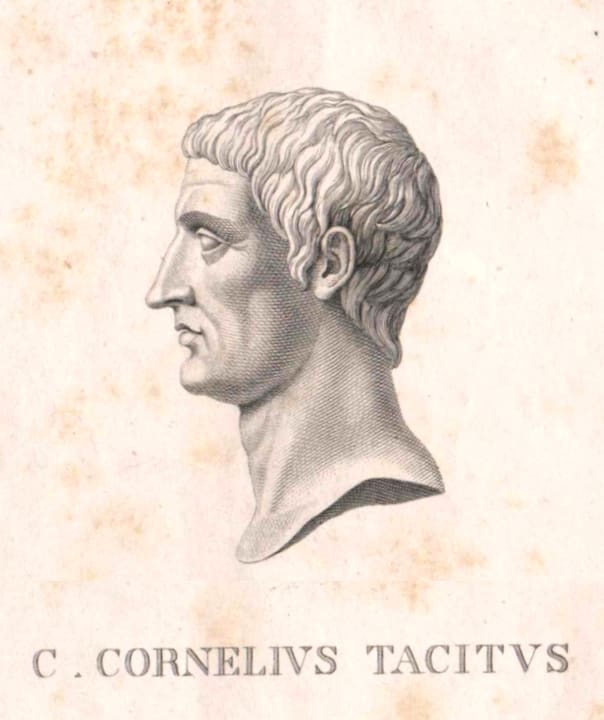

Summary
The Histories is Tacitus's narrative of the Roman Empire from 1 January AD 69 onward. It originally ran to Domitian's death in 96, but only Books I-IV and the first part of Book V survive, covering about eighteen months. The surviving portion is the fullest ancient account of the Year of the Four Emperors. Book I opens with a preface on how truth suffered once power passed to one man, and with the famous survey of a period rich in disaster. Galba, the elderly governor of Nearer Spain who had risen against Nero, reigns in Rome with parsimony and severity, advised by Titus Vinius, Cornelius Laco and the freedman Icelus. His adoption of the young aristocrat Piso Licinianus is answered by Otho, who bribes the Praetorian Guard; Galba and Piso are cut down in the Forum on 15 January. Meanwhile the Rhine legions have already proclaimed Vitellius, governor of Lower Germany. Book II follows the war between Otho and Vitellius. Vitellius's generals Fabius Valens and Caecina Alienus cross the Alps; Otho's army is beaten near Bedriacum, and Otho, refusing to prolong civil war, takes his own life at Brixellum. Vitellius advances to Rome in a mood of feasting and display, while in the East Vespasian, commanding the war in Judaea, is proclaimed emperor at Alexandria and in Judaea in July, backed by Mucianus, governor of Syria. Book III narrates the Flavian counterstroke. Antonius Primus leads the Danubian legions into Italy, defeats the Vitellians at the second battle near Cremona, and lets his troops sack the city. In Rome, Vespasian's brother Flavius Sabinus is besieged on the Capitol, the temple of Jupiter burns, and Sabinus is killed; Flavian troops then storm the city, and Vitellius is dragged through the streets and killed in December. Book IV turns to the settlement under Mucianus and the young Domitian, the senate's debates (including Helvidius Priscus's stand), and the great revolt on the Rhine. Julius Civilis, a Batavian noble and former Roman auxiliary officer, raises his people and is joined by the Gallic leaders Classicus and Tutor and by the prophetess Veleda; legions are besieged at Vetera and some swear allegiance to an Empire of the Gauls. Petillius Cerialis restores order and, at Trier, defends Roman government to the Treviri and Lingones. The book closes in Egypt with the healings attributed to Vespasian at Alexandria. Book V begins Titus's siege of Jerusalem in AD 70 and pauses for Tacitus's account of the origins, customs and history of the Jews, a passage notable for its hostility and its reliance on Greek and Egyptian writers, before returning to the last campaign against Civilis. The text breaks off as Civilis negotiates with Cerialis. Fyfe's 1912 translation, used here, includes his introduction and notes.
Virtues in this work
- Fortitude: Tacitus opens by honouring mothers and wives who followed their families into exile and slaves who stayed loyal under torture in the worst of times.
- Prudence: Vespasian weighs the eastern armies, Mucianus's advice and the state of Italy before accepting the proclamation, and Tacitus contrasts him with rash rivals.
- Honor: Otho chooses to die at Brixellum rather than send his army into another battle, and Tacitus says his death earned him a noble name.
- Justice: Helvidius Priscus presses the senate in Book IV to act independently and hold informers to account after the civil war.
Plot or Argument
- Book I: Preface and the fall of Galba
Tacitus states his aims and surveys the disasters of the period, then examines the state of the armies and provinces at Nero's death. Galba adopts Piso, Otho wins over the Guard, and both Galba and Piso are murdered in the Forum. The Rhine armies proclaim Vitellius.
- Book II: Otho against Vitellius
Vitellian armies under Valens and Caecina descend into Italy. After the defeat near Bedriacum, Otho dies by his own hand at Brixellum to end the bloodshed. Vitellius's slow progress to Rome contrasts with the proclamation of Vespasian in the East and the planning of Mucianus.
- Book III: The Flavian advance and the burning of the Capitol
Antonius Primus wins the second battle at Cremona and sacks the town. Flavius Sabinus is trapped on the Capitol, the temple of Jupiter Best and Greatest is burned, and the Flavian troops fight their way into Rome, where Vitellius is killed.
- Book IV: Rome under Mucianus and the Batavian revolt
The senate reasserts itself in debate while Mucianus and Domitian hold power. On the Rhine, Julius Civilis leads the Batavi and their allies, the legions at Vetera surrender, and Classicus and Tutor proclaim a Gallic empire. Cerialis recovers the region and argues for Roman rule at Trier; Vespasian's healings at Alexandria close the book.
- Book V: Judaea and the end of the Rhine war
Titus marches on Jerusalem. Tacitus digresses on the Jews' origins, religion and history from Pompey to the war, describes the city and its temple and the factions inside it, and notes the portents and the prophecy he applies to Vespasian. He returns to the Rhine, where the war against Civilis winds down; the manuscript ends mid-negotiation.
Characters
- Galba, emperor, June 68 to January 69
Aged aristocrat and former governor of Nearer Spain, strict, frugal and dependent on unpopular advisers.
- Piso Licinianus, Galba's adopted heir
Young noble of old family adopted four days before his death.
- Otho, emperor, January to April 69
Former companion of Nero who seizes power through the Guard and dies by his own hand after Bedriacum.
- Vitellius, emperor, April to December 69
Governor of Lower Germany raised by the Rhine armies, remembered by Tacitus for indolence and gluttony.
- Fabius Valens and Caecina Alienus, Vitellian generals
Rival commanders who lead the invasion of Italy; Caecina later attempts to betray Vitellius.
- Vespasian, commander in Judaea, emperor from July 69
Veteran general of modest origin whom Tacitus credits with improving once in power.
- Mucianus, governor of Syria
Able, ambitious ally who backs Vespasian and governs Rome in his absence.
- Antonius Primus, Flavian general
Bold commander of the Danubian legions who wins at Cremona.
- Flavius Sabinus, Vespasian's elder brother, prefect of the city
Killed after the siege of the Capitol.
- Titus, Vespasian's elder son
Sent to complete the reduction of Judaea and besiege Jerusalem.
- Domitian, Vespasian's younger son
Young prince who escapes the Capitol and holds nominal power in Rome.
- Julius Civilis, Batavian leader
Royal-born auxiliary officer who leads the Rhine revolt.
- Petillius Cerialis, Roman general
Commander who suppresses the revolt and addresses the Gallic tribes at Trier.
- Veleda, prophetess of the Bructeri
Seer revered across the Rhine, consulted by the rebels.
- Helvidius Priscus, senator and praetor
Outspoken Stoic senator who presses the senate's independence.
Lessons
An emperor could be made elsewhere than at Rome
Tacitus locates the crisis of 69 in a discovery: armies in the provinces could choose a ruler. Each new emperor in the Histories owes his throne to soldiers, and each finds that the same soldiers expect pay and indulgence. The book traces how authority grounded in force must keep purchasing loyalty.
- Why does Tacitus call the army's discovery a secret of state?
- How do the Praetorians, the Rhine legions and the Danubian legions each behave once they realize their power?
- What does Galba's refusal to pay a donative reveal about him and about the soldiers?
Character is tested by power
The obituary sketches of Galba, Otho and Vitellius ask how the same man appears before and after rule. Galba seemed fit to reign until he reigned; Otho, a figure of Nero's court, earns praise by his death; Vespasian improves on the throne. Tacitus treats office as a revealer of character rather than a maker of it.
- Which of the four emperors does Tacitus judge most harshly, and on what evidence?
- How does Otho's death change the reader's view of his life?
- Can a person be fit for leadership in every way except the exercise of it?
The historian's own position
The preface admits that Tacitus owed his career to the Flavians and promises to write without love or hatred. Readers can watch how a senator writing under Trajan judges soldiers, crowds, freedmen, provincials and foreign peoples. Knowing the historian's standpoint helps students weigh his vivid judgments as evidence.
- Why does Tacitus disclose his debts to Vespasian, Titus and Domitian at the outset?
- Where does his senatorial outlook shape his portrait of the soldiers or the city crowd?
- How should a reader use Book V's account of the Jews alongside Josephus's Jewish War?
Rome argues for its own rule
In Book IV Civilis speaks for Batavian liberty and Cerialis answers that peace among the tribes requires troops, troops require pay, and pay requires taxes. Tacitus gives both sides strong speeches, letting readers hear how Romans and their subjects each understood the empire.
- What does Civilis claim the Batavi have lost under Rome?
- What alternatives to Roman rule does Cerialis warn the Gauls about?
- Why might Tacitus give such strong speeches to both sides?
Context
Nero's suicide in June 68 ended the Julio-Claudian line that had ruled since Augustus. In 69 four men held the title of emperor in turn, and civil war passed twice through northern Italy and into Rome itself; at the same time Rome fought a revolt on the Rhine and the Jewish war in Judaea. The Flavian dynasty founded by Vespasian ruled until Domitian's murder in 96. Tacitus wrote under Trajan, in a period he describes as one of rare freedom of speech.
Composition
The Histories was written after the Agricola and Germania (c. 98) and before the Annals, probably in the first decade of the second century; Pliny the Younger's letters describing the eruption of Vesuvius (Letters VI.16 and VI.20) were written to supply Tacitus with material for it. The full work probably covered 69 to 96 in twelve or fourteen books; with the Annals the total was reported in antiquity as thirty books. Books I-V.26 survive through a single medieval manuscript, the so-called Second Medicean in the Laurentian Library at Florence, which also preserves Annals XI-XVI. W. Hamilton Fyfe's translation was published by the Clarendon Press, Oxford, in two volumes in 1912.
Reception
Tacitus was little read in late antiquity, though Christian writers knew him; scholars have argued that Sulpicius Severus's account of Titus's council before the burning of the Temple draws on a lost part of Book V, a view that remains debated. Rediscovered in the Renaissance, the Histories shaped early modern political thought about armies, tyranny and reason of state, and its sententiae entered the European commonplace tradition. Modern historians of 69 depend on it alongside Suetonius, Plutarch's Lives of Galba and Otho, Cassius Dio and Josephus.
Comparisons
- the-annals-of-imperial-rome
The Annals, written later, goes back to AD 14 and covers the Julio-Claudians; together the two works formed Tacitus's continuous history of the principate, and the Histories picks up where Nero's death leaves the Annals.
- the-agricola-and-the-germania
Calgacus's speech in the Agricola and Civilis's in Histories IV both give Rome's enemies eloquent speeches against Roman rule, and the Germania supplies the ethnographic background for the Batavi, Bructeri and Veleda.
- the-twelve-caesars
Suetonius's Lives of Galba, Otho, Vitellius and Vespasian cover the same months by anecdote and personal detail rather than continuous narrative; the two accounts of the Alexandrian healings can be read side by side.
- the-jewish-war
Josephus, who knew Vespasian and Titus personally and was present at the siege, gives a Jewish and eyewitness account of the war that Tacitus opens in Book V, with far fuller knowledge of Jewish religion and politics.
- plutarch-lives
Plutarch wrote Lives of Galba and Otho drawing on a common source with Tacitus, so parallel episodes such as Otho's death show how two ancient writers shaped shared material.
- the-history-of-the-peloponnesian-war
Thucydides's account of civil strife at Corcyra is the classical model for the moral collapse Tacitus traces in Italy, where words change meaning and kin turn on kin.
Quotes
Frequently cited
“it is the rare fortune of these days that a man may think what he likes and say what he thinks.”
Frequently cited
“It had divulged a secret of state: an emperor could be made elsewhere than at Rome.”
Frequently cited
“When he was a commoner he seemed too big for his station, and had he never been emperor, no one would have doubted his ability to reign.”
“Slaves were bribed against their masters, freedmen against their patrons, and, if a man had no enemies, he was ruined by his friends.”
“never has it been proved by such terrible disasters to Rome or by such clear evidence that Providence is concerned not with our peace of mind but rather with vengeance for our sin.”
“He was the first emperor who ever changed for the better.”
“You must put up with luxury and greed in your masters, just as you put up with bad crops or excessive rain, or any other natural disaster. Vice will last as long as mankind.”
“he eventually told the doctors to form an opinion whether such cases of blindness and deformity could be remedied by human aid.”
For Students
A reading companion for classical Christian high school students. See the student guide.
Reading Guide
Watch for
- The preface (I.1-3), where Tacitus sets out his debts to the Flavians, his promise of impartiality and his catalogue of the year's disasters.
- The paired death-scenes and obituaries of Galba (I.41-49), Otho (II.46-50) and Vitellius (III.84-86), and how each life is summed up in a single sentence.
- The speeches of Civilis and Cerialis in Book IV, which give the case against and the case for Roman rule on the Rhine.
- The burning of the Capitol (III.71-72), which Tacitus treats as the worst crime in Rome's history.
- The shift in tone in Book V, where the siege of Jerusalem is interrupted by a long ethnographic digression drawn largely from hostile sources.
Key terms and names
- Praetorian Guard
- The emperor's household troops in Rome; their switch from Galba to Otho in January 69 decides the first change of ruler.
- Donative
- A cash gift to soldiers on an emperor's accession; Galba's refusal to pay the one promised in his name costs him the Guard's loyalty.
- Bedriacum
- A village between Cremona and Verona near which two battles of 69 were fought, the first won by Vitellius's generals and the second, near Cremona, by Antonius Primus.
- The Capitol
- The hill and temple of Jupiter Best and Greatest, the religious centre of the Roman state, burned during the fighting of December 69.
- Batavi
- A Germanic people of the Rhine delta who supplied Rome with soldiers instead of tribute and rose under Julius Civilis.
- Sententia
- A pointed, quotable maxim closing a passage; Tacitus's obituary of Galba ends with one of the most famous.
Seminar Questions
- Comprehension What steps lead from Galba's adoption of Piso to the murders in the Forum on 15 January?
- Comprehension How does Vespasian come to be proclaimed emperor, and what role do Mucianus and the eastern legions play?
- Comprehension What reasons does Otho give his nephew and his soldiers for choosing death rather than another battle?
- Interpretation Tacitus says Galba would have seemed fit to rule if he had never ruled. What faults does the narrative show that office brought to light?
- Interpretation Why does Tacitus place the burning of the Capitol at the heart of Book III, and what does it mean for him that Romans set the fire?
- Interpretation Compare the arguments of Civilis and Cerialis in Book IV. Which appeals to liberty, which to peace, and how does each use the past?
- Big Question Tacitus closes his preface by saying the gods cared more for punishment than for Rome's peace. How does that verdict compare with a Christian reading of providence in the same events, such as the fall of Jerusalem?
- Big Question When soldiers can make and unmake rulers, what, if anything, can still give authority legitimacy?
Faith Connections
- Daniel 2:21 (Scripture)
Daniel praises the God who changes times and seasons and removes and sets up kings; the Histories shows four emperors set up and removed in a single year, with Tacitus himself searching for the divine purpose.
- Luke 19:41-44 (Scripture)
Jesus weeps over Jerusalem and foretells its encirclement by enemies; Book V of the Histories opens the Roman siege of AD 70 to which early Christians connected this prophecy.
- Augustine, City of God, Book I, ch. 22-23 (Church Fathers)
Augustine argues that Roman self-killing, even Cato's, shows weakness rather than greatness of soul; his argument gives students a Christian conversation partner for Tacitus's praise of Otho's death.
- Augustine, City of God, Book V (Great Conversation)
Augustine asks why God gave the Romans their empire and how earthly glory relates to true virtue, questions that bear directly on the scramble for glory and power in 69.
Logic and Rhetoric
Central argument: When the principate rests on the armies rather than on law or the senate, each claimant must buy the soldiers' loyalty; because purchased loyalty transfers to the highest bidder, civil war follows, and character, not title, decides whether a ruler grows better or worse in power.
Rhetorical device: Sententia (epigrammatic closure). The obituary of Galba in Book I, ch. 49 ends with the antithesis that he would have seemed fit to rule had he never ruled; Vespasian in I.50 is summed up as the first emperor who changed for the better.
Debate: Resolved: Cerialis's speech at Trier (Histories IV.73-74) gives the Treviri and Lingones good reason to accept Roman rule.
Memory Work
it is the rare fortune of these days that a man may think what he likes and say what he thinks.
When he was a commoner he seemed too big for his station, and had he never been emperor, no one would have doubted his ability to reign.
Writing Prompts
Essay: Using the deaths of Galba, Otho and Vitellius, argue what Tacitus believes a good death can and cannot redeem in a ruler's life.
Comparison with The Jewish War: Compare Josephus's and Tacitus's accounts of Titus and the opening of the siege of Jerusalem. How do each writer's position and sources shape his picture of the Jews and of Rome?
Medical Lens
The Histories is a political narrative, but several episodes interest the historian of medicine. Vespasian's healings at Alexandria (IV.81) are one of the few ancient accounts in which a ruler consults physicians about whether blindness and a maimed limb are curable before attempting a sacral cure; the doctors' answer mixes prognosis with political calculation. The Vitellian troops camped in the low-lying Vatican district (II.93) fall sick in the heat, and Tacitus blames the site and their drinking of Tiber water, reflecting the ancient association of marshy places with fever that later medicine called malaria. Otho's death (II.46-49) is narrated as a deliberate, composed suicide in the Roman manner, with farewell speech, settling of affairs, a night's sleep and a single dagger thrust, followed by soldiers who kill themselves at his pyre. Book V reports, as one of several origin legends, a story that a disfiguring disease drove a people out of Egypt; this is an inherited polemical tale, not medical evidence. The battles at Bedriacum and Cremona and the sack of Cremona give general material on wounds and the fate of the wounded.
- Book II, ch. 46-49
Otho refuses to prolong the war, consoles his nephew, sleeps, and kills himself at dawn; some soldiers die by their own hand at his pyre.
- Book II, ch. 93
Vitellian soldiers settle in the unhealthy Vatican quarter by the Tiber; disease and mortality rise among the Germans and Gauls.
- Book III, ch. 25 and 33
After the second battle at Cremona a son is found to have killed his father; Cremona is then sacked and burned.
- Book IV, ch. 81
Vespasian consults doctors about a blind man and a man with a maimed hand before attempting their cure at Alexandria.
- Book V, ch. 3
Tacitus reports a hostile origin legend in which a disfiguring plague in Egypt leads to an expulsion.
Creative Prompts
- Dialogue
Write the conversation at Trier between Cerialis and a Treviran elder who has heard both Civilis and Cerialis, letting each side argue in its own terms.
- Essay
Compare Tacitus's obituaries of Galba (I.49) and Otho (II.50). What standard of judgment does the historian apply to each?
- Classroom
Build a timeline of 69 on a map of the empire, marking where each emperor was proclaimed and where each died.
- Fiction
Tell the burning of the Capitol in December 69 from the viewpoint of the young Domitian hiding among the temple attendants.
Further Reading
- The Annals of Imperial Rome, Tacitus
- The Jewish War, Josephus
Eyewitness account of the siege that Book V begins.
- The Year of the Four Emperors, Kenneth Wellesley
Narrative history of 69, first published as The Long Year A.D. 69.
- 69 A.D.: The Year of Four Emperors, Gwyn Morgan
- Tacitus, Ronald Syme
Verification notes
Quotations were checked by search against the stored Fyfe text (Project Gutenberg #16927); chapter numbers follow the marginal numbering in that file. The narrative of 69-70 and the manuscript tradition are standard. The original length of the Histories (twelve or fourteen books) is inferred from Jerome's report of thirty books for both works; this is stated with appropriate hedging.
- The original number of books of the Histories (twelve or fourteen) is uncertain.
- Whether Sulpicius Severus drew on a lost part of Histories V for Titus's council on the Temple is a scholarly hypothesis.
- Exact dates of composition and publication of the Histories (c. 100-110) are approximate.