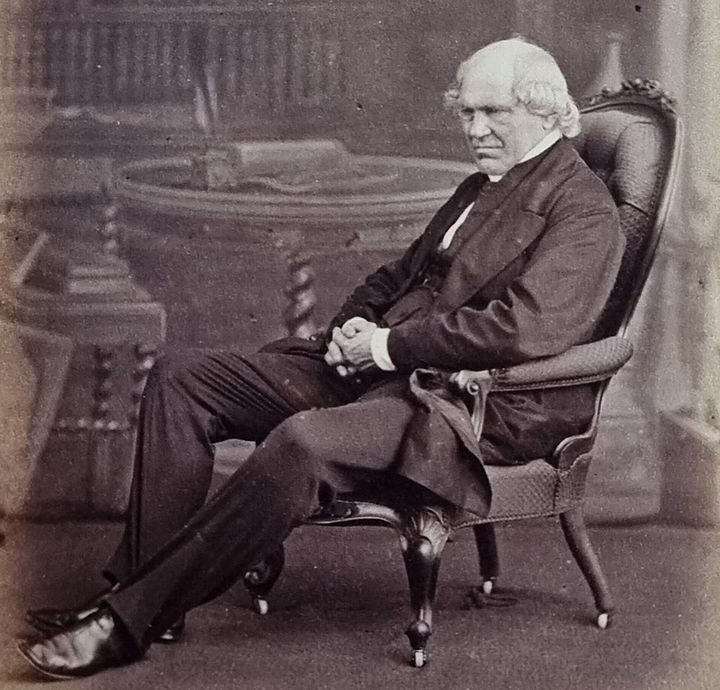
William Whewell (1794–1866) was born in Lancaster, the son of a master carpenter, and won a place at Trinity College, Cambridge, where he spent the rest of his career as fellow, tutor and, from 1841, Master. He held the chairs of mineralogy (1828–1832) and moral philosophy (1838–1855), was ordained in the Church of England, and wrote the Bridgewater Treatise on astronomy and natural theology (1833). His History of the Inductive Sciences (1837) and Philosophy of the Inductive Sciences (1840) made him the leading British philosopher of science of his generation. He coined or helped coin many scientific words, among them 'scientist' and 'physicist', and advised Michael Faraday on terms such as 'anode', 'cathode' and 'ion'. He died at Cambridge in 1866 after a fall from his horse.
Novum Organon Renovatum ('The New Organon Renewed') was published in London in 1858 by William Whewell, Master of Trinity College, Cambridge. It is the revised second part of his Philosophy of the Inductive Sciences (1840; second edition 1847), which for its third edition he divided into three books: the History of Scientific Ideas (1858), this volume on method, and On the Philosophy of Discovery (1860).