Work record
Barron v. Baltimore
1833 · 19th Century · Court Decision · English
Abstract
Question Presented. Does the guarantee of just compensation for property taken for public use, found in the Fifth Amendment, bind a state and its municipalities, or only Congress and federal officers?
Arguments. For the wharf owner: liberty is the amendment's object, its language is unrestricted, and parts of the 1787 text already curb state legislatures, so citizens deserve the same shield against local takings. For Baltimore: the first ten amendments answered fears of a distant new authority, while each state's own charter governs relations between that state and its people.
Holding. Without dissent, the justices ruled that the takings guarantee restrains only national power, found no conflict between Maryland's statutes and the federal charter, and threw out the appeal for lack of jurisdiction. Marshall rested on three supports: the document's origin in a single people creating a single government, the explicit naming of states wherever Article I limits them, and the demand for amendments voiced during ratification.
Significance. For thirty-five years the ruling meant that guarantees such as free speech, jury trial and compensation for takings protected Americans only against Washington. Debate over the 1868 amendment frequently invoked it. Beginning in 1897 with compensation for railroad land, and broadening in the twentieth century, the justices extended most of those protections against state action through due process, while leaving untouched Marshall's account of the original amendments.
Text. The library reproduces Marshall's opinion and the order of dismissal as transcribed on Wikisource.
Key figures
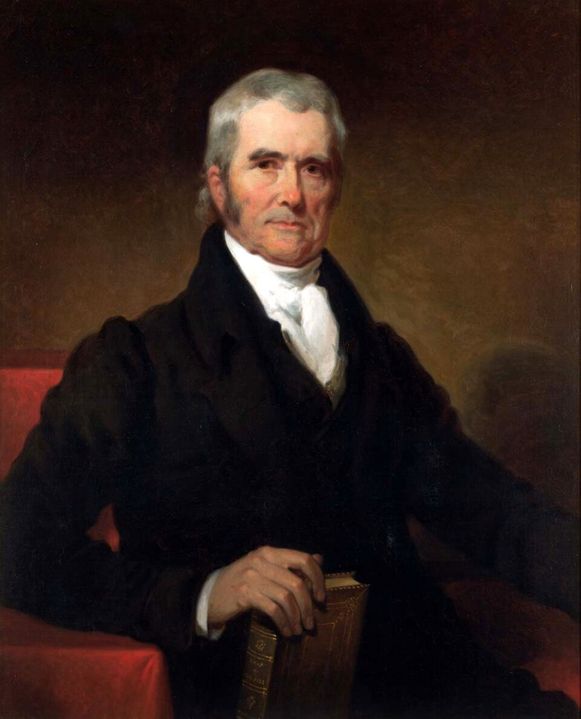
- John Marshall: Chief Justice who wrote for a unanimous bench
- John Barron: Wharf owner seeking compensation from the city
- City of Baltimore: Municipal defendant whose street grading silted the harbor

Summary
John Barron and John Craig owned a profitable wharf on the eastern side of Baltimore harbor, where deep water had let large ships tie up and unload. In the course of paving streets and regrading the town, the city of Baltimore turned the courses of several streams, which then carried sand and earth down into the harbor and left the water at the wharf too shallow for most vessels. Barron sued the mayor and city council and won a verdict of $4,500 in Baltimore County Court, but the Maryland Court of Appeals reversed. He brought the case to the Supreme Court by writ of error under Section 25 of the Judiciary Act of 1789. The question was whether the clause of the Fifth Amendment forbidding the taking of private property for public use without just compensation restrains the states and their cities as well as the federal government. Barron's side argued that the amendment was written in favor of the liberty of the citizen, that its words name no particular government, and that some prohibitions in the original Constitution, such as those in Article I, Section 10, already bound the states. The city answered that the Bill of Rights was drafted to limit the new national government, and that the people of each state had their own constitutions to protect them against their own legislatures. On 16 February 1833 a unanimous Court dismissed the writ for want of jurisdiction. Chief Justice Marshall reasoned that the Constitution was ordained by the people of the United States for the government they were creating, so that limitations expressed in general terms apply to that government. He compared Article I, Section 9, whose restrictions apply only to Congress though phrased broadly, with Section 10, which names the states expressly whenever it restrains them. Had the framers of the amendments meant to bind the states, they would have said so in the same direct way. Marshall added a historical argument: the ratifying conventions called for amendments out of fear of the new central power, not of the state governments, and a state dissatisfied with its own constitution could amend it far more easily than by the national process of two-thirds of Congress and three-fourths of the states. The library text contains Marshall's opinion of the Court and the formal judgment; Wikisource page notes have been stripped. Counsel's arguments are not reproduced. Barron settled the question for a generation. After the Fourteenth Amendment was ratified in 1868, litigants argued that its Due Process and Privileges or Immunities Clauses reached the states. In Chicago, Burlington and Quincy Railroad Co. v. Chicago (1897) the Court held that due process requires just compensation when a state takes property, and through the twentieth century, beginning with cases such as Gitlow v. New York (1925), it applied most Bill of Rights guarantees to the states one by one, a process known as selective incorporation. Barron's reading of the original Bill of Rights itself has not been overruled.
Virtues in this work
- Prudence: Marshall declines to stretch the amendments beyond their evident purpose, reasoning carefully from the structure of Article I rather than from sympathy for Barron's loss.
- Justice: The opinion gives each government its due sphere, insisting that state abuses be remedied by the people of the state under their own constitution.
- Humility: The Court says plainly that it cannot apply the amendments where their framers did not, limiting its own power in a case it could have decided otherwise.
Plot or Argument
- Jurisdiction depends on the Fifth Amendment
Marshall opens by noting that a writ of error from a state court lies only under Section 25 of the Judiciary Act. Barron claims the takings clause protects him against Maryland; if that claim fails, the Court has nothing to decide. The question is called one of great importance but little difficulty.
- A constitution made for one government
The people of the United States framed the Constitution for themselves and for the government it creates, just as the people of each state framed their own constitutions. General limitations in the federal instrument therefore restrain the federal government, not distinct governments framed by different people for different purposes.
- The lesson of Article I, Sections 9 and 10
Counsel for Barron relied on Section 10. Marshall turns it against him: the ban on bills of attainder and ex post facto laws appears in Section 9 in general words, yet plainly applies only to Congress; Section 10 repeats the ban with the words 'No State shall'. Whenever the framers meant to restrain the states, they named them, and they did so chiefly on subjects entrusted to the Union, such as treaties, war and coinage.
- Why the amendments would have spoken plainly
A state wanting new safeguards against its own government could call its own convention. No one would have used the cumbersome national amending process to improve state constitutions, and if Congress had meant to do so it would have said so in intelligible language.
- The history of ratification
The conventions that ratified the Constitution recommended amendments to guard against abuse of the new general power. The first amendments answered those fears and contain no expression applying them to the states, so the Court will not apply them there.
- Holding and judgment
The takings clause limits only the United States; there is no conflict between the Maryland acts and the federal Constitution, and the writ of error is dismissed for want of jurisdiction.
Characters
- John Marshall, Chief Justice; author of the opinion
Virginian who led the Court from 1801 to 1835 and here wrote for a unanimous bench.
- John Barron, plaintiff in error
Co-owner, with John Craig, of a Baltimore wharf whose deep-water berth was lost to silt.
- Mayor and City Council of Baltimore, defendants in error
Municipal government whose street works diverted streams and deposited earth in the harbor.
- Maryland Court of Appeals, state court below
Reversed Barron's jury award, producing the judgment brought to the Supreme Court.
Lessons
Reading a word in light of its neighbors
Marshall's strongest argument is structural. By setting the general words of Article I, Section 9 beside the explicit 'No State shall' of Section 10, he shows that the Constitution names the states whenever it restrains them, and he reads the Fifth Amendment by that pattern.
- Which example from Section 9 does Marshall use, and how does Section 10 repeat it?
- Is it fair to read the Bill of Rights by a pattern found in the original Constitution?
- Can you think of a document where the same words mean different things in different sections?
Two layers of protection
In 1833 Americans lived under two constitutions, state and federal. Marshall assumes that each people guards against its own government through its own charter, which places responsibility for state abuses on the citizens of that state.
- What remedy does Marshall say a discontented state could use?
- What might a citizen do if his own state's constitution offered no protection for his property?
- Why would the Fourteenth Amendment later change this arrangement?
History as evidence of meaning
The opinion appeals to what everyone in 1833 remembered: the amendments were demanded by those who feared the new national government. Marshall treats that shared memory of ratification as proof of what the words were meant to do.
- Which group pressed hardest for amendments during ratification, and what did they fear?
- Should judges rely on the reasons a law was adopted, or only on its words?
A small wharf and a large principle
Barron's loss was concrete and local, but the Court decided it by asking which government the Bill of Rights restrains. A dispute about mud in a harbor became the leading statement of the federal structure of rights for thirty-five years.
- Why did the Court dismiss the case instead of ruling for the city on the merits?
- How can a private injury lead to a question about the whole Constitution?
Context
In the early republic most of the law that touched daily life, from property and contracts to crimes and churches, was state law, and several states retained religious establishments and other arrangements the federal Bill of Rights would have barred to Congress. Baltimore was a fast-growing port whose public works in the 1810s and 1820s regraded streets and redirected streams.
Composition
Barron's suit began in Baltimore County Court, which awarded him $4,500; the Maryland Court of Appeals reversed, and Barron sought review in Washington. The Court heard argument in February 1833 and Marshall delivered the opinion on 16 February, reportedly after stopping argument for the city as unnecessary. The library text is the Wikisource transcription of 32 U.S. (7 Pet.) 243.
Reception
Barron was followed in later cases such as Permoli v. New Orleans (1845) on religious liberty. Supporters of the Fourteenth Amendment in 1866, including Representative John Bingham, cited the rule of Barron as a reason the new amendment was needed. Scholars continue to debate whether the Fourteenth Amendment's framers meant the Privileges or Immunities Clause to apply the Bill of Rights to the states, while the Court has done so mainly through the Due Process Clause.
Comparisons
- the-founding-documents
Set the Fifth Amendment's takings clause beside Article I, Sections 9 and 10, the very texts Marshall compares to decide which government the amendment restrains.
- the-anti-federalist-papers
Writers such as Brutus demanded a bill of rights against the proposed national government, the historical fear Marshall cites to show the amendments were aimed at federal power.
- the-federalist-papers
In Federalist No. 84 Hamilton argued that a bill of rights against a government of enumerated powers was unnecessary, a debate whose outcome Barron interprets.
- madison-selected-writings
Madison proposed in 1789 an amendment forbidding states to violate the rights of conscience, press and jury trial; the Senate rejected it, a fact often cited in support of Barron's reading.
- gitlow-v-new-york
Gitlow assumed that free speech and press are protected against the states by the Fourteenth Amendment, an early step in applying Bill of Rights guarantees that Barron had confined to Congress.
- slaughter-house-cases
Forty years after Barron, the Court read the new Privileges or Immunities Clause narrowly, leaving Barron's division between state and national rights largely in place.
Quotes
Frequently cited
“The Constitution was ordained and established by the people of the United States for themselves, for their own government, and not for the government of the individual States.”
Frequently cited
“These amendments contain no expression indicating an intention to apply them to the State governments. This court cannot so apply them.”
“The question thus presented is, we think, of great importance, but not of much difficulty.”
“If these propositions be correct, the fifth amendment must be understood as restraining the power of the General Government, not as applicable to the States.”
“These amendments demanded security against the apprehended encroachments of the General Government — not against those of the local governments.”
For Students
A reading companion for classical Christian high school students. See the student guide.
Reading Guide
Watch for
- How Marshall states Barron's argument fairly before answering it.
- The comparison of the ban on bills of attainder in Section 9 with the same ban in Section 10.
- The remark that a discontented state could simply amend its own constitution.
- The appeal to what the ratifying conventions feared in 1787 and 1788.
- Why the final order dismisses the writ rather than affirming the Maryland judgment.
Key terms and names
- Writ of error
- An order bringing the record of a lower court before a higher court to examine claimed errors of law.
- Takings clause
- The part of the Fifth Amendment forbidding private property to be taken for public use without just compensation.
- Section 25 of the Judiciary Act
- The 1789 statute provision allowing the Supreme Court to review state court decisions on certain federal questions.
- Bill of attainder
- A legislative act declaring a person guilty and imposing punishment without a judicial trial.
- Incorporation
- The later doctrine by which the Court applied Bill of Rights guarantees to the states through the Fourteenth Amendment.
- General Government
- Marshall's phrase for the national government of the United States, as distinct from the state governments.
Seminar Questions
- Comprehension What did the city of Baltimore do that damaged Barron's wharf, and what did the Maryland courts decide?
- Comprehension What examples from Article I, Sections 9 and 10 does Marshall use to support his reading?
- Interpretation Why does Marshall think the framers of the amendments would have spoken plainly if they meant to restrain the states?
- Interpretation How does Marshall use the memory of the ratification debates as evidence, and is that evidence persuasive?
- Interpretation Barron argued that the amendment was 'in favor of the liberty of the citizen.' Why did that argument not move the Court?
- Big Question Should a person's basic rights depend on which government is threatening them?
Faith Connections
- 1 Kings 21:1-19 (Scripture)
Ahab's seizure of Naboth's vineyard is the classic biblical case of a ruler taking a subject's property, and Elijah's rebuke treats that taking as a grave wrong.
- Deuteronomy 19:14 (Scripture)
The command not to move a neighbor's ancient landmark expresses respect for settled property, the interest Barron believed the city had invaded.
- John Locke, Second Treatise of Government, ch. XI (Great Conversation)
Locke held that the supreme power cannot take any part of a man's property without his consent, a principle behind just-compensation clauses in American constitutions.
Logic and Rhetoric
Central argument: Because the people of the United States made the Constitution for the government it creates, and because that document names the states whenever it restrains them, general limitations in the Bill of Rights, including the takings clause, apply only to the national government; so a claim against Maryland under the Fifth Amendment gives the Court no jurisdiction.
Rhetorical device: argument from parallel structure. Marshall sets the general ban on bills of attainder in Section 9 against the explicit 'No State shall' of Section 10, so that the reader sees the pattern before he applies it to the amendments (quote 1).
Debate: Resolved: that the Fifth Amendment, as originally adopted, should have been read to restrain the states.
Memory Work
The Constitution was ordained and established by the people of the United States for themselves, for their own government, and not for the government of the individual States.
These amendments contain no expression indicating an intention to apply them to the State governments. This court cannot so apply them.
Writing Prompts
Essay: Explain Marshall's three main arguments in Barron (from the source of the Constitution, from Article I, Sections 9 and 10, and from the history of ratification) and decide which is strongest.
Comparison with The Anti-Federalist Papers: Compare the Anti-Federalists' fears of national power with Marshall's description of why the amendments were adopted, and judge whether he describes their purposes accurately.
Medical Lens
Barron concerns a harbor silted by municipal street works and the reach of the takings clause; the opinion contains no medical material.
Creative Prompts
- Classroom
Stage a moot court in 1833: one team argues for Barron that the Fifth Amendment protects every citizen against any government, the other argues for Baltimore, and a bench of seven decides.
- Essay
Write a short brief for the city of Baltimore using only Article I, Sections 9 and 10 and the history of ratification, then a one-paragraph reply for Barron.
- Dialogue
Imagine John Bingham in 1866 explaining to a fellow congressman why Barron v. Baltimore makes a new amendment necessary.
- Fiction
Tell the story of a ship's captain arriving at Barron's wharf in 1822 and finding the water too shallow to come alongside.
Further Reading
- The Bill of Rights: Creation and Reconstruction, Akhil Reed Amar
Argues that the Bill of Rights was first a set of limits on federal power and traces how the Fourteenth Amendment changed it; discusses Barron at length.
- John Marshall: Definer of a Nation, Jean Edward Smith
Full biography of the Chief Justice covering his last years on the Court.
- No State Shall Abridge: The Fourteenth Amendment and the Bill of Rights, Michael Kent Curtis
Study of the debates over whether the Fourteenth Amendment was meant to overturn Barron.
Verification notes
All five quotations were located by Grep as exact strings in content/texts/barron-v-baltimore.txt; the text contains stray zero-width characters at old page breaks, and no quotation spans one. The facts of the wharf, the $4,500 verdict and the unanimous dismissal follow the reported opinion and standard accounts. Web searches were not available while this record was written, so the account of Marshall stopping argument for the city is marked as reported and should be checked.
- Confirm that Marshall stopped argument for the city's counsel before delivering the opinion.
- Confirm the date of decision as 16 February 1833.
- Confirm the citation and holding attributed to Permoli v. New Orleans (1845).