Work record
Brown v. Board of Education of Topeka
1954 · Postwar Contemporary · Court Decision · English
Abstract
Question Presented. When a state assigns children to public schools by race, does it deny the minority pupils equal protection even if buildings, teachers and courses of study are comparable?
Arguments. Marshall's legal team argued that official separation stamps black pupils with a badge of inferiority, injuring their learning whatever the facilities, and that the Reconstruction amendments aimed to end racial distinctions in law. Davis and the state attorneys answered that sixty years of precedent upheld separate schools, that Congress in 1868 tolerated them, that education belongs to the states, and that improvement programs were closing remaining gaps.
Holding. Every justice joined the Chief Justice, and no concurrence or dissent was filed. Finding the framers' intent unclear and public schooling transformed since Reconstruction, the Court judged segregation by its present effects on children and concluded that it deprives them of equal opportunity. The 1896 doctrine was set aside for schools, and argument on relief was scheduled for the following term.
Significance. A 1955 decree entrusted implementation to local federal courts. Resistance across the South, the Little Rock crisis, civil rights legislation in 1964 and later rulings followed. The decision is widely regarded as a turning point in American constitutional history, and its reasoning was soon extended to other public facilities.
Key figures
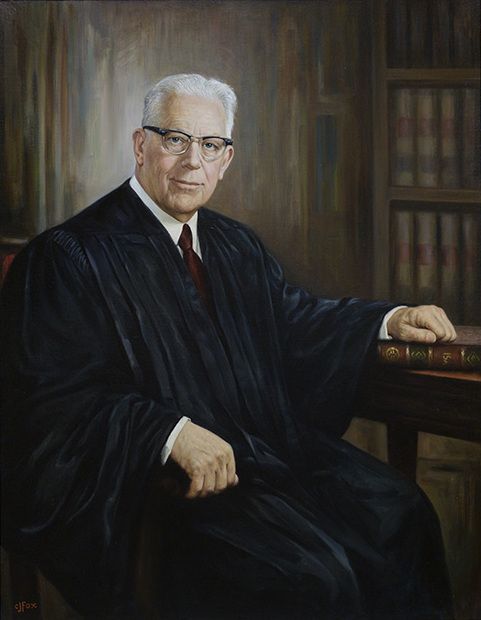
- Earl Warren: Chief Justice who wrote and secured agreement on a single opinion
- Thurgood Marshall: Lead lawyer for the black families challenging school segregation
- John W. Davis: Veteran advocate who defended South Carolina's school laws
- Oliver and Linda Brown: Topeka father and daughter whose name the consolidated case bears

Summary
Brown v. Board of Education of Topeka, 347 U.S. 483, decided on 17 May 1954, held that state laws requiring or permitting separate public schools for black and white children deny the equal protection of the laws guaranteed by the Fourteenth Amendment. The opinion consolidated cases from four states. In Topeka, Kansas, Oliver Brown and other parents challenged a statute allowing cities to keep separate elementary schools; his daughter Linda had to travel to a distant school though a white school stood near her home. Briggs v. Elliott came from Clarendon County, South Carolina; Davis v. County School Board from Prince Edward County, Virginia; and Gebhart v. Belton from Delaware, where the state courts had ordered the plaintiffs admitted to white schools. A companion case from the District of Columbia, Bolling v. Sharpe, was decided the same day under the Fifth Amendment. The plaintiffs, represented by Thurgood Marshall and the NAACP Legal Defense and Educational Fund, argued that segregated schools could never be equal, because separation by law itself marked black children as inferior and damaged their education, and that the Fourteenth Amendment was meant to remove legal distinctions based on race. The states, with John W. Davis arguing for South Carolina, relied on Plessy v. Ferguson (1896) and on later decisions applying it to schools; they contended that the framers of the Amendment had not understood it to forbid school segregation, that public education was a matter reserved to the states, and that they were equalizing buildings, teachers and salaries. The cases were first argued in December 1952 and reargued in December 1953 on questions the Court posed about the Amendment's history. Chief Justice Earl Warren, writing for a unanimous Court, found that history inconclusive, partly because free public schooling was still undeveloped in 1868. Since the lower courts had found the facilities equal or nearly so in tangible respects, the Court turned to the effect of segregation itself. Warren described education as perhaps the most important function of state and local governments and the very foundation of good citizenship. Building on Sweatt v. Painter and McLaurin v. Oklahoma State Regents, he held that separating children solely by race generates a feeling of inferiority that may affect their hearts and minds permanently, and that in public education separate but equal has no place. Any language in Plessy to the contrary was rejected. The Court set the question of remedy for further argument. The library text gives the complete opinion of the Court; the footnotes, including footnote 11 with its list of social-science studies, are omitted. In Brown II (1955) the Court ordered desegregation with all deliberate speed. Many Southern officials resisted, and federal troops were sent to Little Rock in 1957. The Civil Rights Act of 1964 and later decisions such as Green v. County School Board (1968) strengthened enforcement.
Virtues in this work
- Justice: The Court held that the equal protection of the laws forbids states to assign children to schools by race.
- Fortitude: Families in Topeka, Clarendon County, Prince Edward County and Delaware brought suits that exposed them to economic and social pressure in their communities.
- Prudence: Warren wrote a short opinion that all nine justices could join and set the difficult question of remedy for separate argument.
Plot or Argument
- Four states, one question
Warren introduces the consolidated cases from Kansas, South Carolina, Virginia and Delaware, notes that the plaintiffs sought admission to schools on a nonsegregated basis, and states their claim that segregated schools are not and cannot be made equal.
- The inconclusive history of the Fourteenth Amendment
The reargument explored the Amendment's adoption in Congress and the states. Warren finds the evidence inconclusive: proponents and opponents held opposite views, and public schooling in 1868, especially in the South, was too rudimentary to show what the framers intended for it.
- From Plessy to Sweatt
The opinion reviews how separate but equal entered the law in a transportation case, how it was applied to schools, and how recent graduate-school cases found inequality in specific benefits and in intangible qualities without needing to reexamine the doctrine itself.
- Education in American life
Because the facilities in these cases were being equalized, Warren declines to turn the clock back to 1868 or 1896 and considers the place of public education in 1954: compulsory, costly, essential to citizenship and success, and therefore a right to be provided on equal terms.
- The effect of segregation and the holding
The Court answers its own question: segregation by race deprives minority children of equal educational opportunities, generating a feeling of inferiority, as the Kansas court had found. Separate educational facilities are inherently unequal, and the plaintiffs are denied equal protection.
- Postponing the decree
Because these are class actions affecting many communities, the Court restores the cases to the docket and invites further argument on remedy, including from the Attorney General and the states that require or permit segregation.
Characters
- Earl Warren, Chief Justice, author of the opinion
Former governor of California who wrote the unanimous opinion in his first term on the Court.
- Oliver Brown, lead plaintiff
Topeka parent and railroad welder who joined the suit on behalf of his daughter Linda.
- Linda Brown, pupil
Third-grader whose walk and bus ride to a distant school became the emblem of the Kansas case.
- Thurgood Marshall, counsel for the plaintiffs
Director of the NAACP Legal Defense and Educational Fund, who argued the South Carolina case and coordinated the litigation; appointed to the Court in 1967.
- John W. Davis, counsel for South Carolina
Former Solicitor General and 1924 Democratic presidential nominee who defended segregation on the basis of precedent and state authority.
- Board of Education of Topeka, appellee
Kansas school board operating separate elementary schools under a state statute permitting them in larger cities.
Lessons
When history cannot decide
The Court asked the parties to reargue what the framers of the Fourteenth Amendment intended for schools, and then found the answer inconclusive. Warren's opinion therefore rests on the Amendment's guarantee applied to public education as it existed in 1954, a choice of method that later debates over constitutional interpretation have examined closely.
- What reasons does Warren give for finding the historical evidence inconclusive?
- Why does he say the Court cannot turn the clock back to 1868 or 1896?
- What are the advantages and risks of interpreting the Constitution in light of present conditions?
Tangible equality and its limits
The states pointed to new buildings and equalized salaries. The Court's answer was that even with identical facilities, legally enforced separation itself affects children's education. Earlier cases such as Sweatt and McLaurin had already considered intangible factors like reputation and the chance to exchange views with classmates.
- What tangible factors had the lower courts found equal or being equalized?
- What intangible qualities did Sweatt and McLaurin recognize?
- Can two things be physically identical and still unequal?
Education and citizenship
Warren's paragraph on education describes schooling as the foundation of good citizenship, the principal means of awakening children to cultural values, and the gateway to success. By placing education at the center of American life, the opinion explains why the equal protection guarantee applies with particular force in the classroom.
- What functions of education does Warren list?
- Why does Warren mention compulsory attendance laws and military service?
- Does Warren's description of education still hold true?
Unanimity and the remedy
Warren sought a single, short opinion with no dissent, and the Court postponed the question of how to desegregate to a later term. Students can consider why unanimity mattered for a decision touching the laws of many states, and how the 1955 decree of all deliberate speed shaped the years that followed.
- Why might the Court have wanted a unanimous opinion?
- Why did the Court not order an immediate remedy in 1954?
Context
Plessy v. Ferguson (1896) upheld state-mandated separation on railroad cars under the formula of separate but equal, and by the twentieth century seventeen states and the District of Columbia required segregated schools, while others permitted them. From the 1930s the NAACP, led by Charles Hamilton Houston and then Thurgood Marshall, brought a series of cases on graduate and professional education, winning Missouri ex rel. Gaines (1938), Sweatt v. Painter (1950) and McLaurin v. Oklahoma State Regents (1950). In 1950 the organization decided to challenge segregation in elementary and secondary schools directly.
Composition
The Court heard the consolidated cases in December 1952, set them for reargument on five questions in June 1953, and heard reargument in December 1953 after Warren's appointment. The opinion was announced on 17 May 1954. The library text reproduces the U.S. Reports as transcribed on Wikisource, giving Warren's complete opinion but omitting its footnotes.
Reception
The decision was welcomed by civil rights organizations and much of the national press, and opposed by many Southern leaders; in 1956 nineteen senators and seventy-seven representatives signed the Southern Manifesto against it. Brown II (1955) left implementation to district courts. Federal troops enforced desegregation at Central High School in Little Rock in 1957, and Cooper v. Aaron (1958) affirmed that states were bound by the ruling. The Civil Rights Act of 1964 tied federal funds to desegregation, and Green v. County School Board (1968) required districts to eliminate dual systems. Scholars continue to discuss the opinion's reliance on social science and its method of interpretation.
Comparisons
- plessy-v-ferguson
Brown rejects any language in Plessy contrary to its finding on the effects of segregation; Harlan's lone Plessy dissent anticipated much of its reasoning.
- sermons-and-letter-from-birmingham-jail
King's 1963 letter cites the 1954 decision as an example of just law and answers critics who urged waiting for gradual compliance.
- the-founding-documents
The Declaration's statement that all men are created equal was invoked by the plaintiffs, though the opinion itself rests on the Fourteenth Amendment adopted in 1868.
- up-from-slavery
Booker T. Washington's account of building Tuskegee under segregation shows the earlier strategy of developing separate institutions that the Brown litigation set aside.
- to-kill-a-mockingbird
Harper Lee's novel, set in a segregated Alabama town of the 1930s and published in 1960, portrays the social order the decision began to dismantle.
Quotes
Frequently cited
“Today, education is perhaps the most important function of state and local governments.”
Frequently cited
“To separate them from others of similar age and qualifications solely because of their race generates a feeling of inferiority as to their status in the community that may affect their hearts and minds in a way unlikely ever to be undone.”
Frequently cited
“We conclude that, in the field of public education, the doctrine of "separate but equal" has no place. Separate educational facilities are inherently unequal.”
“In approaching this problem, we cannot turn the clock back to 1868, when the Amendment was adopted, or even to 1896, when Plessy v. Ferguson was written.”
“Such an opportunity, where the state has undertaken to provide it, is a right which must be made available to all on equal terms.”
“Does segregation of children in public schools solely on the basis of race, even though the physical facilities and other "tangible" factors may be equal, deprive the children of the minority group of equal educational opportunities? We believe that it does.”
For Students
A reading companion for classical Christian high school students. See the student guide.
Reading Guide
Watch for
- The opening paragraph naming the four states and the common legal question.
- Warren's reasons for finding the history of the Fourteenth Amendment inconclusive.
- The paragraph describing education as the very foundation of good citizenship.
- The finding of the Kansas court that Warren quotes.
- The closing paragraph postponing the decree and inviting further argument.
Key terms and names
- Equal Protection Clause
- The Fourteenth Amendment's command that no state shall deny to any person within its jurisdiction the equal protection of the laws.
- Separate but equal
- The doctrine from Plessy v. Ferguson (1896) that racially separate facilities satisfy the Constitution if they are equal.
- Reargument
- A second hearing of a case; here the Court asked the parties to address the history of the Fourteenth Amendment and the question of remedy.
- Tangible factors
- Measurable features of schools such as buildings, curricula and teachers' salaries, which the lower courts found equal or being equalized.
- Class action
- A lawsuit brought on behalf of a whole group of people in similar circumstances, which is why the remedy required further argument.
- Amicus curiae
- A friend of the court, a party not in the case who is allowed to present arguments, as the states were invited to do on remedy.
Seminar Questions
- Comprehension From which four states did the cases come, and what did the plaintiffs seek?
- Comprehension What did the reargument focus on, and what did the Court conclude about it?
- Comprehension Why did the Court not decide the remedy in this opinion?
- Interpretation Why does Warren emphasize the effect of segregation itself rather than comparing buildings and salaries?
- Interpretation How does Warren use Sweatt v. Painter and McLaurin to reach a conclusion about elementary schools?
- Interpretation Why might a short, unanimous opinion have been more effective than a longer one with concurrences?
- Big Question What does it mean to treat people as equals, and can equality be achieved while keeping people apart by law?
Faith Connections
- Acts 17:26 (Scripture)
Paul tells the Athenians that God hath made of one blood all nations of men, a text often cited in the debates over segregation.
- Galatians 3:28 (Scripture)
There is neither Jew nor Greek, bond nor free, for all are one in Christ Jesus, a statement of unity that shaped Christian arguments in the civil rights era.
- Genesis 1:27 (Scripture)
Every person bears the image of God, the foundation of the claim to equal dignity that underlies the plaintiffs' case.
Logic and Rhetoric
Central argument: Because the history of the Fourteenth Amendment is inconclusive, because education has become essential to citizenship and success, and because legally enforced separation of children by race itself denies them equal educational opportunity even when facilities are equal, separate but equal has no place in public education.
Rhetorical device: rhetorical question answered directly. Warren poses the question presented in full and answers in five words, We believe that it does (quote 3), giving the holding a plain and emphatic form.
Debate: Resolved: that the Court in Brown should have ordered immediate desegregation rather than setting the remedy for later argument.
Memory Work
We conclude that, in the field of public education, the doctrine of "separate but equal" has no place. Separate educational facilities are inherently unequal.
Today, education is perhaps the most important function of state and local governments.
Writing Prompts
Essay: Explain how Warren moves from the inconclusive history of the Fourteenth Amendment to the conclusion that separate schools are inherently unequal, and evaluate the role that the importance of education plays in the argument.
Comparison with Plessy v. Ferguson: Compare the majority's reasoning in Plessy v. Ferguson about the meaning of enforced separation with Warren's reasoning in Brown, and explain how Harlan's Plessy dissent anticipated the later decision.
Medical Lens
The opinion mentions psychological knowledge and the Kansas court's finding about children's motivation, but it contains no clinical or medical discussion; the social-science citations are in an omitted footnote.
Creative Prompts
- Classroom
Reenact the December 1953 reargument, with one team presenting Marshall's case and another Davis's, each answering the Court's questions about the history of the Fourteenth Amendment.
- Essay
Write a brief for South Carolina in 1953 in its own terms, relying on Plessy and state authority over schools, then explain which of its points Warren's opinion answers and how.
- Dialogue
Imagine the conversation in a Topeka household on the evening of 17 May 1954, after the radio reports the decision.
- Fiction
Tell the story of a Prince Edward County student in 1951 who helps organize the walkout that became part of the Davis case.
Further Reading
- Simple Justice: The History of Brown v. Board of Education and Black America's Struggle for Equality, Richard Kluger
Comprehensive narrative history of the five cases, the lawyers and the Court.
- From Jim Crow to Civil Rights: The Supreme Court and the Struggle for Racial Equality, Michael J. Klarman
Study of the Court's race decisions from Plessy through Brown and their consequences.
- Making Civil Rights Law: Thurgood Marshall and the Supreme Court, 1936-1961, Mark V. Tushnet
Account of the NAACP's litigation strategy leading to Brown.
- Thurgood Marshall: American Revolutionary, Juan Williams
Biography of the plaintiffs' chief counsel, later the first black Justice of the Supreme Court.
Verification notes
Grep confirmed all six quotations as exact substrings of content/texts/brown-v-board-of-education.txt, including the famous holding. The opinion is unanimous and has no separate opinions, so all quotations come from Warren. Background facts (Linda Brown's circumstances, the Southern Manifesto figures, Jackson's presence on the bench, the dates of argument) come from general knowledge of the standard histories; web search was unavailable during writing, and the specific figures are listed for checking.
- Confirm the Southern Manifesto signers (19 senators and 77 representatives).
- Confirm that seventeen states and the District of Columbia required segregated schools in 1954.
- Confirm Oliver Brown's occupation as a railroad welder and Linda Brown's grade in 1951.