Work record
A Disquisition on Government
1849 (published 1851) · 19th Century · Political Theory · English
Abstract
Background. Near the end of a long career spent defending South Carolina and the slaveholding states in national councils, the senator set down the general principles behind his doctrines of interposition and nullification, leaving the application to America for a second volume.
Argument. People prefer their own good to that of others, so rulers misuse authority and voting merely hands that authority to the larger party. Unequal taxes and expenditures then set group against group. The cure is to require the assent of every major interest, each able to block measures that injure it; such arrangements live by bargaining, while unchecked regimes live by coercion.
Illustrations. The Polish diet, the Iroquois council, the jury room, the Roman struggle of the orders and the English Parliament supply the evidence that a requirement of agreement can function.
Key Concepts. Self-preference in human nature; responsibility through elections; numerical versus concurrent majority; the veto as the essence of a constitution; liberty measured against security; legal equality without equality of condition.
Significance. First received as the theoretical charter of Southern sectionalism, the book later drew interest from students of pluralism and of government by consensus in divided societies; interpreters still debate how far its theory can be detached from its purpose.
Key figures
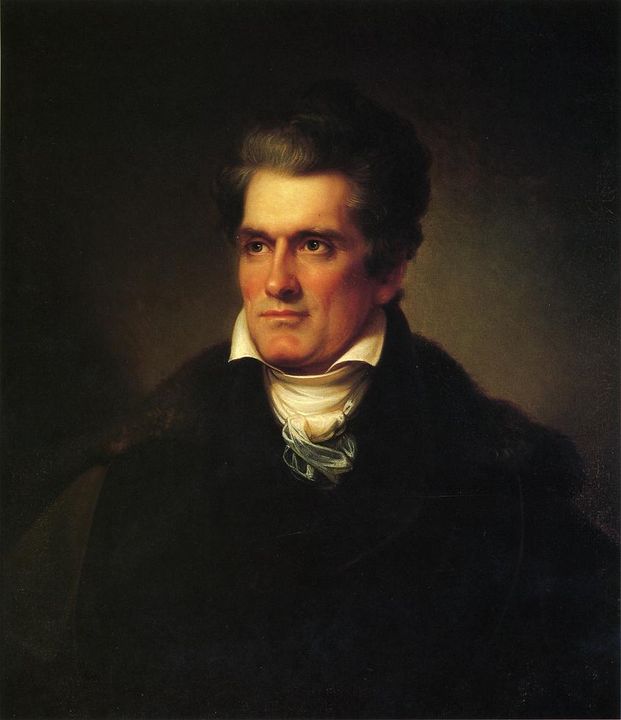
- John C. Calhoun: South Carolina senator and former vice president theorizing about minority protection
- Richard K. Crallé: Friend and editor who brought the manuscript into print
- The Roman plebeians and tribunes: Ancient order whose veto Calhoun treats as a model of mutual consent
- King, Lords and Commons: British estates whose separate assent to legislation illustrates his principle
- The Six Nations: Haudenosaunee league whose council decided only by common consent

Summary
A Disquisition on Government is John C. Calhoun's general theory of constitutional government, completed in 1849 in the last year of his life and published in 1851 by his editor Richard K. Crallé as the first part of volume one of his Works. It was meant as the theoretical introduction to a companion study, A Discourse on the Constitution and Government of the United States, which the library text omits. The Disquisition has no chapters; it moves in one continuous argument from human nature to the histories of Rome and Britain. The library text is an OCR scan of the 1851 printing, with many scanning errors. Calhoun begins with man's constitution. Human beings are social by nature, but each feels what affects himself more strongly than what affects others. Society is therefore necessary to human existence, and government is necessary to keep society from conflict. Yet the same self-preference moves those who govern, so government itself must be restrained by a constitution. The first step is the right of suffrage, which makes rulers answerable to the ruled. Suffrage alone, however, only transfers power to the majority. Because the burdens and benefits of taxation and public spending never fall equally, a community divides into interests, and the larger interest can use the government against the smaller, so that citizens become in effect tax-payers and tax-consumers. The remedy is what Calhoun calls the concurrent majority. Instead of counting heads across the whole community (the numerical majority), government should take the sense of each major interest or section through its own organ and require their agreement, giving each a negative on the others. A negative power, he argues, is what makes a constitution; without it the numerical majority is as absolute as a monarch. Governments of the concurrent majority are preserved by compromise, absolute governments by force. To the objection that such a system is impracticable, he answers with Poland's diet, the confederacy of the Six Nations, and above all the jury, where the need for unanimity leads twelve strangers to agree. Calhoun then distinguishes liberty from protection. Liberty, he says, must be proportioned to a people's intelligence and virtue; it is a reward to be earned, and when the two conflict, protection of the community takes precedence. He rejects the view that all men are born free and equal, calling the state of nature a hypothesis, and argues that inequality of condition spurs progress while equality before the law is essential. He closes with Rome, where the tribunes gave the plebeians a negative on the patricians, and Britain, where King, Lords and Commons must concur, as historical models of the concurrent principle.
Virtues in this work
- Prudence: Calhoun argues that durable government must be built on a realistic account of human self-interest rather than on hopes of disinterested rulers.
- Temperance: His concurrent majority makes compromise, the restraint of each interest's demands, the principle that preserves constitutional government.
- Justice: His praise of the jury, where twelve must agree on a true verdict under oath, shows the even-handed judgment he wanted government to imitate.
Plot or Argument
- Human nature and the origin of government
Man is a social being, but his individual feelings are stronger than his sympathetic ones. Society is necessary to his existence and government to society, since without it conflicting interests would end in universal discord. Government is thus ordained by the Creator, but the same nature that makes it necessary inclines those who wield it to abuse their power.
- Constitution, suffrage and the limits of majority rule
A constitution is the means of restraining government. The right of suffrage makes rulers responsible, but it only turns the government over to the majority. Because the fiscal action of government cannot be equal, the stronger interest gains from taxation and spending at the expense of the weaker, and party contests turn into struggles for the honours and emoluments of office.
- The concurrent majority and the negative power
Calhoun distinguishes the numerical majority from the concurrent majority, which takes the sense of each interest through its own organ and requires their joint consent. Each interest thereby holds a negative on the others. The negative power makes the constitution and the positive power the government; where only the numerical majority rules, there is no constitution in the strict sense.
- Compromise versus force
The conservative principle of constitutional governments is compromise, because each interest must win the agreement of the rest; that of absolute governments, whether of one, a few or a majority, is force. Concurrent government encourages harmony, patriotism and the choice of wise men for office, while numerical majorities breed faction, the spoils of office and eventually rule by a single strong man.
- Objections answered: Poland, the Six Nations and the jury
To the charge that requiring the consent of every interest would paralyse government, Calhoun replies that necessity produces agreement. Poland's diet required the assent of every noble and yet the kingdom endured for two centuries; the Six Nations' council required unanimity and grew powerful; a jury of twelve must agree and almost always does.
- Liberty, protection and equality
Power and liberty each have a proper sphere. Protection of the community comes first, and liberty must be proportioned to a people's intelligence and moral condition; it is a reward of development, not a gift equally due to all. Equality before the law is essential, but equality of condition would destroy progress. Calhoun denies that all men are born free and equal and treats the state of nature as a fiction.
- Rome and Great Britain as historical models
In Rome the plebeians, after their secession, obtained tribunes with a veto over the acts of the patrician government, and the two orders had to concur. In Britain the King, the Lords and the Commons each hold a negative in the legislature. The essay ends by announcing a study of the government of the United States, which follows in the Discourse.
Characters
- John C. Calhoun, author
Senator from South Carolina writing a general treatise on government in the last year of his life.
- The Six Nations (Iroquois Confederacy), historical example
A confederacy whose council of forty-two required the agreement of all, cited as proof that unanimity can work.
- The Kingdom of Poland, historical example
An elective monarchy in which every noble present could block the choice of a king, cited as the extreme case of the concurrent principle.
- The Roman tribunes, historical example
Officers of the plebeians whose veto gave one order a negative on the other.
- King, Lords and Commons, historical example
The three estates of the British constitution, each of whose separate consent is needed to make law.
Lessons
A majority can also govern absolutely
Calhoun's central warning is that elections alone do not make a government limited. If the greater number can do whatever it wishes, the lesser interests have no defence, and majority rule becomes as absolute as the rule of one man. A constitution must give each interest some means of protecting itself.
- Why does Calhoun say the right of suffrage is necessary but not sufficient?
- How does he explain the division of a community into tax-payers and tax-consumers?
- Does a written constitution with separated powers answer his concern? What does Calhoun say about that remedy?
The negative power makes a constitution
For Calhoun the essence of constitutional government is the power to stop action. If each great interest must consent, government can act only on measures all can accept. He calls this the concurrent majority and argues that it turns politics from conquest into compromise.
- What is the difference between the numerical and the concurrent majority?
- Why does Calhoun think the need for consent produces compromise rather than deadlock?
- What examples does he use to show that unanimity can work in practice, and how persuasive are they?
Liberty and protection must be weighed
Calhoun holds that protection of the community is the first end of government and that liberty must be suited to a people's condition. He rejects the theory that all men are born free and equal in a state of nature. This part of his argument stood close to the defence of the Southern social order he led in the Senate.
- What does Calhoun mean by calling liberty a reward to be earned?
- How does he distinguish equality before the law from equality of condition?
- How might Jefferson, Lincoln or Frederick Douglass answer his rejection of the claim that all men are born free and equal?
Human nature sets the problem of politics
The Disquisition starts not from rights but from a picture of human nature: social yet self-preferring. Government is needed because of selfishness, and limits on government are needed for the same reason. Every later step follows from this starting point.
- Why does Calhoun compare the science of government to astronomy at the opening of the work?
- How does his view of human nature compare with Madison's in Federalist 51?
Context
Calhoun wrote in the late 1840s, when the admission of new territories after the Mexican War reopened the question of slavery's extension and the free states were gaining a lasting majority in the House and in the Electoral College. Since the tariff crisis of 1828–1833 he had argued that a state could interpose its authority to nullify unconstitutional federal laws, and that the South, as a minority section with its own economy of staple crops and slave labour, needed constitutional protection against a national majority. The Disquisition generalizes that position into a theory of government, without naming the sections of the Union.
Composition
Calhoun worked on the Disquisition and the Discourse during the late 1840s and finished the Disquisition in 1849, months before his death on 31 March 1850. His friend Richard K. Crallé edited both for publication by the South Carolina legislature in 1851 as volume one of Calhoun's Works. The library text is the Disquisition alone from that edition.
Reception
The work was read at first chiefly as a statement of the Southern constitutional position in the decade before secession. Later political scientists took it up as a general theory of minority protection: some saw in the concurrent majority an anticipation of interest-group pluralism, consensus government and the protection of minorities in divided societies, while others read it mainly as a brief for the slaveholding South. Historians and theorists still disagree about how far its principles can be separated from the purposes for which Calhoun wrote.
Comparisons
- the-federalist-papers
Madison in Federalist 10 and 51 also fears majority faction, but trusts an extended republic and separated powers to check it; Calhoun argues that these devices cannot hold the numerical majority in check without a negative for each interest.
- webster-second-reply-to-hayne
In 1830 Webster answered the nullification doctrine that Calhoun, then presiding over the Senate as Vice President, had framed; his Union of the people stands against Calhoun's compact of interests.
- compromise-of-1850-speeches
Calhoun's last Senate speech of March 1850, read for him while he sat dying, applies the Disquisition's reasoning to the sectional crisis and asks for a constitutional guarantee for the South.
- virginia-and-kentucky-resolutions
Jefferson and Madison's resolutions of 1798–1799 on the right of states to judge federal acts were the precedent Calhoun claimed for interposition and nullification.
- democracy-in-america
Tocqueville's chapter on the tyranny of the majority raises the same worry about an all-powerful majority but looks to associations, local liberty, the courts and religion for remedies rather than a sectional veto.
- cicero-republic-and-laws
Both writers treat the Roman tribunate as the plebeians' check on the senate; Cicero in Laws III defends it as a safety valve, and Calhoun makes it his chief ancient example of the concurrent majority.
Quotes
“It follows, then, that man is so constituted, that government is necessary to the existence of society, and society to his existence, and the perfection of his faculties.”
“takes the sense of each, through its majority or appropriate organ, and the united sense of all, as the sense of the entire community.”
“constitution implies limitation or restriction”
“This principle, in constitutional governments, is compromise”
“it is found, in practice, not only to succeed, but to be the safest, the wisest and the best that human ingenuity has ever devised.”
“A reward more appropriate than liberty could not be conferred on the deserving”
“But to go further, and make equality of condition essential to liberty, would be to destroy both liberty and progress.”
For Students
A reading companion for classical Christian high school students. See the student guide.
Reading Guide
Watch for
- The opening comparison between the science of government and astronomy, and the law of human nature Calhoun claims to find.
- How the argument moves from suffrage to the fiscal action of government and the division into tax-payers and tax-consumers.
- The definitions of the numerical and the concurrent majority, and the claim that the negative power makes the constitution.
- The three examples used to answer the charge of impracticability: Poland, the Six Nations and the jury.
- The passage on liberty and protection and the rejection of the claim that all men are born free and equal.
Key terms and names
- Numerical majority
- The greater number of the whole community counted as individuals, which Calhoun says is often mistaken for the people itself.
- Concurrent majority
- Government by the agreement of each major interest or section, each consulted through its own organ, so that the combined sense of all is taken as the sense of the community.
- Negative power
- The power of an interest to stop or veto action affecting it; for Calhoun the element that turns a government into a constitutional one.
- Fiscal action
- The collecting of taxes and spending of public money, which Calhoun argues can never fall equally and so divides a community into opposed interests.
- Nullification
- Calhoun's earlier doctrine that a state convention could declare a federal law unconstitutional and void within the state, a practical form of the concurrent majority.
- Conservative principle
- The principle that keeps a government in being: compromise for constitutional governments, force for absolute ones.
Seminar Questions
- Comprehension According to Calhoun, why is government necessary, and why does it need to be restrained?
- Comprehension What is the difference between the numerical majority and the concurrent majority?
- Comprehension Which three examples does Calhoun give to show that a requirement of general agreement can work?
- Interpretation Why does Calhoun say that the negative power makes the constitution and the positive power makes the government?
- Interpretation How does Calhoun's account of taxation and public spending lead to his conclusion that majorities will divide the community?
- Interpretation The Disquisition never names the North, the South or slavery. How does knowing Calhoun's career change the way a reader understands its general principles?
- Big Question Should a minority ever be able to stop the will of a majority? If so, which minorities, on which questions, and by what means?
- Big Question Is liberty a natural right belonging to every person, or something a people grows into? What is at stake in the answer?
Faith Connections
- Romans 13:1-4 (Scripture)
Paul teaches that rulers are ordained of God to restrain evil. Calhoun likewise says government is ordained by the Creator because of human nature, though he adds that the ruler's power must itself be checked.
- James 4:1-2 (Scripture)
James traces quarrels to the desires that war within us. Calhoun's whole system begins from the claim that each person feels his own interests more keenly than others', so that unchecked power turns to conflict.
- Acts 17:26 (Scripture)
Paul's statement that God made of one blood all nations of men was often cited in the nineteenth century by those who answered Calhoun's denial that men are born equal; students can weigh the two positions.
- James Madison, Federalist No. 51 (Great Conversation)
Madison's line that if men were angels no government would be necessary shares Calhoun's starting point; the two differ on whether separated powers or a negative for each interest is the better safeguard.
Logic and Rhetoric
Central argument: Human beings are social, but each feels his own interests more strongly than others'. Government is therefore necessary, but those who hold power will use it for their own interest. Suffrage makes rulers answerable to the majority, but the majority will then use the government against the minority, since taxes and spending can never fall equally. Only a constitution that gives each major interest a negative on the others can prevent this. Therefore true constitutional government rests on the concurrent majority and is preserved by compromise, while government by the numerical majority alone is absolute.
Rhetorical device: analogy. Calhoun opens by comparing the science of government to astronomy: just as the solar system cannot be understood without the law by which bodies act on one another, government cannot be understood without the law of human nature. The analogy presents his conclusions as deductions from fixed laws rather than as political preferences.
Debate: Resolved: That a constitution should give each major region or interest a veto over laws that affect it.
Memory Work
This principle, in constitutional governments, is compromise
constitution implies limitation or restriction
Writing Prompts
Essay: Calhoun argues that the numerical majority, if unchecked, is as absolute as any monarch. Explain his reasoning from human nature through suffrage and fiscal action to the concurrent majority, and evaluate whether his remedy would protect liberty or paralyse government.
Comparison with The Federalist Papers: Madison in Federalist 10 and Calhoun in the Disquisition both fear the power of a majority faction. Compare their remedies, the extended republic and separated powers on one side and the concurrent majority on the other, and argue which better answers the problem they share.
Medical Lens
A treatise on constitutional theory with no medical subject matter.
Creative Prompts
- Classroom
Divide the class into four interests (for example, farmers, merchants, a large city and a small town). Decide a budget first by simple majority and then by Calhoun's concurrent majority, and compare the outcomes and the length of debate.
- Dialogue
Write a conversation in 1850 between Calhoun and James Madison's ghost about whether the Constitution of 1787 protects minorities enough, each drawing on his own writings.
- Essay
Calhoun praises the jury because the need to agree makes twelve strangers reach a verdict. Is a nation more like a jury or less? Test his analogy.
Further Reading
- Union and Liberty: The Political Philosophy of John C. Calhoun, John C. Calhoun, ed. Ross M. Lence
The Disquisition, the Discourse and major speeches in a modern edition.
- John C. Calhoun: American Portrait, Margaret L. Coit
- The Great Triumvirate: Webster, Clay, and Calhoun, Merrill D. Peterson
- The American Political Tradition and the Men Who Made It, Richard Hofstadter
Includes a chapter on Calhoun as a political thinker.
Verification notes
Dates and publication history (completed 1849, published 1851 by Crallé with the Discourse) are standard. The argument follows the stored text closely. All seven quotations were found by search in the stored OCR text (content/texts/calhoun-disquisition-on-government.txt) and copied exactly; because the scan is badly garbled in places, only clean passages were chosen. The Disquisition has no chapter divisions, so locations name the stage of the argument. The account of later readings (pluralism, consensus government, and critics who read it chiefly as a sectional brief) summarizes a broad literature rather than a single source.
- OCR errors in the stored text: check any quotation against a printed copy before publication.
- Whether the South Carolina legislature formally sponsored the 1851 edition of the Works.