Work record
The Republic and The Laws
c. 54-51 BC · Ancient · Political Theory · Latin
Abstract
Background. Shut out of leadership after his exile, Rome's former consul answered the crisis of the 50s BC with a Latin counterpart to Plato, setting his inquiry in the circle of the younger Scipio a lifetime earlier.
Content. Scipio and his friends define the state as a people's shared concern, rank monarchy, aristocracy and popular rule, and favour a balanced blend, demonstrated through Rome's development from Romulus onward. Philus doubts that justice is anything but expedience; Laelius invokes an eternal law of reason. Fragments on education and the statesman follow, and the work ends in a celestial vision. In the companion dialogue Cicero, Quintus and Atticus root right in nature and frame codes for worship and for officials.
Key Concepts. Consent to right and common advantage; the decay of unmixed regimes; mixed government; natural law binding on every nation; the human race as fellow citizens with God; the immortality of the soul and heavenly reward for service.
Transmission. Most of the six-book dialogue vanished in the Middle Ages and was recovered from a scraped Vatican manuscript; Macrobius had preserved the vision, and Lactantius and Augustine kept other passages.
Significance. These dialogues carried Greek political theory into Latin and gave Christian, medieval and modern thinkers their standard formulas for natural law and balanced government, from Augustine to the American founders.
Key figures
- Scipio Aemilianus: Destroyer of Carthage who leads the inquiry into the ideal constitution
- Gaius Laelius: Statesman whose reply to the sceptic defends a universal law of reason
- Lucius Furius Philus: Consular who voices Carneades' case against natural justice
- Africanus the Elder: Hannibal's conqueror, who appears in a vision to reveal the heavens
- Quintus Cicero: Younger brother who opposes the tribunate in the third book of the Laws
- Atticus: Epicurean friend who prompts Cicero to compose a code of laws
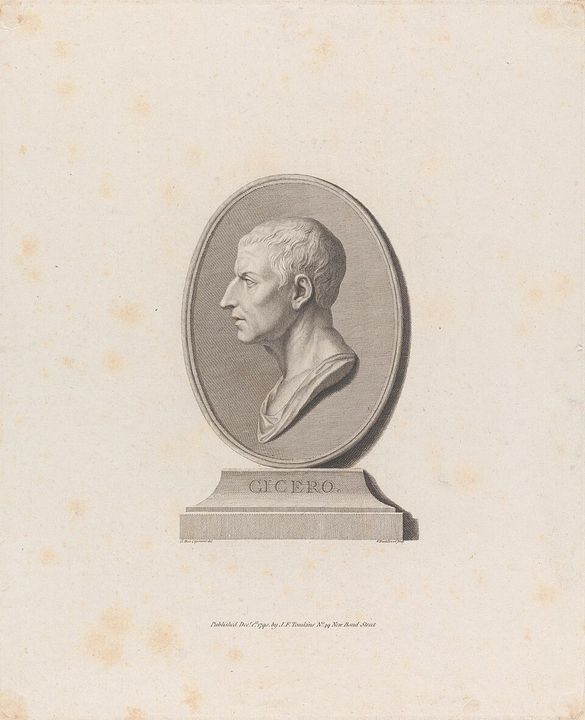

Summary
Cicero wrote his two dialogues on the state in the troubled 50s BC, when the Roman Republic was strained by the private power of Pompey, Caesar and Crassus. On the Commonwealth (De re publica), published in 51 BC, imitates Plato's Republic but asks what the best constitution is for a real people, and answers with Rome itself. On the Laws (De legibus), begun soon after and probably left unfinished, then supplies the laws such a commonwealth should have. The library text is Francis Barham's translation of 1841–1842, reprinted in C. D. Yonge's Bohn volume of 1853 with the editor's preface and Barham's introductions to each book. The scan has been converted by OCR, so some words and numerals are garbled. The Republic is set in 129 BC at the country house of Scipio Aemilianus, the conqueror of Carthage, during a festival holiday a few days before his death. In Book I, after a conversation about a reported second sun, Scipio defines a commonwealth as the affair of a whole people bound by agreement about justice and by shared advantage. He sets out the three simple forms, kingship, aristocracy and democracy, shows how each slides into tyranny, faction or mob rule, and prefers a fourth form blended from all three. Book II tells Roman history from Romulus to the decemvirs as the gradual growth of that blended constitution. In Book III Philus argues, as the sceptic Carneades had done at Rome, that justice is mere convention, and Laelius replies with the famous account of true law as right reason in agreement with nature. Books IV and V, on education, morals and the ideal statesman, survive in scraps. Most of the Republic was lost until 1819, when Cardinal Angelo Mai found about a third of it beneath a copy of Augustine's commentary on the Psalms in a Vatican palimpsest. The ending, the Dream of Scipio, had survived separately through the commentary of Macrobius. In it Scipio's adoptive grandfather, Scipio Africanus the Elder, shows him the heavens, the smallness of the earth, the music of the spheres and the reward waiting for those who serve their country. On the Laws is a conversation at Cicero's family estate near Arpinum among Cicero, his brother Quintus and his friend Atticus. Book I grounds law in nature, reason and a fellowship between God and man; Book II gives a code of religious law; Book III a code for magistrates, with Cicero defending the tribunate against his brother's objections. A fourth and a fifth book are cited by later writers but are lost.
Virtues in this work
- Justice: Laelius defends justice as a law of nature against Philus's argument that it is only the interest of the stronger.
- Prudence: Scipio's preference for a mixed constitution rests on a practical study of how each simple form has decayed in history.
- Piety: The second book of the Laws begins the whole code with the duty of approaching the gods in purity and keeping the ancestral rites.
- Magnanimity: In the Dream Scipio is taught to seek the reward of virtue itself rather than the narrow, short-lived praise of men.
Plot or Argument
- Republic, Book I: the commonwealth defined and the best constitution
Cicero's preface defends the active life of the statesman against philosophers who counsel withdrawal. The dialogue opens with talk of a double sun seen in the sky before Laelius turns the company to politics. Scipio defines the commonwealth as the property of a people, a people being a multitude united by agreement about right and by common interest. He weighs kingship, aristocracy and democracy, traces how each degenerates and gives way to another, prefers kingship among the simple forms, and finally commends a mixed and moderate government that combines all three.
- Republic, Book II: Rome as the model
Following Cato's method, Scipio narrates Rome's growth from Romulus and the site of the city through Numa, Servius Tullius and the expulsion of Tarquin to the early Republic. The point is that Rome's constitution was formed not by one lawgiver but by many generations, each adding something, until consuls, senate and people balanced one another. The book closes with fragments on the statesman who governs his passions as a driver governs an elephant.
- Republic, Book III: is justice natural or conventional?
Philus reluctantly takes up the argument Carneades made at Rome in 155 BC, that states run on interest and that justice, applied consistently, would require Rome to give back its empire. Laelius answers that true law is right reason in agreement with nature, the same everywhere and for all time, with God as its author. Fragments preserved by Augustine and Lactantius also record Scipio's conclusion that a tyranny, a faction or a lawless mob is no commonwealth at all.
- Republic, Books IV–V: education and the statesman
Only fragments remain. They touch the Roman distribution of citizens into classes, the moral education of the young, the reasons Roman custom did not allow the comic stage to attack citizens by name, and the portrait of the ideal guardian of the commonwealth, whose aim is the happiness of his fellow citizens as a pilot's is a safe voyage and a physician's the health of his patient.
- Republic, Book VI: the Dream of Scipio
Scipio recounts a dream from his youth in Africa. Africanus the Elder and his father Aemilius Paullus show him the Milky Way, the nine spheres and the tiny earth with its narrow inhabited zones. He learns that earthly fame is brief and local, that the soul is immortal and divine, and that those who preserve their country have a place prepared in heaven. He is urged to train the soul in the best pursuits, above all the service of the commonwealth.
- Laws, Book I: the foundation of law in nature
Walking near the oak of Marius at Arpinum, Atticus asks Cicero to write on law. Cicero refuses to start from the praetor's edict or the Twelve Tables and goes to the source: law is the highest reason implanted in nature, and because God and man share reason they form a single community. Human beings are born for justice, and right is founded in nature, not in opinion or utility.
- Laws, Book II: the laws of religion
Moving to an island in the river Fibrenus, Cicero argues that a true law cannot command what is wicked, any more than a quack's poison is a physician's prescription. He then recites a code in archaic legal style about approaching the gods in purity, public priesthoods, the auspices, festivals, vows and burial, with commentary on each.
- Laws, Book III: the laws of magistrates
Cicero gives a code for consuls, praetors, censors, aediles, tribunes and the senate, including the maxim that the safety of the people is the supreme law. Quintus attacks the tribunate of the plebs as a source of sedition; Marcus defends it as a safety valve that gave the people a lawful share of power. The book breaks off in a discussion of voting by ballot, and the later books are lost.
Characters
- Scipio Aemilianus (Africanus the Younger), principal speaker of the Republic
Conqueror of Carthage and Numantia, in whose garden the dialogue is set; he defines the commonwealth, narrates Roman history and recounts his dream.
- Gaius Laelius, Scipio's friend and interlocutor
Urges the company toward political questions and answers Philus in Book III with the account of true law.
- Lucius Furius Philus, devil's advocate
Restates, against his own conviction, Carneades' case that justice is a convention of the strong.
- Scipio Africanus the Elder, guide in the Dream
Victor over Hannibal and the younger Scipio's grandfather by adoption, who shows him the heavens and the reward of statesmen.
- Marcus (Cicero), principal speaker of the Laws
Sets out the natural foundation of law and drafts codes of religious and magisterial law.
- Quintus Cicero, Cicero's younger brother
Questions his brother's codes and argues against the power of the tribunes in Laws III.
- Titus Pomponius Atticus, friend and host of the conversation
Cicero's lifelong correspondent, an Epicurean by profession, who asks him to write on law and challenges his premises.
Lessons
A people is joined by justice, not by numbers
Scipio's definition says a crowd is not yet a people. A commonwealth exists only where citizens share an agreement about what is right and a common interest. When rulers or majorities stop serving that common good, the community loses the thing that made it a commonwealth.
- What two bonds, according to Scipio in Book I, turn a multitude into a people?
- Why does the Book III fragment insist that a lawless mob is no more a commonwealth than a tyranny is?
- Augustine later argued that by this definition Rome never was a true commonwealth. Is his objection fair to Cicero?
Blend the simple forms so that none decays alone
Each simple constitution carries the seed of its own corruption: kings become tyrants, nobles a faction, the people a mob. Cicero, following Polybius, argues that a constitution mixing royal, aristocratic and popular elements is more stable, and that Rome built one slowly through many generations rather than by a single founder's design.
- Why does Scipio prefer kingship among the simple forms but the mixed form overall?
- What is the point of telling Rome's history in Book II instead of describing an ideal city as Plato did?
- Which Roman institutions, in Cicero's telling, supply the royal, aristocratic and popular elements?
There is one true law above every statute
Laelius and the Cicero of the Laws hold that right reason in agreement with nature binds all peoples at all times. Senate and people cannot repeal it, and an enactment that commands wickedness is not truly law. This is one of the classic statements of natural law in the Western tradition.
- How does Laelius answer Philus's claim that justice is only advantage?
- In Laws II, why does Cicero compare an unjust statute to a quack's poison?
- If true law needs no interpreter but conscience, why do we still need judges and written codes?
Earthly glory looks small from heaven
The Dream of Scipio asks a man at the height of his fame to look down at the tiny earth. Fame is local and short; the soul is immortal; the reward that lasts belongs to those who serve their country justly for its own sake. Cicero joins public duty to a hope beyond the grave.
- What does Africanus show Scipio about the size of the earth and the reach of fame?
- Why is service to the commonwealth the activity most pleasing to the supreme God in the Dream?
- How can the Dream both humble ambition and still urge Scipio to public action?
Context
Cicero wrote these dialogues after his return from exile in 57 BC, when the alliance of Pompey, Caesar and Crassus dominated Roman politics and street gangs disrupted elections. Barred from his former leading role, he used philosophy to restate the case for the traditional Republic of senate, magistrates and assemblies. He drew on Plato, Aristotle, the Stoics and especially the Greek historian Polybius, a friend of the real Scipio, whose sixth book had explained Roman success by Rome's mixed constitution.
Composition
Letters to his brother Quintus show Cicero planning the Republic in 54 BC, first in nine books and then in six, and moving the setting back to the generation of Scipio. It was published in 51 BC, before he left to govern Cilicia. The Laws was begun around 52 BC as a companion piece and seems never to have been finished or published in his lifetime. Barham's English translation of both appeared in 1841–1842 and was reprinted in Yonge's Bohn volume of 1853, the text used here.
Reception
The Republic was much read in antiquity. Lactantius preserved Laelius's account of true law, Augustine debated Scipio's definition of a people in City of God books II and XIX, and Macrobius wrote a long commentary on the Dream of Scipio that carried it through the Middle Ages, when Chaucer retold it in The Parliament of Fowls. The rest of the work was lost until Angelo Mai published the Vatican palimpsest in 1822. The Laws shaped the natural-law tradition through the medieval and early modern jurists, and the maxim of Laws III on the safety of the people became a byword of political writing. American founders such as John Adams cited Cicero on mixed government. Scholars still debate how far Cicero's mixed constitution follows Polybius and how far he idealized the Rome of Scipio's day.
Comparisons
- cicero-first-catilinarian
The consul of 63 BC defending the Republic by speech in the Senate is the statesman these later dialogues describe in theory; the Laws III maxim on the safety of the people is the principle Cicero had invoked against Catiline.
- the-republic
Cicero takes Plato's title, dialogue form and closing vision of the afterlife, but sets his conversation in a real Roman garden, makes Rome's historical constitution the model, and replaces the Myth of Er with Scipio's dream.
- polybius-histories-book-vi
Polybius, Scipio's companion, explained Rome's rise by its blend of consuls, senate and people and by the cycle of constitutions; Scipio's argument in Republic I and II follows that analysis closely.
- politics
Aristotle sorts constitutions into three good forms and three corrupt ones and praises a mixed polity; Cicero adopts the scheme but locates the best mixture in Rome's inherited institutions.
- city-of-god
Augustine quotes Scipio's definition of a people bound by agreement about right and argues in Books II and XIX that, without true justice toward God, pagan Rome never met it.
- cicero-on-duties
Cicero's last philosophical work, addressed to his son, turns from the constitution of the state to the duties of the individual citizen, and like Laws I grounds them in nature and the fellowship of reason.
Quotes
“a commonwealth is a constitution of the entire people. But the people is not every association of men, however congregated, but the association of the entire number, bound together by the compact of justice, and the communication of utility.”
“There is a fourth kind of government, therefore, which, in my opinion, is preferable to all these: it is that mixed and moderate government, which is composed of the three particular forms which I have already noticed”
“True law is right reason conformable to nature, universal, unchangeable, eternal, whose commands urge us to duty, and whose prohibitions restrain us from evil”
“It is not one thing at Rome, and another at Athens; one thing to-day, and another to-morrow”
“For nothing on earth is more agreeable to God, the Supreme Governor of the universe, than the assemblies and societies of men united together by laws, which are called States.”
“consider your body only, not yourself, as mortal. For it is not your outward form which constitutes your being, but your mind”
“man is born for justice, and that law and equity have not been established by opinion, but by nature.”
“the safety of the people is the supreme law”
For Students
A reading companion for classical Christian high school students. See the student guide.
Reading Guide
Watch for
- Scipio's definition of a commonwealth in Book I and the two bonds, justice and common interest, that it requires.
- The cycle in which each simple constitution decays into its corrupt twin, and how the mixed form is meant to stop it.
- How Book II uses Roman history, not an imagined city, as the proof of the argument.
- Laelius's description of true law in Book III and its echo in Laws I.
- The change of viewpoint in the Dream of Scipio, when the earth and Roman fame shrink to a speck.
Key terms and names
- Res publica
- Literally the people's thing or affair; Barham translates it commonwealth. For Cicero it is a community held together by shared justice and shared interest, not simply any state.
- Mixed constitution
- A government that combines a royal element (the consuls), an aristocratic element (the senate) and a popular element (the assemblies), so that each restrains the others.
- Natural law
- Right reason in agreement with nature, binding on all peoples and times, which no senate or assembly can repeal and by which human enactments are measured.
- Palimpsest
- A manuscript whose original writing was scraped off so that the parchment could be reused. Most of the Republic survived only under a later copy of Augustine on the Psalms.
- Tribune of the plebs
- A Roman magistrate elected to protect ordinary citizens, with a power of veto; Quintus attacks the office in Laws III and Marcus defends it.
- Salus populi
- The safety or welfare of the people, which the consuls' law in Laws III names as the supreme law.
Seminar Questions
- Comprehension Where and when is the conversation of the Republic set, and who is its main speaker?
- Comprehension What three simple forms of government does Scipio describe in Book I, and what does each become when corrupted?
- Comprehension What does Africanus show the young Scipio in the Dream, and what reward does he promise?
- Interpretation Why does Cicero have Philus argue a position Philus himself rejects? What does the dialogue gain by stating the sceptic's case at full strength?
- Interpretation In Laws III Quintus wants to abolish the tribunes and Marcus keeps them. What does Marcus's defence show about how he thinks a mixed constitution should work?
- Interpretation How does the Dream of Scipio change the meaning of the political arguments that come before it?
- Big Question Is there a law above the laws that any people can know by reason, and if so, what should a citizen do when the two conflict?
- Big Question Can a constitution stay healthy if its citizens no longer share an agreement about what is just?
Faith Connections
- Romans 2:14-15 (Scripture)
Paul says that Gentiles who do not have the law of Moses show the work of the law written in their hearts, their conscience bearing witness. Laelius's true law, which needs no interpreter but conscience, is a pagan statement of the same idea, and Christian writers read the two together.
- Lactantius, Divine Institutes VI.8 (Church Fathers)
The Christian apologist quotes Cicero's description of true law at length, saying he had described it almost as with a divine voice, and so preserved the passage for later readers.
- Augustine, City of God XIX.21-24 (Great Conversation)
Augustine takes Scipio's definition of a people bound by agreement about right and argues that true justice, which gives God his due, was never found in pagan Rome; he then proposes a definition based on the objects a people loves.
- 2 Corinthians 4:18 (Scripture)
Paul's contrast between the things seen, which are temporal, and the things not seen, which are eternal, may be set beside the Dream's lesson that earthly fame is brief and the soul's home lies beyond the world.
Logic and Rhetoric
Central argument: A commonwealth is a people bound by agreement about justice and by common interest. Each simple form of government, ruled by one, few or many, tends to decay into tyranny, faction or mob rule. A constitution that blends all three is more stable, and Rome developed such a constitution over generations. Justice itself is not a convention but right reason in agreement with nature, the same for all nations, with God as its author. Therefore the best commonwealth is a mixed one whose laws follow the law of nature, and those who preserve it serve the purposes of heaven.
Rhetorical device: prosopopoeia (speech given to an absent or imagined figure). In the Dream of Scipio, Cicero gives the final word not to any living speaker but to the dead Africanus, speaking from the heavens. Putting the argument for immortal reward in the mouth of Rome's great hero lends it an authority no ordinary speaker could claim.
Debate: Resolved: That a mixed constitution is more stable than any pure form of government.
Memory Work
True law is right reason conformable to nature, universal, unchangeable, eternal, whose commands urge us to duty, and whose prohibitions restrain us from evil
the safety of the people is the supreme law
Writing Prompts
Essay: Scipio says the best government is mixed and moderate. Using Books I and II, explain why each simple form decays, how Rome's institutions combined them, and argue whether Cicero's case depends on his admiration for Rome or would hold for any people.
Comparison with The Republic: Plato builds an ideal city in speech while Cicero describes the Roman constitution he inherited. Compare their methods and their closing visions (the Myth of Er and the Dream of Scipio), and argue which approach better prepares a reader for public life.
Medical Lens
These are works of political philosophy, but they use medicine as a recurring analogy. The statesman of Republic V aims at the happiness of citizens as the physician aims at the health of his patient, and in Laws II an unjust statute is no more a law than the poison of an ignorant empiric is a physician's prescription. A fragment of Republic II lists kinds of disordered passion, one of them an anxiety given to mourning and melancholy, inside an extended image of reason as a charioteer or elephant-driver controlling the soul; this belongs to the Stoic and Platonic tradition of philosophy as therapy for the passions that Cicero later developed fully in the Tusculan Disputations. The Dream of Scipio's teaching that the mind, not the body, is the true self is a classical statement of soul-body dualism.
- Republic, Book II, closing fragments
Reason as the driver of an elephant or charioteer of the passions, with a fragment naming a kind of anxiety prone to mourning and melancholy.
- Republic, Book V fragments
The ruler's aim compared with a pilot's safe voyage and a physician's restoring his patient to health.
- Laws, Book II
Unjust enactments compared with the recipes of unskilful empirics who give poisons instead of medicines.
- Republic, Book VI (Dream of Scipio)
The body is mortal but the mind is the true self, divine and self-moving.
Creative Prompts
- Dialogue
Write the conversation that might follow Book III if Philus, now speaking for himself, asked Laelius how a Roman should act when the law of Rome and the true law of nature disagree.
- Classroom
Assign three groups to kingship, aristocracy and democracy. Each describes its form at its best and at its worst, using Scipio's examples, and the class then designs a mixed constitution that guards against all three corruptions.
- Essay
Compare the Dream of Scipio with the Myth of Er at the end of Plato's Republic. What does each vision teach about why a person should be just?
Further Reading
- On the Commonwealth and On the Laws, Cicero, ed. James E. G. Zetzel
A modern translation with introduction and notes in the Cambridge Texts in the History of Political Thought.
- Commentary on the Dream of Scipio, Macrobius, trans. William Harris Stahl
The late-antique commentary through which the Dream was known in the Middle Ages.
- Cicero: A Portrait, Elizabeth Rawson
- Cicero on Politics and the Limits of Reason: The Republic and Laws, Jed W. Atkins
Verification notes
The structure of both dialogues, their dates, the setting of 129 BC, the discovery of the palimpsest by Angelo Mai and the transmission of the Dream through Macrobius are standard. The editor's preface in the stored text gives 1822 for the discovery (the date of Mai's publication). All eight quotations were found by search in the stored OCR text (content/texts/cicero-republic-and-laws.txt) and copied exactly, including Barham's spellings. The text's book headings are partly garbled by OCR, so book locations were checked against the order of the introductions; chapter numbers are given only where the text prints them beside the quoted passage.
- OCR errors in the stored text: check any quotation against a printed copy of Barham's translation before publication.
- Whether the Laws was ever published in Cicero's lifetime (usually thought not).
- The exact chapter numbers of the Laws quotations in Barham's division.