Work record
The Commonwealth of Oceana
1656 · Renaissance Early Modern · Political Theory · English
Abstract
Background. Writing under the Protector, a Rutland gentleman who had served the captive Charles I offered his nation a republican settlement, veiling England, its rulers and Cromwell in invented names.
Principles. Landownership decides who governs: sole proprietors make absolute kings, a landed few a feudal monarchy, and a broadly propertied people a republic. Sound rule obeys standing laws rather than persons, and fairness is secured when one body frames proposals and another accepts or rejects them.
History. Tudor statutes and the sale of church estates shifted acreage toward yeomen and gentry, so the Stuart throne lost its footing long before the fighting began.
Model. Thirty orders establish a cap on inherited estates, nested parishes, hundreds and tribes, a deliberating upper house, a voting representative assembly, staggered yearly turnover, Venetian secret ballots, specialized councils, schools, a militia and tolerance alongside a national church. Speeches answer objections, including a garrulous lord's ridicule.
Form. Part treatise and part fable, the work frames dry constitutional clauses with orations, classical precedent from Sparta, Rome and Venice, and a closing narrative in which the founder retires, grows old among grateful citizens and is commemorated by a bronze equestrian colossus.
Significance. The book shaped Restoration and Hanoverian commonwealthmen and was prized by American constitution-makers such as Adams; historians still dispute its reading of English social change and its place between classical republicanism and economic interpretation.
Key figures
- Olphaus Megaletor: Lord Archon and lone lawgiver, standing for Cromwell
- Lord Epimonus de Garrula: Talkative councillor who ridicules urns and voting balls
- Leviathan: Harrington's label for Hobbes, his chief theoretical adversary
- Panurgus and Coraunus: Henry VII and Henry VIII, whose land policies undid the feudal order
- Parthenia: Elizabeth I, a queen who ruled by wooing the commons

Summary
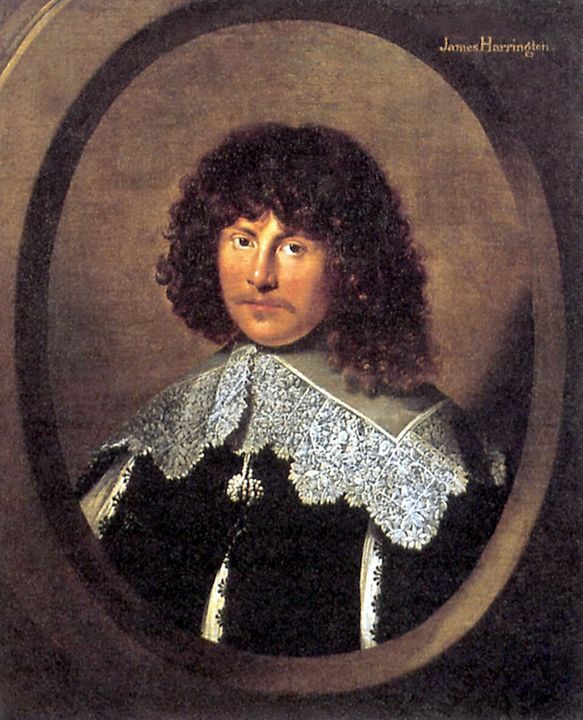
The Commonwealth of Oceana, published in London in 1656 during Oliver Cromwell's Protectorate, is a model constitution for a republic set in an island called Oceana, which is England under a thin disguise. Scotland is Marpesia, Ireland Panopea, London Emporium, and Cromwell himself appears as Olphaus Megaletor, the Lord Archon or sole legislator who founds the commonwealth and then gives up his power. Harrington dedicated the book to the Protector; the printing was seized at one point and, according to the story told in the library edition's introduction, released after Harrington appealed to Cromwell's daughter Lady Claypole. The library text is Henry Morley's Universal Library edition of 1887, with Morley's biographical introduction. The Preliminaries lay down the principles. Following the Venetian writer Giannotti, Harrington contrasts ancient prudence, government by laws for the common interest, which God first showed in the commonwealth of Israel and which Greece, Rome and Venice followed, with modern prudence, the rule of one or a few for private interest that began with the barbarian conquest of Rome. His central claim is that political power follows the balance of property, chiefly land: where one man owns most land there is absolute monarchy, where a few do there is a mixed monarchy of king and nobles, and where the people do there is a commonwealth. Against Hobbes, whom he calls Leviathan, he defends the ancient maxim that a commonwealth should be an empire of laws and not of men, and he finds its secret in two girls sharing a cake: one divides and the other chooses. In a commonwealth the senate, the natural aristocracy of wisdom, debates and proposes; the people resolve; the magistrates execute. The second part of the Preliminaries explains the English civil war as the result of a long shift in landholding. The statutes of Henry VII (Panurgus) and the dissolution of the monasteries by Henry VIII (Coraunus) moved land from the nobility to the commons, so that the old monarchy lost its foundation and fell. The Council of Legislators and the Model then build the new commonwealth in thirty numbered orders, with speeches by the Archon and his councillors. An agrarian law prevents any family from holding land worth more than £2,000 a year, chiefly by dividing estates among sons. Citizens are grouped by parishes, hundreds and fifty tribes, and elect a senate of three hundred and a popular assembly, the prerogative tribe, by an elaborate Venetian ballot of gold and silver balls; a third of each body retires every year in rotation. Councils manage state, war, religion and trade, liberty of conscience is allowed beside a national church, and the youth are educated and trained for a citizen militia. The Corollary shows the commonwealth at work and ends with the Archon's peaceful old age, death and the people's mourning.
Virtues in this work
- Magnanimity: The Lord Archon uses his sole power to found a free commonwealth and then gives that power up, as Lycurgus and Timoleon did.
- Justice: The girls' rule of divide and choose, which Harrington makes the principle of his senate and people, ensures that each receives a fair share.
- Prudence: The Council of Legislators studies the orders of Israel, Sparta, Rome and Venice before framing any law for Oceana.
Plot or Argument
- The Preliminaries, part one: principles of government
Harrington defines government de jure as an art by which a civil society is founded on common right or interest, an empire of laws and not of men, and government de facto as rule by one man or a few for private interest. Empire follows the balance of property: as land is held by one, by a few or by the many, so the government will be monarchy, aristocracy or commonwealth. Reason in the many is best secured by dividing and choosing, which in a commonwealth means a senate that debates and proposes and a people that resolves.
- Equal commonwealth: agrarian and rotation
An equal commonwealth rests on an equal agrarian, which fixes the balance of land so that no few can overpower the whole people, and on equal rotation, which brings every part of the people in turn into office through the ballot. Israel, Sparta, Rome, Athens and above all Venice are examined to show how each order lengthened or shortened a commonwealth's life.
- The Preliminaries, part two: the fall of the old monarchy
The ancient government of Oceana is traced through Roman, Teutonic, Scandian and Neustrian (Norman) conquests to a Gothic balance of king and nobles. The laws of Panurgus (Henry VII) on population and alienation of land, and Coraunus's (Henry VIII's) dissolution of the abbeys, shifted land to the yeomanry and gentry. Parthenia (Elizabeth) governed by courting the people, and when the balance had fully changed, the monarchy could no longer stand.
- The Council of Legislators
After the civil war, the army names Olphaus Megaletor Lord Archon and sole legislator. He gathers fifty legislators to study the ancient commonwealths of Israel, Athens, Sparta, Carthage, Rome, Venice, Switzerland and Holland, and to propose orders for Oceana, which are then published for debate by the people.
- The Model: the thirty orders of the commonwealth
The orders divide citizens from servants and elders from youth, set up parishes, hundreds and tribes, and prescribe the ballot step by step. The agrarian limits landed estates to £2,000 a year. The senate of three hundred and the prerogative tribe of 1,050 deputies form the Parliament, renewed by a third each year. Councils of state, war, religion and trade, magistrates called strategus and orator, universities and schools, a national religion with liberty of conscience, and a citizen army are all provided for.
- Debates on the Model
Each order is followed by the Archon's or a legislator's speech answering objections. In one comic episode Lord Epimonus de Garrula mocks the ballot as a pill sold by quacksalvers, and the Archon replies with a long defence of the Venetian method and of the agrarian as a cure for a desperate disease of the state. The Parliament is likened to a heart with two ventricles, circulating the vital blood of the nation.
- The Corollary
Following Plutarch's story of Lycurgus, the Archon, having established the commonwealth, lays down his power. The commonwealth's provinces, finances and foreign policy are set in order. Like Timoleon of Syracuse, the Archon spends his last years honoured by a free people; after his death a colossal statue is raised with the inscription His name is as precious ointment.
Characters
- Olphaus Megaletor, Lord Archon, founder and sole legislator
The figure for Oliver Cromwell, who frames the commonwealth's orders, defends them in speeches and then resigns his power.
- Lord Epimonus de Garrula, comic critic
A legislator who ridicules the ballot and its urns and balls, giving the Archon occasion for a fuller defence.
- Leviathan (Thomas Hobbes), philosophical opponent
Named by his book's title, Hobbes is answered throughout the Preliminaries for denying that ancient liberty was liberty of the commonwealth and for preferring the rule of men to laws.
- Panurgus, Coraunus and Parthenia, historical figures in disguise
Henry VII, Henry VIII and Elizabeth I, whose reigns Harrington makes the turning points in the shift of landed property.
- Machiavel, authority and sparring partner
Machiavelli, praised as the only modern politician to recover ancient prudence, but corrected on Rome's agrarian strife.
- Lycurgus and Timoleon, classical models
Founders of liberty from Plutarch whose example frames the Archon's resignation and old age in the Corollary.
Lessons
Power follows property
Harrington's distinctive claim is that a government's form depends on who owns the land. Laws and constitutions that do not match the distribution of property will not last. To keep a commonwealth stable, the founder must set the balance of property and keep it fixed by law.
- How does Harrington connect the ownership of land with the forms of monarchy, aristocracy and commonwealth?
- How does he use this principle to explain the fall of the English monarchy?
- Does wealth in money or trade fit his theory as well as land? What does he say about cities that live by trade?
Divide and choose
Two girls sharing a cake show the secret of a just commonwealth: if one divides and the other chooses, the divider has every reason to be fair. Harrington builds his constitution on this idea, giving a senate of the wise the power to propose and the people the power to decide.
- Why does Harrington think the senate should not also choose?
- What does he mean when he says the wisdom of the few may be the light of mankind but their interest is not its profit?
- Where else might the method of dividing and choosing settle a dispute fairly?
Rotation keeps office from becoming property
Harrington requires that a third of every elected body leave office each year and that officers wait before being chosen again. Rotation, with the secret ballot, keeps a constant flow of new citizens into government and prevents any group from making office its possession.
- What problem is rotation meant to solve?
- Why does Harrington admire the Venetian ballot so much, and what objections does Epimonus raise?
- What are the costs as well as the benefits of term limits in government?
A founder who lays down power
The Lord Archon gathers sole legislative power, uses it to establish a free commonwealth, and then resigns it. Harrington presents this as the greatest act of a founder, modelled on Lycurgus and Timoleon, and offered as counsel to Cromwell, who held power at the time.
- Why might Harrington have written the Archon's resignation into a book dedicated to Cromwell?
- What makes the Corollary's comparison with Timoleon fitting?
- Which founders in history have laid down power willingly, and what followed?
Context
Harrington wrote after the English civil wars, the execution of Charles I in 1649 and the brief Commonwealth, when Oliver Cromwell ruled as Lord Protector under the Instrument of Government (1653). Many projects for a settled constitution were circulating, from the Levellers' Agreements of the People to proposals for restoring kingship. Harrington drew on classical republican writers (Aristotle, Livy, Plutarch), on Machiavelli's Discourses and on accounts of the Venetian republic by Donato Giannotti and Gasparo Contarini, and he answered Hobbes's Leviathan (1651), whose case for an absolute sovereign he rejected.
Composition
Oceana was published in 1656 by J. Streater for Livewell Chapman and dedicated to Cromwell. Harrington defended and restated its ideas in later works, including The Prerogative of Popular Government (1658), The Art of Lawgiving (1659) and A System of Politics. In 1659, as the Protectorate collapsed, he founded the Rota Club, which debated constitutional questions and voted by ballot. Henry Morley's edition of 1887, used here, reprints the text with his own introduction.
Reception
Oceana was much discussed and attacked at once, for example by Henry Ferne and Matthew Wren, and Harrington's circle influenced republican proposals of 1659. After the Restoration his ideas passed to later writers known as commonwealthmen, including Henry Neville, and in the eighteenth century to Americans. John Adams admired Harrington's principle that power follows property, and historians have traced his influence in the frames of government of some American colonies and in later debates over rotation, the ballot and bicameral legislatures. Historians still debate whether Harrington's theory of the gentry's rise is accurate history and how far he should be read as a classical republican or as an early analyst of economic causes in politics.
Comparisons
- leviathan
Hobbes argued that the liberty praised by the ancients was the liberty of the sovereign state and that laws need a man to enforce them; Harrington, calling him Leviathan, answers that a well-ordered commonwealth is an empire of laws and not of men.
- the-federalist-papers
Harrington's bicameral design, rotation in office and fear of concentrated land were known to the American founders; the Federalist debates over terms of office and the Senate as a deliberative body continue questions Oceana raised.
- utopia
More's island republic also abolishes great estates and orders citizens' lives by detailed laws, but holds all property in common; Harrington keeps private property and limits it, and offers his model as practicable for England rather than as a philosophical fiction.
- machiavelli-discourses-on-livy
Harrington calls Machiavelli the only politician of later ages to recover ancient prudence, but disputes his view that Rome's strife over the agrarian law destroyed it, arguing instead that the lack of an equal agrarian did.
- plutarch-lives
The Corollary is built from Plutarch's lives of Lycurgus, who bound Sparta to his laws before leaving, and Timoleon, who freed Syracuse and lived as a private citizen honoured by the people.
- areopagitica
Milton and Harrington were both republicans of the 1640s and 1650s; Milton argued for free inquiry within a godly commonwealth, while Harrington sought liberty in institutional machinery of balance, ballot and rotation.
Quotes
“government (to define it de jure, or according to ancient prudence) is an art whereby a civil society of men is instituted and preserved upon the foundation of common right or interest; or, to follow Aristotle and Livy, it is the empire of laws, and not of men.”
“as is the proportion or balance of dominion or property in land, such is the nature of the empire.”
“But without an agrarian law, government, whether monarchical, aristocratical, or popular, has no long lease.”
“the whole mystery of a commonwealth, which lies only in dividing and choosing.”
“Dividing and choosing, in the language of a commonwealth, is debating and resolving”
“The wisdom of the few may be the light of mankind; but the interest of the few is not the profit of mankind nor of a commonwealth.”
“An equal commonwealth (by that which has been said) is a government established upon an equal agrarian, arising into the superstructures or three orders, the Senate debating and proposing, the people resolving, and the magistracy executing, by an equal rotation through the suffrage of the people given by the ballot.”
“Which is as if a man should tell famous Harvey that he transcribed his circulation of the blood, not out of the principles of nature, but out of the anatomy of this or that body.”
For Students
A reading companion for classical Christian high school students. See the student guide.
Reading Guide
Watch for
- The contrast between ancient prudence and modern prudence at the very start of the Preliminaries.
- The principle of the balance of property and the three forms of government that follow from it.
- The story of the two girls and the cake, and how it becomes the senate proposing and the people resolving.
- The disguised names for English places and rulers, and how the history of Panurgus and Coraunus explains the civil war.
- The Archon's resignation and death in the Corollary, and the inscription on his statue.
Key terms and names
- Balance of property
- The proportion of land held by one, a few or the many, which in Harrington's theory determines whether a government will be monarchy, aristocracy or commonwealth.
- Agrarian law
- A law limiting how much land one family can hold, meant to fix the balance of property; Oceana's agrarian caps estates at £2,000 a year.
- Rotation
- The regular retirement of a portion of every elected body, so that offices pass through the whole citizenry in turn.
- Ballot
- Secret voting by placing balls in urns, borrowed from Venice, which Harrington describes in great detail.
- Ancient prudence
- Government by laws for the common interest, which Harrington traces from Israel through Greece and Rome to Venice.
- Prerogative tribe
- Oceana's popular assembly of elected deputies, which votes on the senate's proposals.
Seminar Questions
- Comprehension Whom do Oceana, Olphaus Megaletor and Leviathan stand for?
- Comprehension What does Harrington mean by the balance of property, and what three forms of government does it produce?
- Comprehension In Oceana, which body proposes laws, which resolves them, and which executes them?
- Interpretation How does the story of the cake show why a senate of wise men should not have the final choice?
- Interpretation Why did Harrington dedicate the book to Cromwell and end it with the Archon laying down his power?
- Interpretation Harrington compares his political science to Harvey's study of the blood. What does the comparison claim about the kind of knowledge politics can achieve?
- Big Question Can a constitution be designed to last forever, as Harrington hoped, or must every government change with its people?
- Big Question Should the law limit how much property one person or family may hold in order to preserve free government?
Faith Connections
- Numbers 26:52-56; Joshua 13-19 (Scripture)
Harrington calls the agrarian law God's own invention, because the land of Canaan was divided among the tribes and families of Israel by lot; Israel is his first example of ancient prudence.
- Exodus 18:13-26 (Scripture)
Jethro's counsel to Moses to appoint rulers over thousands, hundreds, fifties and tens is cited in the book as a pattern of taking counsel from others, and stands behind Oceana's graded divisions of parishes, hundreds and tribes.
- Song of Solomon 1:3; Ecclesiastes 7:1 (Scripture)
The Archon's statue bears the words His name is as precious ointment, drawn from the Song of Solomon and echoing the Preacher's saying that a good name is better than precious ointment.
- Aristotle, Politics IV (Great Conversation)
Aristotle's account of the mixed polity and of the political weight of the middle class lies behind Harrington's maxim of the empire of laws and his concern with the distribution of property.
Logic and Rhetoric
Central argument: Political power follows the balance of property in land. A government whose form does not match that balance will fall, as the English monarchy fell when land passed to the commons. A commonwealth will be stable if an agrarian law fixes an equal balance of land. Reason in a commonwealth is secured by dividing and choosing: a senate proposes and the people resolve. Rotation and the ballot keep every office open to the whole people. Therefore a commonwealth founded on an equal agrarian, with a proposing senate, a resolving people and rotation by ballot, can be equal, free and, as far as human prudence can foresee, immortal.
Rhetorical device: exemplum (homely illustration). To explain the deepest principle of government, Harrington turns from philosophers to two girls sharing a cake, one dividing and the other choosing. The everyday example makes an abstract constitutional rule seem obvious and fair.
Debate: Resolved: That an elected senate should have the power to propose laws but not to pass them.
Memory Work
The wisdom of the few may be the light of mankind; but the interest of the few is not the profit of mankind nor of a commonwealth.
as is the proportion or balance of dominion or property in land, such is the nature of the empire.
Writing Prompts
Essay: Harrington argues that the English monarchy fell because land had passed from the nobility to the people. Explain his account of Panurgus, Coraunus and Parthenia, and evaluate whether economic change alone can explain a political revolution.
Comparison with Leviathan: Hobbes says a commonwealth needs a single sovereign whose will is law; Harrington answers that it must be an empire of laws and not of men. Compare their reasoning and decide which better accounts for how free government can be made to last.
Medical Lens
Harrington thought of politics as an anatomy of the body politic, and William Harvey's discovery of the circulation of the blood (1628) is his model of a science drawn from nature rather than from particular cases. In the Preliminaries he compares the principles of ancient prudence to Harvey's circulation, and in the Model he describes the Parliament of Oceana as a heart of two ventricles that draws in and sends out the vital blood of the nation in perpetual circulation. The agrarian law is defended as a dangerous but necessary cure for a desperate disease, and the comic Epimonus mocks the ballot as pills sold by quacksalvers. Morley's introduction records that in prison on St Nicholas Island and at Plymouth Harrington suffered from scurvy and then from mental breakdown, and that he later wrote to prove that those who thought him mad were mad themselves; other biographers add delusions about his body. Any retrospective diagnosis would be interpretive.
- Part I, The Preliminaries (reply to Leviathan)
Political principles compared with Harvey's circulation of the blood, discovered from nature and not from the anatomy of a single body.
- Part III, The Model (discourse on the Parliament)
The Parliament likened to a heart with two ventricles circulating the vital blood of Oceana.
- Part III, The Model (debate on the ballot and agrarian)
Epimonus's speech on urns, balls and the pills of quacksalvers; the agrarian as the cure of a desperate disease.
- Morley's Introduction
Harrington's imprisonment, scurvy, mental breakdown, later gout and palsy.
Creative Prompts
- Classroom
Run a small Oceana election: divide the class into tribes, draw lots and ballot with two colours of counters as in the Venetian method, elect a senate to propose a class rule and an assembly to resolve it, then rotate a third of each body out and repeat.
- Dialogue
Write the conversation in which Harrington, waiting for Lady Claypole, persuades her to ask her father to release the seized manuscript of Oceana.
- Essay
Harrington says that power follows property. Test the principle against one revolution or change of government you have studied.
Further Reading
- The Commonwealth of Oceana and A System of Politics, James Harrington, ed. J. G. A. Pocock
The Cambridge Texts edition with an introduction by the leading Harrington scholar.
- The Machiavellian Moment, J. G. A. Pocock
Places Harrington in the line of republican thought from Florence to America.
- Thoughts on Government, John Adams
A 1776 pamphlet on constitution-making by an American admirer of Harrington.
Verification notes
Dates, the disguised names, the agrarian limit of £2,000 a year, the Rota Club and Harrington's imprisonment are confirmed by the stored text and its 1887 introduction. All eight quotations were found by search in the stored Project Gutenberg text (content/texts/harrington-oceana.txt) and copied exactly. The story of Lady Claypole is reported from Morley's introduction (and earlier from Toland's life of Harrington) rather than from independent documents. The number of orders (thirty), the size of the senate (300) and of the prerogative tribe (1,050) follow the Model as usually summarized and were spot-checked in the text. Morley's introduction is warmly partisan toward Harrington and sharp about Charles II; the record does not adopt its judgments.
- The printer and bookseller of the 1656 edition (J. Streater for Livewell Chapman is the usual attribution).
- Details of Harrington's influence on the frames of government of particular American colonies.