Work record
Homilies on the Statues
387 CE · Ancient · Sermons · Greek
Abstract
Background. Early in 387 a new imperial levy provoked a riot in Antioch, and the crowd threw down and dragged the statues of Theodosius and his family. Such an insult to the imperial image counted as treason, and the city braced for executions, confiscations, or its own destruction.
Occasion. Ordained presbyter the year before, John preached through Lent while Bishop Flavian journeyed to the emperor. The sermons follow events as they unfold: flight from the city, arrests and trials, the arrival of the commissioners, the intercession of monks, and at last Flavian's return with a pardon, celebrated at Easter.
Content. Alongside commentary on Scripture and on the order of creation, John returns repeatedly to a single reform: abandoning the habit of swearing oaths. He contrasts the fear of an earthly ruler with the fear of God, and presents Lent as a season in which panic may be turned into amendment.
Teaching. Sin is treated as sickness and the preacher as physician; fasting, almsgiving, guarded speech and confidence in divine mercy are the remedies. Death, he insists, is no evil to the righteous.
Significance. The series is the most sustained surviving record of Christian preaching through a civic emergency in late antiquity and helped build the reputation that later brought John to the see of Constantinople.
Key figures
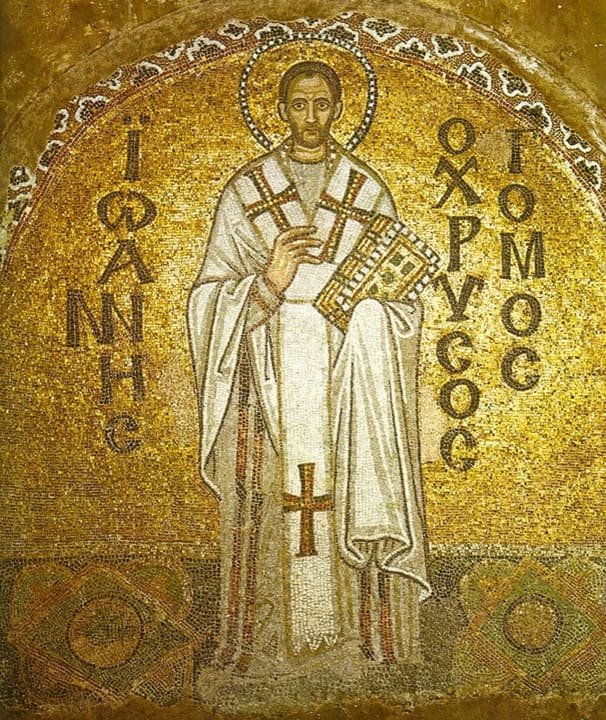
- John Chrysostom: Presbyter of Antioch, preaching to a terrified congregation
- Flavian: Bishop of Antioch who travelled to Constantinople to beg clemency
- Theodosius I: Emperor whose statues were thrown down and whose punishment was feared
- Hellebichus and Caesarius: Imperial commissioners sent to investigate the riot
- The monks of the mountains: Hermits who came down to intercede for the accused citizens
- The people of Antioch: Congregation awaiting the emperor's sentence

Summary
Homilies on the Statues records Chrysostom preaching to Antioch during a civic emergency in 387. After unpopular imperial taxes provoked unrest, a crowd in Antioch insulted and damaged statues of Emperor Theodosius and his family. In a Roman imperial city, such an act could be treated as treason, and the population feared collective punishment. Chrysostom used the crisis as a pastoral, political, and moral occasion. The sermons do not simply report events; they interpret fear, rumor, anger, repentance, and communal responsibility through Scripture. Chrysostom urges hearers to discipline speech, reject blasphemy, practice mercy, fast seriously, and accept correction before punishment arrives. He praises monks and clergy who intercede with imperial authorities, especially Bishop Flavian's mission to plead for Antioch. The collection shows preaching as a form of public medicine for panic. Chrysostom diagnoses the city's disorder not only as political revolt but as spiritual and verbal disease: rash tongues, theatrical passions, greed, fear of death, and habits of oath-taking. His remedies are penitence, almsgiving, self-command, and confidence in divine mercy. Historically, the homilies reveal late antique Christianity negotiating its place within imperial power. Chrysostom neither rejects the empire nor flatters it completely; he tries to shepherd frightened citizens while defending Christian moral order. The medical lens is unusually vivid because his rhetoric repeatedly treats sin as illness and repentance as cure. He speaks to bodies under threat, minds unsettled by public terror, and households waiting for possible violence. For modern readers, the sermons display both pastoral brilliance and the dangers of moralizing civic suffering. They are among the strongest examples of crisis preaching in the ancient church, turning a city's dread into a sustained exercise in communal interpretation. Their power comes from that double register: imperial politics become intimate conscience, while private habits are shown to have public consequences today.
Plot or Argument
- Antioch waits under imperial threat
The sermons open from a city frightened by its own riot and unsure whether Theodosius will punish the whole community.
- Speech becomes a moral battlefield
Chrysostom repeatedly attacks oaths, blasphemy, slander, and theatrical rumor as habits that reveal and intensify social disorder.
- Repentance is preached as civic therapy
Fasting, almsgiving, prayer, and self-command become remedies for fear and anger while church leaders seek imperial clemency.
- Mercy reframes political danger
The later homilies celebrate intercession and divine compassion, presenting Antioch's reprieve as a call to permanent reform.
Key claims
The main steps of the argument, in order, and how they fit together.
- Antioch's crisis has a moral cause as well as a political one, growing out of anger, rash speech and disordered habits.How it is supported: Diagnosis of the riot as a sickness of the city's soul and tongue
- A city that fears an earthly emperor's punishment should fear God's judgment far more.How it is supported: Contrast between the fear of Theodosius and the fear of God
- God's mercy is greater than any emperor's, so the city may hope rather than despair.How it is supported: Scriptural examples of divine compassion and the intercession of Flavian and the monks
- Death is no evil to the righteous, so fear of execution should not rule a Christian.How it is supported: Scriptural teaching on death and the hope of resurrection
- The right response to danger is repentance rather than panic, using Lent as a season for amendment.How it is supported: The preacher as physician prescribing fasting, prayer and almsgiving
- Hearers should give up the habit of swearing oaths as a concrete sign of real reform.How it is supported: Repeated exhortation across the series with practical advice for guarding speech
- The city's pardon calls for lasting reform, not a return to old habits once the danger passes.How it is supported: The Easter celebration of Flavian's return with the emperor's pardon
Argument map
Supported by
- 5The right response to danger is repentance rather than panic, using Lent as a season for amendment.
which rests on
- 1Antioch's crisis has a moral cause as well as a political one, growing out of anger, rash speech and disordered habits.
- 2A city that fears an earthly emperor's punishment should fear God's judgment far more.
- 3God's mercy is greater than any emperor's, so the city may hope rather than despair.
- 4Death is no evil to the righteous, so fear of execution should not rule a Christian.
- 6Hearers should give up the habit of swearing oaths as a concrete sign of real reform.
- 7The city's pardon calls for lasting reform, not a return to old habits once the danger passes.
Therefore
Plain-language summaries of the author's argument, not quotations.
Lessons
Public fear needs interpretation
Chrysostom treats civic panic as something that can be shaped by speech. The preacher's task is not to deny danger, but to give fear a moral and communal frame.
- When does interpretation comfort, and when does it control?
- How does Chrysostom turn political uncertainty into spiritual urgency?
Language can inflame a city
The sermons insist that careless words are not harmless. Oaths, rumors, and insults are presented as social forces capable of turning grievance into disaster.
- Why does Chrysostom focus so much on speech?
- What modern crises show similar verbal contagion?
Repentance is imagined as treatment
Chrysostom's pastoral method often uses the language of sickness and cure. This makes sin concrete and treatable, but it can also medicalize moral failure in ways that deserve scrutiny.
- What does the sickness metaphor make clearer?
- Where might it become cruel or simplistic?
Context
The homilies belong to late fourth-century Antioch, a major Roman city where imperial taxation, urban unrest, and Christian preaching intersected. The statue riot of 387 created a real threat of punishment from Theodosius I.
Composition
Chrysostom preached the homilies during Lent while Bishop Flavian traveled to intercede with the emperor. They were preserved as a linked crisis sequence in the Greek homiletic tradition.
Reception
The collection helped establish Chrysostom's reputation as a master of public preaching. Later Christian readers valued its rhetoric of repentance, civic discipline, and pastoral response to fear.
Comparisons
- the-bible
Chrysostom's preaching depends on biblical models of repentance, prophetic warning, and mercy, especially when public sin threatens communal disaster.
- city-of-god
Augustine interprets imperial catastrophe after Rome's sack; Chrysostom interprets imperial danger before punishment arrives.
- sinners-and-the-surprising-work-of-god
Edwards and Chrysostom both use fear to awaken repentance, but Chrysostom's fear is rooted in an immediate civic emergency.
Quotes
For Students
A reading companion for classical Christian high school students. See the student guide.
Reading Guide
Watch for
- The lament at the opening of Homily 2, preached after the riot, when Chrysostom describes a city emptied by fear and waiting for the emperor's sentence.
- Homily 1, preached before the riot, on Paul's advice to Timothy to take a little wine for his stomach. Notice how a sermon on bodily weakness becomes the first of a series on a city's sickness.
- Chrysostom's repeated demand that his hearers give up swearing oaths. Watch how he returns to it sermon after sermon and treats it as the concrete Lenten reform that will prove the city's repentance.
- The monks who come down from the mountains around Antioch to intercede with the imperial commissioners, whom Chrysostom praises in contrast to the philosophers who hid.
- Homily 21, where Chrysostom reports Bishop Flavian's return from Constantinople, the speech Flavian made to Theodosius, and the emperor's pardon.
Key terms and names
- Antioch
- The great Syrian city of the Roman East where Chrysostom was a priest in 387. Its riot over new taxes put the whole population under threat of imperial punishment.
- The statues
- Images of Emperor Theodosius I and his family, including his late wife, which rioters threw down and dragged through the streets. Insulting the emperor's image counted as an offence against the emperor himself.
- Flavian
- The bishop of Antioch who, though old and with his sister near death, travelled to Constantinople during Lent to plead with Theodosius for the city.
- Theodosius I
- The emperor whose anger the city feared. The homilies end with his pardon, which Chrysostom presents as an imitation of divine mercy.
- The imperial commissioners
- Officials sent from the capital to investigate the riot and judge the guilty. Their arrival and hearings fill the middle sermons with dread.
- Oaths
- The habit of swearing by God in ordinary speech, which Chrysostom attacks throughout the series as a sin of the tongue and asks his hearers to abandon during the crisis.
- Lent
- The fast before Easter, during which the homilies were preached. Chrysostom uses the season to tie the city's fasting and prayer to its hope of reprieve.
Seminar Questions
- Comprehension What happened to the statues of Theodosius and his family, and why did the people of Antioch fear that the whole city would be punished?
- Comprehension Who is Flavian, where does he go during the crisis, and what news does Chrysostom bring the congregation in Homily 21?
- Comprehension What role do the monks from the surrounding mountains play while the imperial commissioners are in Antioch?
- Interpretation Why does Chrysostom spend so much of a political emergency preaching against swearing oaths? What connection does he see between careless speech and the riot?
- Interpretation Chrysostom often calls sin a disease and repentance a medicine. How does this language change the way his hearers are meant to understand their guilt and their fear?
- Interpretation How does Chrysostom use the city's fear of an earthly emperor to teach about the fear and mercy of God? Where does he set the two side by side?
- Big Question Chrysostom tells a frightened city that the crisis is an opportunity for reform. Is it right for a preacher to use public fear to press for changes in private habits, and what keeps such preaching from becoming manipulation?
Faith Connections
- Jonah 3 (Scripture)
Nineveh, threatened with destruction, fasts and repents and is spared. Antioch under threat of the emperor's wrath fits this story closely, and the eventual pardon in Homily 21 completes the pattern.
- Matthew 5:33-37 (Scripture)
Jesus forbids swearing at all and tells his hearers to let their yes be yes. This is the text behind Chrysostom's persistent campaign against oaths throughout the series.
- James 3:5-6 (Scripture)
James calls the tongue a small fire that sets a great forest ablaze. Chrysostom's view that the riot grew from undisciplined speech is a practical sermon on this passage.
- Ambrose of Milan, Letter 51, to Theodosius (Great Conversation)
Three years after Antioch's reprieve, Theodosius ordered the massacre at Thessalonica, and Ambrose wrote to require public penance before the emperor could receive communion. Read together, the two episodes show bishops pleading with and correcting the same emperor.
Logic and Rhetoric
Central argument: Antioch's crisis has both a political and a moral cause: the riot grew from anger, rash speech and disordered habits. A city that fears an earthly emperor's punishment should fear God's judgment more, and should also trust that God's mercy is greater than any emperor's. Therefore the right response to the danger is not panic but repentance, shown in concrete reforms such as fasting, almsgiving and giving up oaths, which will both prepare the city for the emperor's judgment and heal the habits that led to the riot.
Rhetorical device: exemplum. Chrysostom repeatedly sets living examples before his hearers, most memorably the monks who came down from the mountains to intercede with the commissioners and Flavian's journey to the emperor, so that the congregation sees the virtues he preaches already at work in their own city.
Debate: Resolved: Chrysostom was right to use Antioch's fear of the emperor to press for the reform of everyday habits such as swearing.
Writing Prompts
Essay: Chrysostom treats the riot as a symptom of a sick city and repentance as its cure. Using his campaign against oaths, his praise of the monks, and the account of Flavian's mission, argue how he understands the relation between private sin and public disaster.
Comparison with City of God: Chrysostom preaches to a city waiting for imperial punishment; Augustine writes after Rome itself has been sacked. Compare how each explains the meaning of a civic catastrophe for Christians, and argue which offers the more enduring account of the relation between earthly cities and God's judgment.
Medical Lens
The work is not medical in a technical sense, but it is rich for the history of pastoral care under mass anxiety. Chrysostom's metaphors of illness and cure show how ancient preaching treated moral disorder and civic panic as conditions requiring disciplined treatment.
- Opening homilies after the riot
The citywide dread of imperial punishment offers a case study in mass anxiety and pastoral containment.
- Homilies against oaths and blasphemy
Chrysostom describes habitual sins as diseases to be treated through practice and discipline.
Creative Prompts
- Essay
Compare crisis preaching after Antioch's statue riot with modern public-health messaging during civic fear.
- Dialogue
Write a conversation between Chrysostom and a trauma clinician about fear, guilt, and communal repair.
Further Reading
- John Chrysostom and the Jews, Robert L. Wilken
Important context for Chrysostom's Antiochene preaching, including the sermons against Judaizing Christians that he preached in Antioch in 386-387.
- Golden Mouth, J. N. D. Kelly
A major biography of Chrysostom.
Verification notes
The statue riot context, Flavian's intercession, and broad pastoral themes are secure. No quotations are included pending line-level verification in the NPNF translation.
- Verify exact homily numbers for any future quoted passages.