Work record
Jacobson v. Massachusetts
1905 · Early 20th Century · Court Decision · English
Abstract
Question Presented. Did a Massachusetts law letting local health boards require smallpox vaccination, enforced against a Cambridge minister by a five-dollar fine, take his liberty without due process or deny him equal protection under the Fourteenth Amendment?
Arguments. Jacobson's counsel described the mandate as an arbitrary intrusion on a free man's care of his own body, noted that physicians disputed the procedure's worth, and insisted he should have been allowed to tell jurors why he feared it. The Commonwealth replied that halting epidemics lay at the heart of state authority, that lawmakers could follow the weight of medical opinion, and that the sanction was small.
Holding. By seven votes to two the Court let the Cambridge fine stand. Harlan located the law within the police power, explained that constitutional freedom does not mean exemption from all restraint, and refused to let judges or jurors second-guess a legislative choice backed by long experience abroad and at home. He added that grossly arbitrary orders, or ones that would be cruel to a particular adult, would warrant judicial relief.
Significance. The ruling anchors American public-health law. It supported school vaccination requirements in 1922 and was invoked by Holmes for Virginia's sterilization law in 1927, and judges debated its scope again during the pandemic of 2020-2021.
Text. The library holds Harlan's legal analysis without the reporter's factual statement or notes.
Key figures
- Henning Jacobson: Cambridge Lutheran pastor fined for declining vaccination
- Cambridge Board of Health: Municipal body that ordered general vaccination in 1902
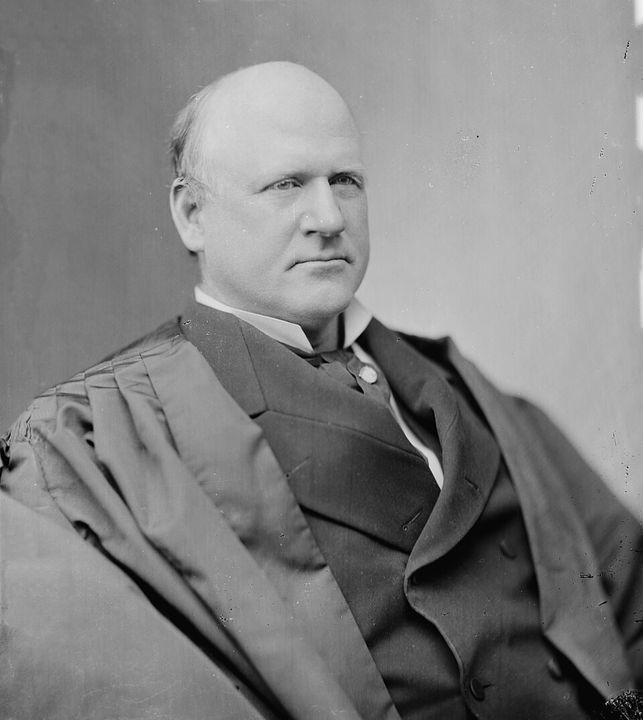
- John Marshall Harlan: Justice who grounded the order in communal self-defense
- David J. Brewer: Dissenter who filed no opinion
- Rufus W. Peckham: Second silent dissenter, soon to write Lochner

Summary
A Massachusetts statute authorized the board of health of any city or town to require the vaccination of its inhabitants when it judged that necessary for public health or safety, and provided a five-dollar penalty for adults who refused; children certified by a physician as unfit for vaccination were exempt. In February 1902, during a smallpox outbreak, the Cambridge board of health ordered all inhabitants who had not been vaccinated since 1897 to be vaccinated, and offered vaccination without charge. Henning Jacobson, a Swedish-born Lutheran minister in Cambridge, refused. He was prosecuted, offered at trial to prove that vaccination was ineffective and sometimes injurious and that he had personal reasons to fear it, and was convicted and fined five dollars when the judge excluded that evidence. The Massachusetts Supreme Judicial Court affirmed, and Jacobson brought the case to Washington. The question was whether the statute and the Cambridge regulation deprived Jacobson of liberty without due process or denied him equal protection under the Fourteenth Amendment. His side argued that compulsory vaccination was an unreasonable and arbitrary invasion of a free person's right to care for his own body and health, that the medical value of vaccination was disputed, and that he was entitled to show the jury why it was dangerous for him. Massachusetts argued that the police power plainly included measures to stop epidemics, that the legislature and local health boards were entitled to rely on prevailing medical opinion, and that the penalty was modest. On 20 February 1905 the Court affirmed, seven to two. Justice Harlan held that the authority to enact the statute lay in the state's police power, which extends to reasonable regulations protecting public health and safety. The liberty secured by the Constitution is not an absolute freedom from restraint; real liberty for all depends on limits that prevent each person from injuring others, and a community may protect itself against an epidemic on the principle of self-defense. Because vaccination had strong support in the experience of many countries, neither a court nor a jury could override the legislature's choice merely because some doubted it. Harlan cautioned that the police power might be exercised so arbitrarily in particular cases that courts must intervene, and that the law should not be read to require vaccinating an adult whose particular condition would make it cruel and inhuman in the last degree. Justices Brewer and Peckham dissented without opinion. The library text begins with the Court's legal analysis; the reporter's statement of the facts and the notes are not included. The Court relied on Jacobson in Zucht v. King (1922), upholding a school-vaccination rule, and in Buck v. Bell (1927), where Justice Holmes cited it in upholding Virginia's compulsory sterilization statute. Courts and commentators returned to the case frequently during the COVID-19 pandemic of 2020-2021.
Virtues in this work
- Justice: Harlan holds that each person's liberty must be exercised without injury to the safety of neighbors.
- Prudence: The Court entrusts a disputed question of method to a local board acting in an emergency, while reserving protection against arbitrary or cruel enforcement.
- Charity: The opinion treats submission to a public-health measure as a duty owed for the protection of the whole community.
Plot or Argument
- Preamble and spirit of the Constitution set aside
Harlan disposes briefly of arguments resting on the Preamble and on the spirit of the Constitution, holding that neither is a source of substantive rights or powers.
- The statute as the state court construed it
Accepting the Massachusetts court's interpretation, Harlan treats the evidence Jacobson offered as an attack on the legislature's judgment that vaccination prevents smallpox.
- The police power and liberty
Health and quarantine laws belong to the police power the states never surrendered, and the liberty the Fourteenth Amendment protects is subject to such restraint as the safety of the general public may demand.
- A board of health in an emergency
The legislature reasonably entrusted the decision to a local board, which acted when smallpox was prevalent and increasing in Cambridge; on the principle of self-defense a community may protect itself against an epidemic.
- Medical dispute and legislative judgment
Jacobson's offers of proof are more formidable by their number than their value; vaccination finds strong support in experience, and courts may not substitute their opinion for the legislature's on a disputed question of method.
- Limits on the holding
Harlan warns that health regulations may be so arbitrary in particular cases as to require judicial intervention, and that the statute should not be applied where vaccination would be cruel and inhuman for an adult in a particular condition of health.
Characters
- Henning Jacobson, plaintiff in error
Swedish-born Lutheran pastor in Cambridge who refused vaccination in 1902 and was fined five dollars.
- Cambridge Board of Health, local health authority
Body that ordered general vaccination in February 1902 during a smallpox outbreak and offered it free of charge.
- Justice John Marshall Harlan, author of the opinion of the Court
Wrote that a community may protect itself against an epidemic by reasonable regulations under the police power.
- Justices David J. Brewer and Rufus W. Peckham, dissenters
Dissented without filing an opinion; Peckham wrote the majority opinion in Lochner two months later.
Lessons
Liberty under law
Harlan answered Jacobson's claim to control his own body by describing liberty as something that exists only within a social order. Real liberty for all, he wrote, could not survive if each person might use his person or property regardless of injury to others. The argument places individual freedom and the common good in relation rather than simple opposition.
- What does Harlan mean by real liberty for all?
- How does his idea of liberty compare with Jacobson's?
- Are there liberties so personal that no public emergency can justify restraining them?
Who decides disputed medical questions?
Jacobson wanted to show the jury that vaccination was unreliable and risky. The Court held that the legislature had already weighed such questions, that vaccination was supported by the experience of many countries, and that courts and juries should not reopen the matter case by case. The ruling rested on deference to lawmakers advised by prevailing medical opinion.
- Why does Harlan say Jacobson's offers of proof were more formidable by number than by value?
- What reasons does the Court give for leaving the choice of method to the legislature?
- When experts disagree, how should a free society decide what the law requires?
The limits Harlan placed on his own holding
The opinion does not give health authorities unlimited power. Harlan said courts may intervene when regulations are arbitrary in particular cases, and that the statute should not be applied where vaccination would be cruel and inhuman to a particular adult. Later readers have debated how much weight these limits carry.
- What example does Harlan give of a case where enforcement would be cruel and inhuman?
- Why might the Court have added these cautions at the end of the opinion?
- How should a court tell a reasonable health regulation from an arbitrary one?
A precedent with a long reach
Jacobson was later cited for very different purposes: to uphold school-vaccination rules in 1922, Virginia's sterilization statute in 1927, and many public-health orders during the pandemic of 2020-2021. Following a precedent through its later uses shows how a principle stated for one setting can be extended to others.
- How did Holmes use Jacobson in Buck v. Bell?
- What features of Jacobson's facts, such as the modest fine and the epidemic, might limit its reach?
Context
Vaccination against smallpox, developed from Edward Jenner's work in 1796, spread through the nineteenth century, and Massachusetts had passed the first American school-vaccination law in 1855. Compulsory vaccination provoked organized opposition in Britain and the United States, where anti-vaccination societies questioned its safety and the state's authority. A smallpox epidemic struck Boston and Cambridge in 1901-1903, and local boards of health ordered general vaccination.
Composition
The Cambridge order was adopted on 27 February 1902. Jacobson was tried in the Middlesex County courts, and the Supreme Judicial Court of Massachusetts affirmed his conviction in 1903 together with that of another objector. The Supreme Court heard argument on 6 December 1904. Harlan's opinion was issued with only a two-line notice of the dissent of Brewer and Peckham.
Reception
The decision became the leading authority for state power over public health, cited in Zucht v. King (1922) and in Buck v. Bell (1927). Historians such as Michael Willrich have placed it within the Progressive Era expansion of public-health administration and the popular resistance it met. During the COVID-19 pandemic, judges disagreed over how much deference Jacobson requires, with some treating it as a broad grant of emergency authority and others, including Justice Gorsuch in Roman Catholic Diocese of Brooklyn v. Cuomo (2020), reading it more narrowly in light of its modest penalty and later constitutional doctrine.
Comparisons
- buck-v-bell
Holmes cited Jacobson's principle of compulsory vaccination in upholding Virginia's sterilization statute in 1927, extending it to a very different use of state power over the body.
- lochner-v-new-york
Decided two months later by the same bench, Lochner struck down a health-based hours law; Harlan dissented there, and Holmes's dissent listed compulsory vaccination among accepted limits on liberty.
- on-liberty
Mill's principle that power may be exercised over an individual only to prevent harm to others parallels Harlan's statement that real liberty cannot include injuring others.
- gibbons-v-ogden
Harlan relied on Marshall's 1824 recognition that quarantine and health laws of every description remain within the powers of the states.
Quotes
Frequently cited
“But the liberty secured by the Constitution of the United States to every person within its jurisdiction does not import an absolute right in each person to be, at all times and in all circumstances, wholly freed from restraint.”
Frequently cited
“Real liberty for all could not exist under the operation of a principle which recognizes the right of each individual person to use his own, whether in respect of his person or his property, regardless of the injury that may be done to others.”
Frequently cited
“Upon the principle of self-defense, of paramount necessity, a community has the right to protect itself against an epidemic of disease which threatens the safety of its members.”
“But it is equally true that in every well-ordered society charged with the duty of conserving the safety of its members the rights of the individual in respect of his liberty may at times, under the pressure of great dangers, be subjected to such restraint, to be enforced by reasonable regulations, as the safety of the general public may demand.”
“We are not prepared to hold that a minority, residing or remaining in any city or town where smallpox is prevalent, and enjoying the general protection afforded by an organized local government, may thus defy the will of its constituted authorities, acting in good faith for all, under the legislative sanction of the state.”
“Before closing this opinion we deem it appropriate, in order to prevent misapprehension as to our views, to observe-perhaps to repeat a thought already sufficiently expressed, namely-that the police power of a state, whether exercised directly by the legislature, or by a local body acting under its authority, may be exerted in such circumstances, or by regulations so arbitrary and oppressive in particular cases, as to justify the interference of the courts to prevent wrong and oppression.”
For Students
A reading companion for classical Christian high school students. See the student guide.
Reading Guide
Watch for
- Harlan's brief rejection of arguments based on the Preamble.
- The description of the police power as a power the states did not surrender.
- The sentence about real liberty for all.
- The principle of self-defense applied to a community during an epidemic.
- The cautions in the closing paragraphs about arbitrary regulations.
Key terms and names
- Police power
- The authority of a state to enact reasonable regulations for public health, safety and morals.
- Board of health
- A local body empowered by state law to make and enforce regulations against the spread of disease.
- Offer of proof
- A statement to the court of what evidence a party would present, made so that an appellate court can review its exclusion.
- Plaintiff in error
- The party who brought a case to the Court on a writ of error, here Jacobson.
- Smallpox
- A contagious disease, once epidemic in American cities, against which vaccination was the principal public-health measure in 1905.
Seminar Questions
- Comprehension What did the Massachusetts statute authorize local boards of health to do, and what penalty did it impose?
- Comprehension What did Jacobson offer to prove at trial, and why did the Court treat that evidence as immaterial?
- Comprehension What exception did the statute make for children, and why did Harlan find no denial of equal protection to adults?
- Interpretation How does Harlan reconcile individual liberty with the safety of the community?
- Interpretation What limits on state power does Harlan describe in the closing paragraphs, and how strong are they?
- Big Question When may a community require something of a person's body for the protection of others?
Faith Connections
- Philippians 2:4 (Scripture)
Paul's exhortation to look not only to one's own interests but also to the interests of others bears on Harlan's view of liberty within a community.
- Leviticus 13:45-46 (Scripture)
The law's provisions for separating those with infectious skin disease are an ancient example of community measures against contagion.
- Acts 5:29 (Scripture)
The apostles' answer that they must obey God rather than men frames the question of when conscience may refuse a civil command.
Logic and Rhetoric
Central argument: Harlan reasons that the police power extends to reasonable health regulations, that constitutional liberty is not absolute freedom from restraint, that a community may defend itself against an epidemic, and that a legislature's choice of vaccination, supported by wide experience, may not be overridden by courts or juries, subject only to exceptions for arbitrary or cruel applications.
Rhetorical device: antithesis. Harlan sets the right of each individual to use his own against real liberty for all, showing that unlimited individual license would destroy the liberty of others (quote 1).
Debate: Resolved: that a state may impose a penalty on an adult who refuses vaccination during an epidemic.
Memory Work
Upon the principle of self-defense, of paramount necessity, a community has the right to protect itself against an epidemic of disease which threatens the safety of its members.
Real liberty for all could not exist under the operation of a principle which recognizes the right of each individual person to use his own, whether in respect of his person or his property, regardless of the injury that may be done to others.
Writing Prompts
Essay: Explain how Justice Harlan defines liberty in Jacobson, and evaluate whether his definition leaves enough room for individual conscience.
Comparison with On Liberty: Compare Mill's harm principle with Harlan's reasoning about liberty and injury to others, and decide whether Mill would have accepted the Cambridge vaccination order.
Medical Lens
Jacobson is the foundational American decision on state authority to compel a public-health measure during an epidemic, and a key text in the history of smallpox vaccination, local boards of health and organized resistance to compulsory vaccination. It shows a court deferring to legislative judgment informed by prevailing medical opinion while reserving a narrow exception for individuals whose condition would make the measure cruel, and it later served as precedent for Buck v. Bell, a use historians of medicine treat as a cautionary episode.
- Opinion of the Court, on the board of health: Upon the principle of self-defense, of paramount necessity, a community has the right to protect itself against an epidemic of disease which threatens the safety of its members.
Harlan grounds the authority of a local board of health in a community's right of self-protection during an epidemic, the core public-health principle of the case.
- Opinion of the Court, on medical evidence: Since, then, vaccination, as a means of protecting a community against smallpox, finds strong support in the experience of this and other countries
The Court rests on the accumulated experience of vaccination programs abroad and at home rather than on trial testimony, illustrating how law treated medical consensus in 1905.
- Opinion of the Court, on exemptions: making an exception in favor of children certified by a registered physician to be unfit subjects for vaccination
The statute's medical exemption for children, and the Court's discussion of whether adults in like condition must also be excused, show early legal treatment of physician certification in public-health law.
Creative Prompts
- Classroom
Stage the December 1904 argument: counsel for Henning Jacobson argues the right to care for one's own body, counsel for Massachusetts argues the police power, and student justices must decide whether to admit Jacobson's medical evidence.
- Essay
Write the minutes of the Cambridge Board of Health meeting of February 1902, explaining in period terms why the board ordered general vaccination and offered it without charge.
- Dialogue
Write a conversation between Pastor Jacobson and a member of his congregation about whether a Christian should comply with the vaccination order.
- Essay
Trace how Jacobson's reasoning was used in Buck v. Bell, and explain which features of the 1905 case make that extension a large step.
Further Reading
- Pox: An American History, Michael Willrich
History of the smallpox epidemics of 1898-1904, compulsory vaccination campaigns and the resistance that produced the Jacobson case.
- Three Generations, No Imbeciles: Eugenics, the Supreme Court, and Buck v. Bell, Paul A. Lombardo
Study of Buck v. Bell that discusses Holmes's reliance on Jacobson.
Verification notes
All six quotations and the three medical-lens passage locators were found by Grep as exact substrings of content/texts/jacobson-v-massachusetts.txt; the stored text uses hyphens where the printed report has dashes, and the quotations keep them. The stored text begins with the Court's analysis and omits the reporter's statement of facts, so details of the Cambridge order, the trial and Jacobson's background come from standard histories such as Willrich's. Medical content is limited to what the opinion requires; no clinical detail is given.
- Confirm the date of the Cambridge Board of Health order (27 February 1902) and its reference to persons not vaccinated since 1 March 1897.
- Confirm the year of the Massachusetts Supreme Judicial Court decision (1903).
- Confirm Henning Jacobson's denomination and place of birth.