Work record
Perpetual Peace
1795 · 18th Century · Political Theory · German
Abstract
Background. Written in the year Prussia left the coalition fighting revolutionary France, the essay takes up an old genre, the plan for ending war among European powers, earlier attempted by the Abbé de Saint-Pierre and discussed by Rousseau. Kant gives the genre a new philosophical foundation in his theory of right and of history.
Content. Kant drafts a mock treaty. Its opening clauses ban hidden pretexts for renewed fighting, the trading of countries like estates, permanent armies, borrowing to finance hostilities, forcible meddling in foreign constitutions and treacherous tactics. Its positive clauses require lawful representative government, a voluntary league of nations and a guest-right for travellers. Supplements argue that nature's mechanism drives humanity toward order and that rulers should hear philosophers.
Key Concepts. Peace as a legal condition rather than a pause in fighting; citizens' consent as a brake on war; federation instead of universal monarchy; a test that just policy can bear open declaration; the moral politician who serves principle rather than advantage.
Significance. Cited in debates over the League of Nations and the United Nations and in modern study of whether constitutional governments fight each other, the essay remains a touchstone for international thought; its irony leaves interpreters divided over how practical Kant meant it to be.
Key figures
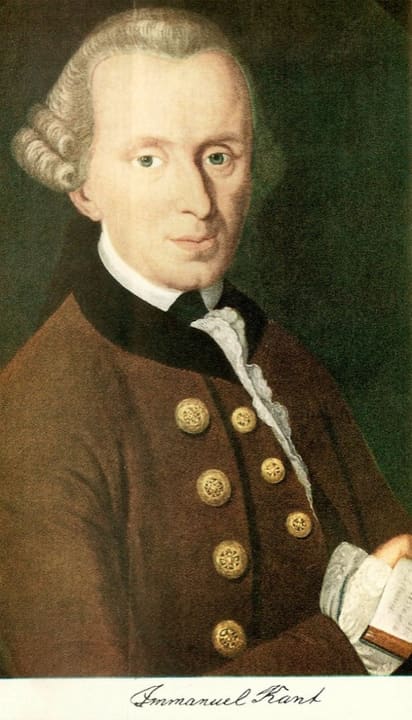
- Immanuel Kant: Königsberg philosopher proposing conditions for lasting peace
- The practical politician: Skeptical statesman addressed with irony
- The moral politician: Kant's model ruler who fits policy to right

Summary
Perpetual Peace (Zum ewigen Frieden) is a short philosophical essay by Immanuel Kant, published at Königsberg in 1795, a few months after Prussia made a separate peace with revolutionary France at Basel. Kant cast it, with a touch of irony, in the form of a peace treaty. He opens with a joke about a Dutch innkeeper's sign bearing the words 'perpetual peace' above a picture of a churchyard, and with a mock 'saving clause' asking practical statesmen not to take offence at a mere theorist. The First Section lays down six preliminary articles, conditions that would remove the immediate causes of war: no peace treaty is valid if it secretly reserves material for a future war; no independent state may be acquired by inheritance, exchange, purchase or gift; standing armies shall in time be abolished; no national debts shall be contracted for external affairs; no state shall violently interfere in the constitution and government of another; and no state at war shall use methods, such as assassins, poisoners or incitement to treason, that would make trust impossible in a later peace. The Second Section gives three definitive articles. The civil constitution of every state shall be republican, by which Kant means a representative government under law that separates the executive from the legislative power; such a state is inclined to peace, he argues, because citizens who must bear the costs of war will hesitate to vote for it. The law of nations shall be founded on a federation of free states, a league for preserving peace rather than a single world state. And cosmopolitan right shall be limited to universal hospitality: a stranger may visit any land without being treated as an enemy, but has no right to settle there uninvited, and Kant censures the conduct of trading nations that entered distant lands as if they belonged to no one. A First Supplement argues that nature itself guarantees progress toward peace, since war has scattered people over the earth, forced them into states, and commerce and the separation of languages and religions keep them in balance; even a race of devils, if intelligent, could organize a state. A Second Supplement, added in the 1796 edition, proposes one secret article: states should consult the opinions of philosophers. Two appendices discuss the relation of morals and politics, distinguishing the moral politician from the political moralist and offering a principle of publicity: an action affecting others' rights is wrong if its maxim cannot be made public. The library text is Mary Campbell Smith's 1903 English translation, with Robert Latta's preface and her long historical introduction surveying earlier peace plans from Dante to the Abbé de Saint-Pierre and Rousseau.
Virtues in this work
- Justice: Kant grounds peace in right, insisting that every state's constitution and every policy toward other nations be measured by principles that could be declared publicly.
- Prudence: He allows some preliminary articles to be carried out gradually and warns the moral politician not to force the conditions of peace before circumstances permit.
- Honor: The sixth preliminary article forbids assassins, poisoners and treachery in war so that trust remains possible when peace returns.
- Hope: In the First Supplement Kant argues that even human discord serves a design that moves mankind toward lawful peace.
Plot or Argument
- Opening: the innkeeper's sign and the saving clause
Kant introduces his sketch with the satirical churchyard inscription 'perpetual peace' and a mock legal reservation protecting the theorist from statesmen who regard him as a harmless pedant.
- First Section: six preliminary articles
Prohibitions that would remove standing causes of war: secret reservations in treaties, the transfer of states like property, standing armies, war debts, forcible interference in another state's constitution, and dishonourable methods of war. Kant distinguishes strict articles to be applied at once from those whose execution may be postponed.
- Second Section, First Definitive Article: republican constitution
Every state's constitution shall be republican, founded on the freedom and equality of citizens under common law and the separation of executive and legislative power. Kant distinguishes this from democracy as a form of rule, and argues that citizens whose consent is needed will be slow to choose war.
- Second and Third Definitive Articles: federation and hospitality
Nations shall form a federation of free states to keep the peace, since a world state is neither practicable nor desired by nations. Cosmopolitan right is limited to hospitality, the right of a visitor not to be treated as an enemy; growing contact means a violation of right anywhere is felt everywhere.
- First Supplement: the guarantee of perpetual peace
Nature, 'the great artist', uses human discord to push mankind toward lawful order: war disperses peoples, compels them to form states, and the spirit of commerce and the variety of languages and religions keep nations apart and in balance.
- Second Supplement: a secret article
States armed for war should consult the opinions of philosophers on the conditions of peace. Kant adds that kings need not become philosophers, for power corrupts free reason, but they should let philosophers speak publicly.
- Appendix I: the disagreement between morals and politics
Kant rejects maxims of cunning statecraft and distinguishes the moral politician, who fits policy to principles of right, from the political moralist, who bends morals to policy. He urges seeking first the kingdom of pure practical reason.
- Appendix II: the harmony of politics with morals
The transcendental formula of public right: actions affecting the rights of others are wrong if their maxims cannot be made public. Kant applies the test to constitutional and international law.
Characters
- Immanuel Kant, author
The Königsberg philosopher, writing as a theorist who claims the statesman need not fear him.
- The practical politician, type figure
The worldly-wise statesman who scorns theory and whom Kant addresses with irony in the opening and the appendices.
- The moral politician and the political moralist, contrasting types
Kant's two kinds of statesman in Appendix I: one adapts policy to right, the other adapts morality to advantage.
- Mary Campbell Smith, translator
Scottish translator whose 1903 version includes Kant's notes and her own introduction surveying the history of peace projects.
- Robert Latta, preface writer
Professor at the University of Glasgow who wrote the preface in place of D. G. Ritchie of St Andrews.
Lessons
Peace as a matter of right, not only of feeling
Kant does not appeal to sentiment or philanthropy. He asks what legal arrangements, within states, between states and among all people, would make lasting peace possible, and he treats peace as something reason commands rather than a dream. The structure of articles makes the argument concrete.
- Why does Kant cast his essay in the form of a treaty with articles?
- Which of the six preliminary articles seems most difficult for states to keep, and why?
- What does Kant mean by saying that a peace with a secret reservation is only a truce?
Who decides on war?
The first definitive article rests on a simple observation: where those who must fight and pay for a war must consent to it, they will weigh it carefully, whereas a ruler who owns the state can decide on war for trifling reasons, as if it were a pleasure party. Kant's republic is not rule by the crowd but representative government under law.
- How does Kant distinguish a republican constitution from a democracy?
- Why does he think citizens' consent makes war less likely?
- Can you think of reasons that might weaken or strengthen this argument?
A league, not an empire
Kant considers whether peace would be best secured by merging all nations into one world state and decides against it: nations do not want it, and vast states tend toward despotism. He proposes instead a voluntary federation of free states that grows over time.
- What reasons does Kant give against a single world state?
- How is a federation of free states different from an alliance for war?
- What would a nation give up, and what would it keep, by joining Kant's federation?
Honesty and statecraft
The appendices ask whether politics must be cunning. Kant rejects the maxims of seizing advantage and denying wrongs afterward, and proposes a test of publicity: a policy that could not survive being announced is unjust. The moral politician fits his conduct to principle and waits for favourable circumstances rather than forcing them.
- What is the difference between a moral politician and a political moralist?
- Explain the principle of publicity in your own words and test it on an example.
- Why does Kant say 'Honesty is better than any policy' rather than 'Honesty is the best policy'?
Context
Kant wrote amid the wars of the French Revolution. In April 1795 Prussia withdrew from the coalition against France by the Peace of Basel, and many in Germany hoped for a wider settlement. Proposals for lasting peace had a long history, including the Abbé de Saint-Pierre's Project for Perpetual Peace (1713), which Rousseau summarized and criticized, and earlier plans associated with William Penn and Henry IV's minister Sully. Kant's essay builds on his own earlier writings on history, especially the Idea for a Universal History (1784), which had already called for a league of nations.
Composition
Zum ewigen Frieden: Ein philosophischer Entwurf was published by Friedrich Nicolovius at Königsberg in 1795 and reissued in an enlarged edition in 1796, which added the Second Supplement, the secret article on consulting philosophers. Mary Campbell Smith's English translation, made from Kehrbach's edition at the suggestion of D. G. Ritchie, was published in London in 1903 with a preface by Robert Latta and her own historical introduction; the library text is a later impression of that edition.
Reception
The essay was widely discussed in Germany at once, and Fichte reviewed it in 1796. In the nineteenth century it was read alongside other peace projects, and in the twentieth it was often cited in connection with the League of Nations and the United Nations. Political scientists later drew on its first definitive article in discussing whether representative governments tend to avoid war with one another. Readers have debated how literally Kant meant his plan, given its ironic framing and his statement that perpetual peace is an idea to be approached rather than achieved, and how his trust in nature's guarantee fits his moral philosophy.
Comparisons
- grotius-rights-of-war-and-peace
Kant calls Grotius, Pufendorf and Vattel "Job's comforters", whose codes are quoted to justify attacks though they have no legal force; Perpetual Peace seeks a legal order that would end war rather than merely regulate it.
- leviathan
Hobbes describes states as remaining in a state of nature toward one another; Kant accepts the description but argues that reason requires states to leave that condition through a federation, as individuals leave it through a civil constitution.
- groundwork-of-the-metaphysics-of-morals
The appendices apply the moral philosophy of the Groundwork to politics: the test of publicity resembles the test of whether a maxim can be universalized.
- the-social-contract
Rousseau's idea of the original contract underlies Kant's republican constitution, and Rousseau's summary of Saint-Pierre's peace project is one of the essays Kant answers.
- city-of-god
Augustine in Book XIX describes peace as the tranquillity of order and the end that even warring peoples seek; Kant seeks an earthly legal order of peace through reason and law.
- the-republic
Plato hoped philosophers would become kings; Kant's secret article answers that kings need not philosophize and philosophers should not rule, but rulers should let philosophers speak freely.
Quotes
“No treaty of peace shall be regarded as valid, if made with the secret reservation of material for a future war.”
“The civil constitution of each state shall be republican.”
“If, as must be so under this constitution, the consent of the subjects is required to determine whether there shall be war or not, nothing is more natural than that they should weigh the matter well, before undertaking such a bad business.”
“The law of nations shall be founded on a federation of free states.”
“a violation of right in one part of the world is felt all over it.”
“The problem of the formation of the state, hard as it may sound, is not insoluble, even for a race of devils, granted that they have intelligence.”
“Seek ye first the kingdom of pure practical reason and its righteousness, and the object of your endeavour, the blessing of perpetual peace, will be added unto you.”
“All actions relating to the rights of other men are wrong, if the maxims from which they follow are inconsistent with publicity.”
For Students
A reading companion for classical Christian high school students. See the student guide.
Reading Guide
Watch for
- The ironic opening about the innkeeper's sign and the 'saving clause' addressed to statesmen.
- The difference between the preliminary articles, which remove causes of war, and the definitive articles, which establish peace.
- Kant's distinction between a republican constitution and a democracy in the First Definitive Article.
- The argument in the First Supplement that nature uses human conflict to move mankind toward peace.
- The principle of publicity in Appendix II.
Key terms and names
- Preliminary article
- One of six conditions in the First Section that remove standing causes of war and must be observed before lasting peace is possible.
- Definitive article
- One of three positive conditions in the Second Section that establish lasting peace: republican government, a federation of states and cosmopolitan hospitality.
- Republican constitution
- In Kant's sense, government under common law by representatives, with the executive separate from the legislature, founded on the freedom and equality of citizens.
- Federation of free states
- A voluntary league of nations for preserving peace, distinct from a single world state.
- Cosmopolitan right
- The right of every person as a citizen of the world, limited by Kant to hospitality: not to be treated as an enemy when visiting another land.
- Principle of publicity
- Kant's test that a policy affecting others' rights is unjust if it could not be openly declared without defeating itself.
Seminar Questions
- Comprehension List the six preliminary articles. Which does Kant say must be applied at once, and which may be delayed?
- Comprehension What are the three definitive articles of perpetual peace?
- Comprehension What is the secret article, and why does Kant call it secret?
- Interpretation Why does Kant think a republican constitution makes war less likely?
- Interpretation How can nature 'guarantee' peace, according to the First Supplement, if human beings are quarrelsome?
- Interpretation What does Kant mean when he says even a race of devils could form a state?
- Big Question Is lasting peace among nations a goal human beings can reach, or an ideal they can only approach?
- Big Question Should public officials ever act on policies they could not announce openly?
Faith Connections
- Matthew 6:33 (Scripture)
Kant adapts Christ's command to seek first the kingdom of God and his righteousness into a maxim of politics. Students can compare the original with Kant's version and ask what has changed.
- Isaiah 2:4 (Scripture)
The prophet's vision of nations beating swords into plowshares and learning war no more is the oldest expression of the hope Kant pursues by the means of law and reason.
- Matthew 5:9 (Scripture)
'Blessed are the peacemakers': Christian readers have long seen the work of making peace between peoples as a calling, and can weigh what Kant's articles contribute to it.
- Augustine, City of God XIX.12–13 (Church Fathers)
Augustine observes that even war is waged for the sake of peace and defines peace as the tranquillity of order, while holding that perfect peace belongs to the heavenly city. His realism offers a counterpoint to Kant's hope for progress.
Logic and Rhetoric
Central argument: War arises from conditions that law can remove. If treaties are honest, states are not traded as property, standing armies and war debts are abandoned, and no state interferes by force in another, the immediate causes of war are reduced. If every state is governed by representatives of citizens who bear the costs of war, if states join a federation for peace, and if all people are granted the right of hospitality, peace becomes lasting. Since reason commands this order and nature's mechanism pushes mankind toward it, perpetual peace is a duty and an ideal to be approached.
Rhetorical device: irony. Kant opens with an innkeeper's sign that labels a graveyard 'perpetual peace' and adds a mock legal 'saving clause' so that statesmen will not be alarmed by a harmless theorist.
Debate: Resolved: Representative government makes nations more peaceful.
Memory Work
Seek ye first the kingdom of pure practical reason and its righteousness, and the object of your endeavour, the blessing of perpetual peace, will be added unto you.
No treaty of peace shall be regarded as valid, if made with the secret reservation of material for a future war.
Writing Prompts
Essay: Kant argues that peace depends on the kind of government each state has. Explain his reasoning in the First Definitive Article and evaluate it with examples from history you have studied.
Comparison with Leviathan: Hobbes and Kant both describe nations as living in a state of nature toward one another. Compare their accounts and explain why Kant thinks nations, unlike individuals in Hobbes, need a federation rather than a single sovereign.
Medical Lens
A political and philosophical essay on war and peace with no medical subject matter.
Creative Prompts
- Classroom
Divide the class into delegations of imaginary states and draft a short treaty using Kant's six preliminary articles; then test each clause against his principle of publicity.
- Dialogue
Write a conversation in 1795 between Kant and a Prussian minister who has just returned from negotiating the Peace of Basel.
- Essay
Explain why Kant prefers a federation of free states to a single world government, and weigh his reasons.
Further Reading
- Idea for a Universal History with a Cosmopolitan Purpose, Immanuel Kant
The 1784 essay in which Kant first proposed a league of nations.
- The Metaphysics of Morals, Immanuel Kant
Its Doctrine of Right (1797) restates the theory of the state and international right.
- Kant's Political Writings, Hans Reiss (ed.), trans. H. B. Nisbet
- Kant's Life and Thought, Ernst Cassirer
Verification notes
Quotations are exact substrings of Mary Campbell Smith's 1903 translation in the stored Gutenberg text and all come from Kant's essay, not from the translator's introduction. Publication facts (Nicolovius, Königsberg, 1795; enlarged edition 1796 adding the secret article) and the Peace of Basel (April 1795) follow standard accounts. The note that Smith worked from Kehrbach's edition comes from her translator's note in the text. Kant's description of Grotius, Pufendorf and Vattel as "Job's comforters" (the wording of this translation) occurs in the Second Definitive Article.
- That the Second Supplement was first added in the 1796 edition.
- Date and place of Fichte's review of the essay.