Work record
Elements of Chemistry
1789 · 18th Century · Essays · French
Abstract
Background. Chemists of the 1770s and 1780s were isolating new gases while still explaining fire by phlogiston. In Paris a wealthy academician with fine instruments set out to account for every change by weight, and with colleagues remade the vocabulary of the discipline.
Content. Opening with a theory of heat as a weightless fluid, the book separates common air into a life-supporting gas and a suffocating one, explains burning and rusting as union with the first, and shows water to be a compound. Sugar turning to wine is tracked grain by grain. Long tables then name the simple substances and their salts, and a final part describes apparatus and laboratory procedure.
Key Concepts. Conservation of mass; operational definition of elements; oxygen theory of combustion and acidity; caloric; systematic nomenclature; quantitative laboratory method.
Translation. Robert Kerr, an Edinburgh surgeon, published the English version in 1790 to be ready for the university session. He added Fahrenheit equivalents in brackets and appendices for converting French weights and measures, since recalculating every figure was too great a task for the time allowed.
Significance. Widely translated within a few years, the treatise served as the founding textbook of modern chemistry. Its author was guillotined in 1794 as a former farmer-general of taxes.
Key figures
- Antoine Lavoisier: French chemist, academician and tax farmer
- Abbé de Condillac: Philosopher whose maxims on language frame the Preface
- Pierre-Simon Laplace: Mathematician who designed the calorimeter with Lavoisier
- Claude-Louis Berthollet and Antoine Fourcroy: Chemists and collaborators in the reformed nomenclature
- Joseph Priestley: English chemist whose dephlogisticated air Lavoisier renamed
- Marie-Anne Paulze Lavoisier: Lavoisier's wife and collaborator, who drew the plates

Summary
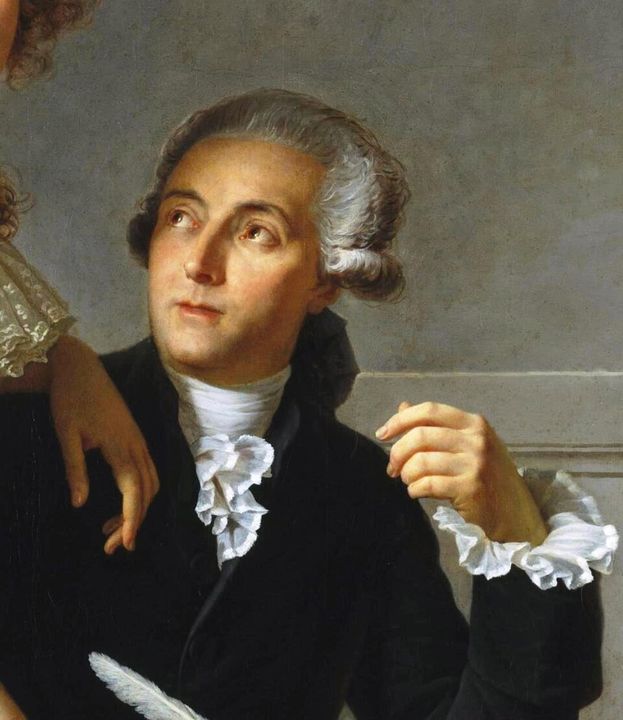
Elements of Chemistry (Traité élémentaire de chimie, Paris, 1789) is Antoine Lavoisier's systematic textbook of the new chemistry he had built over the previous fifteen years. The library text is Robert Kerr's English translation, published at Edinburgh in 1790; Kerr, an Edinburgh surgeon, added Fahrenheit temperatures in brackets beside Lavoisier's Réaumur degrees and appended rules for converting French weights and measures, and the text describes the thirteen copperplates of apparatus drawn by Madame Lavoisier. The Preface explains that the book grew out of the reform of chemical names undertaken in 1787. Quoting the Abbé de Condillac, Lavoisier argues that a science consists of facts, ideas and words, so that one cannot improve the language of a science without improving the science. He resolves to proceed only from the known to the unknown and to draw no conclusion not grounded in experiment. He sets aside the ancient debate about four elements as metaphysical and defines elements practically, as the substances analysis has not yet been able to decompose. Part First, in seventeen chapters, sets out the doctrine. Heat is treated as a subtle fluid, caloric, whose combination with bodies makes them solid, liquid or gaseous. Chapter III describes the famous experiment in which mercury heated for twelve days in a closed vessel of air absorbs part of it, leaving an unbreathable remainder, while the red calx yields back pure air when heated more strongly. Lavoisier names the respirable part oxygen, the acid-maker, and the other azote, the lifeless. He shows that combustion, the calcination of metals and the formation of acids are combinations with oxygen, that water is composed of oxygen and hydrogen, and that the old phlogiston is unnecessary. Chapter XIII analyses vinous fermentation by weighing sugar, water and yeast against alcohol and carbonic acid, stating as an axiom that in all operations of art and nature nothing is created and the same quantity of matter exists before and after. Part II gives the Table of Simple Substances, thirty-three in all, including light and caloric, followed by tables naming the neutral salts formed by each acid with each base. Part III describes the instruments and operations of chemistry: balances, the pneumatic apparatus and gazometer, the ice calorimeter designed with Laplace, distillation, crystallization, furnaces and deflagration. The book was quickly translated and became the textbook of the chemical revolution. Five years after its publication Lavoisier was executed with the other former farmers-general of taxes.
Virtues in this work
- Prudence: Lavoisier refuses to claim that his simple substances are truly indivisible, holding them as elements only until experiment shows otherwise.
- Industry: He keeps mercury heated in a closed vessel of air for twelve days and accounts for every change in weight and volume.
- Friendship: The Preface acknowledges a community of opinions with Berthollet, Fourcroy, Laplace and Monge, in which he can hardly distinguish his ideas from theirs.
- Humility: He admits that the name azote seems extraordinary and that the nature of the noxious part of the air is still little known.
Plot or Argument
- Preface: language, method and elements
Lavoisier explains that reforming chemical names forced him to reform the science, adopts Condillac's view that we think through words, commits himself to reasoning from the known to the unknown, and defines elements as the last products of analysis rather than metaphysical atoms.
- Part I, Chs. I–II: caloric and the states of matter
Heat is a subtle fluid whose quantity in a body determines whether it is solid, liquid or aeriform; the atmosphere is a mixture of the vapours of substances that are gaseous at ordinary temperatures.
- Part I, Chs. III–IV: the analysis of air
Heating mercury in a closed volume of air for twelve days separates air into a respirable part and a part fatal to animals; the red calx returns the absorbed portion. The two are named oxygen and azote, and the new names are defended.
- Part I, Chs. V–XII: oxygen, acids and water
Combustion of sulphur, phosphorus, charcoal and hydrogen forms acids or water; metals become oxyds; water is shown to be oxygen and hydrogen; the heat released by combustion is measured; vegetable and animal substances are composed chiefly of hydrogen, carbon and oxygen.
- Part I, Chs. XIII–XV: fermentation and putrefaction
Vinous fermentation is analysed by a balance sheet of the elements in sugar against those in alcohol and carbonic acid, under the axiom that nothing is created; putrefactive and acetous fermentation follow.
- Part I, Chs. XVI–XVII: neutral salts
Acids combine with salifiable bases, potash, soda, ammoniac, the earths and metals, to form neutral salts, and Lavoisier explains how their names are composed.
- Part II: tables of simple substances and salts
The Table of Simple Substances lists light, caloric, oxygen, azote and hydrogen, the non-metallic and metallic substances and the salifiable earths, with old names beside new; dozens of tables then name the salts each acid forms.
- Part III: instruments and operations
Balances, the gazometer, methods of correcting gas volumes for pressure and temperature, the calorimeter, and the operations of pulverizing, filtering, dissolving, evaporating, crystallizing, distilling, deflagrating and heating are described with reference to the plates.
Lessons
Weigh everything
Lavoisier's decisive tool was the balance. By weighing what goes into a reaction and what comes out, including the gases earlier chemists let escape, he showed that burning metals gain weight by absorbing part of the air and that fermentation rearranges matter without creating or destroying it. Careful accounting turned chemistry from a collection of recipes into a science of quantities.
- Why did a metal's gain in weight when it burned trouble the theory of phlogiston?
- How does the balance sheet of Chapter XIII depend on the axiom that nothing is created?
- What would have been lost if Lavoisier had not trapped and weighed the gases?
Words shape thought
The Preface argues that facts, ideas and words are like three impressions of one seal. Names such as 'oil of vitriol' or 'flowers of zinc' said nothing about composition; names such as 'sulphuric acid' and 'sulphate of potash' carry the analysis within them. Lavoisier shows that a clear vocabulary is not decoration but an instrument of knowledge.
- What does the name 'oxygen' claim about the substance it names? Was the claim fully correct?
- Why does Lavoisier admit that the name 'azote' seems extraordinary, and how does he defend it?
- Can you think of a field where better words have made clearer thinking possible?
An honest definition of an element
Rather than speculate about ultimate atoms, Lavoisier defines an element as whatever analysis has not yet decomposed, and he admits that some of his simple substances may later prove compound. The lime and other earths on his list were later decomposed, which shows the wisdom of the provisional definition.
- Why does Lavoisier call the old debate about four elements 'metaphysical'?
- What does it mean to hold a scientific claim provisionally without being unsure of it?
Science as a common work
Lavoisier says that frequent conversation with Berthollet, Fourcroy, Laplace and Monge had created a community of opinions in which no one could always tell his own ideas from his friends'. The new chemistry was the work of a circle, and of a household, since Madame Lavoisier drew the plates.
- Why might Lavoisier mention his colleagues so carefully in the Preface?
- How do collaboration and individual credit fit together in science?
Context
Eighteenth-century chemistry was dominated by the phlogiston theory of Georg Ernst Stahl, which explained burning as the release of an inflammable principle. Pneumatic chemists, Joseph Black, Henry Cavendish, Joseph Priestley and Carl Wilhelm Scheele among them, had isolated fixed air, inflammable air and the gas Priestley called dephlogisticated air. Lavoisier reinterpreted their discoveries through quantitative experiment, proposing from the 1770s that combustion and calcination are combinations with a part of the air.
Composition
After the 1787 Method of Chemical Nomenclature, written with Guyton de Morveau, Berthollet and Fourcroy, Lavoisier wrote the Traité to teach the new system in order from first principles. It was published in Paris in 1789, the year the Estates-General met, with plates engraved from Madame Lavoisier's drawings. Robert Kerr's translation appeared at Edinburgh in 1790, and the book was soon translated into other languages.
Reception
Younger chemists in France and Scotland adopted the new chemistry quickly; Priestley defended phlogiston for the rest of his life, and Richard Kirwan, who had written in its defence, gave way in 1791. The caloric theory of heat was later abandoned in favour of the mechanical theory of heat, and several of Lavoisier's earths were decomposed by Humphry Davy, but the conservation of mass, the oxygen theory of combustion and the reformed nomenclature became foundations of modern chemistry. Lavoisier's execution in 1794 occasioned the remark, attributed to Lagrange, that it took only a moment to cut off a head whose like a century might not produce.
Comparisons
- boyle-the-sceptical-chymist
Boyle attacked the four elements and the three principles of the chemists; Lavoisier completes the critique by defining elements operationally and drawing up a table of them.
- pasteur-and-lister-germ-theory-papers
Lavoisier analysed fermentation as a chemical balance of elements; Pasteur showed that it is carried out by living organisms, while keeping Lavoisier's insistence on weighing reactants and products.
- aristotle-posterior-analytics-and-physics
The four elements and qualities of Aristotelian natural philosophy are the starting point that Lavoisier's Preface sets aside as metaphysical.
- newton-opticks
Newton's Queries speculate on attractions between particles; Lavoisier's tables of elective attraction and his weighing method belong to the chemical tradition those Queries helped inspire.
- bernard-introduction-to-experimental-medicine
Bernard regards Lavoisier's work on respiration and animal heat as the beginning of a chemical physiology, and adopts his model of exact experiment.
Quotes
“Like three impressions of the same seal, the word ought to produce the idea, and the idea to be a picture of the fact.”
“we cannot improve the language of any science without at the same time improving the science itself; neither can we, on the other hand, improve a science, without improving the language or nomenclature which belongs to it.”
“I have imposed upon myself, as a law, never to advance but from what is known to what is unknown; never to form any conclusion which is not an immediate consequence necessarily flowing from observation and experiment”
“they act with regard to us as simple substances, and we ought never to suppose them compounded until experiment and observation has proved them to be so.”
“We cannot deny that this name appears somewhat extraordinary; but this must be the case with all new terms, which cannot be expected to become familiar until they have been some time in use.”
“We may lay it down as an incontestible axiom, that, in all the operations of art and nature, nothing is created; an equal quantity of matter exists both before and after the experiment”
“By means of light, the benevolence of the Deity hath filled the surface of the earth with organization, sensation, and intelligence.”
For Students
A reading companion for classical Christian high school students. See the student guide.
Reading Guide
Watch for
- The Preface's argument, borrowed from Condillac, that facts, ideas and words must match like three impressions of one seal.
- Lavoisier's practical definition of an element, and his admission that some of his simple substances may one day be decomposed.
- The twelve-day mercury experiment in Part I, Chapter III, and how he accounts for every grain of weight gained and every cubic inch of air lost.
- The axiom of Chapter XIII that nothing is created in the operations of art and nature, and the balance sheet of fermentation built on it.
- Light and caloric at the head of the Table of Simple Substances, a sign that the new chemistry still treated heat as a material substance.
Key terms and names
- Phlogiston
- The supposed principle of inflammability that older chemists believed escaped from bodies when they burned. Lavoisier argues it is unnecessary.
- Caloric
- Lavoisier's name for the subtle fluid of heat, which he lists among the simple substances. Later physics replaced it with a theory of heat as motion.
- Oxygen
- From Greek words meaning 'acid-producer': the respirable part of air, which Lavoisier believed to be the principle of all acids.
- Azote
- From Greek 'without life': Lavoisier's name for the part of the air that cannot support breathing, now called nitrogen.
- Calx (oxyd)
- The powdery substance a metal becomes when heated in air, which Lavoisier shows is the metal combined with oxygen.
- Simple substance
- An element in Lavoisier's sense: a substance that chemical analysis has not yet been able to break down.
- Neutral salt
- The compound formed when an acid combines with a base, named in the new system after both its acid and its base.
- Gazometer
- An apparatus for collecting and measuring gases by volume, described in Part III, which allowed gases to be weighed and accounted for.
Seminar Questions
- Comprehension What happened to the mercury and to the air in Lavoisier's twelve-day experiment, and how did he recover the air the mercury had absorbed?
- Comprehension How does Lavoisier define an element, and why does he refuse to say how many elements exist in an absolute sense?
- Comprehension What reasons does Lavoisier give for the names oxygen and azote?
- Interpretation Lavoisier says we cannot improve a science without improving its language. Is he claiming that better words alone create knowledge, or something more careful?
- Interpretation Lavoisier lists light and caloric as simple substances, a choice later chemists rejected. Does this mistake weaken his method, or show its strength?
- Interpretation In the Preface Lavoisier says that he and his colleagues share 'a sort of community of opinions'. What does this suggest about how the chemical revolution happened?
- Big Question Lavoisier attributes the life that light makes possible to 'the benevolence of the Deity'. How can the precise study of matter and an attitude of gratitude toward a Creator belong together?
Faith Connections
- Wisdom of Solomon 11:20 (Scripture)
'Thou hast ordered all things in measure and number and weight.' Lavoisier's chemistry of the balance, in which every grain is accounted for, is a striking illustration of this ancient confession of order in creation.
- Genesis 2:19-20 (Scripture)
Adam names the creatures God brings to him. Lavoisier's insistence that names should fit the things they name recalls the dignity Scripture gives to the human work of naming.
- Ecclesiastes 3:14 (Scripture)
'Whatsoever God doeth, it shall be for ever: nothing can be put to it, nor any thing taken from it.' Readers have long set this verse beside Lavoisier's axiom that nothing is created in natural operations, though the Preacher speaks of God's works and Lavoisier of chemical change.
- Genesis 1:3-4 (Scripture)
God creates light first and sees that it is good. Lavoisier's passage on light as the condition of organization, sensation and intelligence echoes the primacy of light in the creation account.
Logic and Rhetoric
Central argument: Metals and combustibles gain weight when they burn, and the air in which they burn loses exactly that weight; the absorbed part of the air can be recovered from the calx unchanged; therefore combustion and calcination are combinations with a definite part of the air, oxygen, and not releases of phlogiston; and since matter is neither created nor destroyed, every chemical change can be analysed by weighing, and every substance named by the simple substances it contains.
Rhetorical device: argument from authority joined to analogy. The Preface quotes Condillac's maxims that we think only through words and that a well-made language is an analytical method, then compares fact, idea and word to three impressions of one seal, making the nomenclature reform seem a requirement of good reasoning rather than a matter of taste.
Debate: Resolved: The language of a science should be reformed whenever its theory changes, even at the cost of breaking with familiar names.
Memory Work
We may lay it down as an incontestible axiom, that, in all the operations of art and nature, nothing is created; an equal quantity of matter exists both before and after the experiment
Like three impressions of the same seal, the word ought to produce the idea, and the idea to be a picture of the fact.
Writing Prompts
Essay: Lavoisier claimed that reforming the language of chemistry and reforming chemistry itself were one task. Using the Preface and the chapters on oxygen and azote, explain what he meant and argue whether he was right.
Comparison with The Sceptical Chymist: Boyle and Lavoisier both doubted the traditional elements. Compare Boyle's sceptical arguments with Lavoisier's operational definition and Table of Simple Substances, and explain what Lavoisier could do that Boyle could not.
Medical Lens
Elements of Chemistry deliberately leaves aside respiration and animal heat, but it lays the chemical foundation for both. The analysis of air distinguishes the respirable portion (oxygen) from the part fatal to animals (azote), and Part III describes the ice calorimeter with which Lavoisier and Laplace measured the heat given off by a guinea pig and compared it with the heat of burning charcoal, an early quantitative link between respiration and combustion. Lavoisier's later experiments on human respiration with Armand Séguin (1789–1790) carried the programme further. The reformed nomenclature transformed the names of drugs and salts in pharmacy, so that the pharmacopoeias of the following decades adopted names such as sulphate of magnesia in place of the older terms. The translator, Robert Kerr, was an Edinburgh surgeon. In a passage on light Lavoisier observes that people grow less healthy in sedentary manufactures and crowded city lanes and better in open-air labour, an observation of the kind later taken up by sanitary reformers. Lavoisier was also a member of the Royal Society of Medicine and served on the 1784 royal commission that examined Mesmer's animal magnetism, though neither appears in this book.
- Part I, Chs. III–IV
Air is separated into a part that supports respiration and combustion and a part that kills animals forced to breathe it; the names oxygen and azote are given.
- Part II, Sect. III
Light is necessary to the health of plants and of people, who decline in sedentary manufactures and crowded houses and improve in open-air labour.
- Part II, tables of neutral salts
Tables give the new systematic names for the salts used in pharmacy and medicine, with the old names beside them.
- Part III, Ch. III
The calorimeter measures the caloric released in combustion and in the respiration of animals; guinea pigs are recommended as subjects.
Creative Prompts
- Classroom
Burn a small ball of steel wool on a balance and record whether its weight goes up or down. Explain the result first as a phlogiston chemist would, then as Lavoisier would.
- Classroom
Take ten household substances with common names (baking soda, Epsom salt, chalk, vinegar) and give each a Lavoisier-style name that states its composition. Which names would help a student most?
- Essay
Write the dialogue Lavoisier and Priestley might have had about the gas Priestley called dephlogisticated air, with each defending his interpretation of the same experiment.
Further Reading
- Method of Chemical Nomenclature, Guyton de Morveau, Lavoisier, Berthollet and Fourcroy
- Lavoisier: Chemist, Biologist, Economist, Jean-Pierre Poirier
- Antoine Lavoisier: Science, Administration, and Revolution, Arthur Donovan
- Lavoisier and the Chemistry of Life, Frederic Lawrence Holmes
On Lavoisier's research on respiration, fermentation and animal chemistry.
- The Sceptical Chymist, Robert Boyle
Verification notes
Structure, chapter contents and all seven quotations follow the stored Project Gutenberg text of Kerr's 1790 translation; each quotation was found by search in content/texts/lavoisier-elements-of-chemistry.txt and copied exactly, including the spelling 'incontestible'. The title page names Kerr as a member of the Royal College of Surgeons and surgeon to the Orphan Hospital of Edinburgh, and the publisher as William Creech. Biographical facts, the 1787 nomenclature, the Laplace calorimeter and the 1794 execution are standard. The remark about Lavoisier's death is attributed to Lagrange by early biographers and is given as an attribution. The count of thirty-three simple substances follows the usual reading of the table.
- That Kerr's 1790 first edition is the text Project Gutenberg #30775 reproduces (rather than a later Kerr edition).
- The year Kirwan conceded to the oxygen theory (usually 1791).
- Dates of the Lavoisier–Séguin respiration experiments (1789–1790).